Professor, Urban and Environmental Policy and Planning (UEPP), Virginia Tech; Joann Boughman Innovation Fellow at USG; Acting Director, Center for Future of Work Places and Practices (CFWPP); Head of Outreach and Engagement, Center for European and Transatlantic Studies (CEUTS)
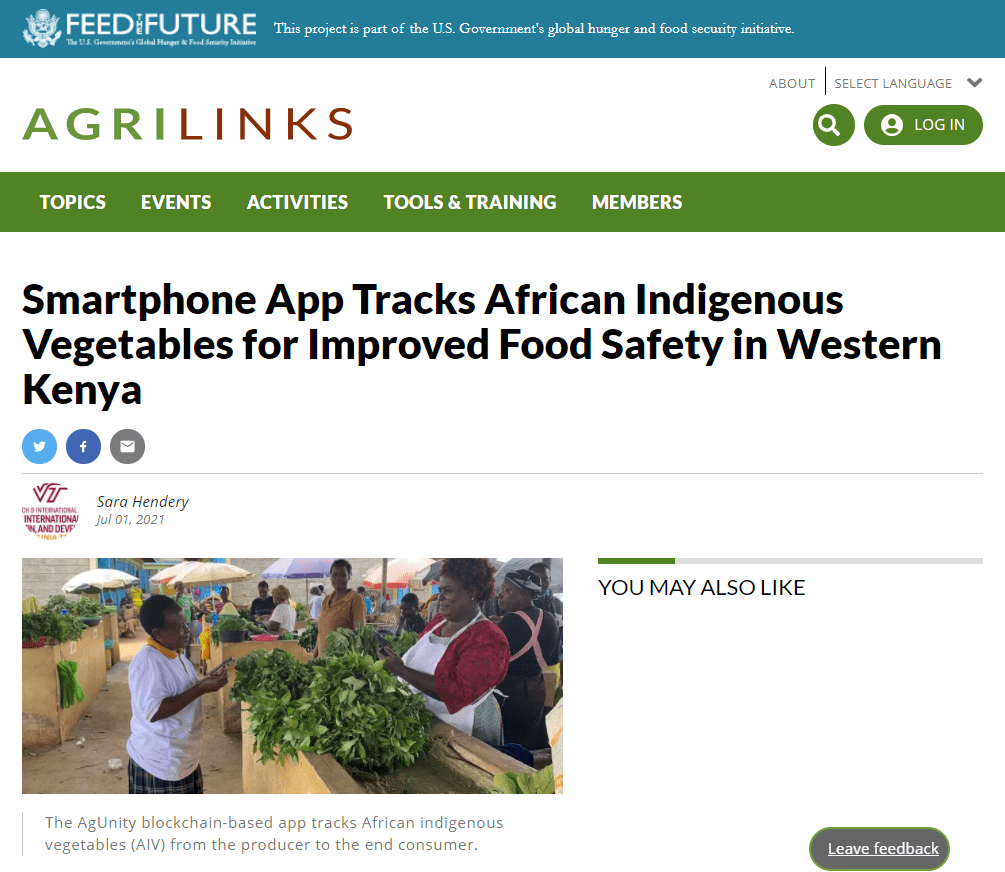
The following AGRILINKS article by Sara Hendery was just published on our USAID LASER PULSE project in Kenya. The purpose of this project is to explore how a blockchain-based technology platform developed by AgUnity, could be used to enhance the supply chain for African Indigenous Vegetables (AIVs). The project is co-managed by our in-country partners at Egerton University.
Earlier this week, I had the pleasure of talking with Prof. Anne Khademian, the Executive Director of the Universities at Shady Grove (USG), about a wide range of topics related to USG’s new strategic planning process. Our conversation covers why I decided to travel to the USA (over 20 years ago!) to study in the Technology and Policy Program at MIT, and how my subsequent research on sustainable development and binary economics/inclusive capitalism, led me to the emerging movement of Community Wealth Building (CWB).
During the spring semester, students in the VT Honors College SuperStudio had the pleasure of engaging with Riccardo Mastini, a researcher at the Institute of Environmental Science and Technology (ICTA) at the Autonomous University of Barcelona. The video below shows Riccardo’s opening remarks that cover the Green New Deal (GND), the need for a new political economy that reduces inequality and protects/enriches the environment, the difference between pubic vs. private services and how the enclosure of public goods can result in artificial scarcity and growth, environmental (in)justice, and the need to move towards a post-growth GND agenda.
The paper behind Riccardo’s remarks that explores the idea of a GND without growth can be access here.
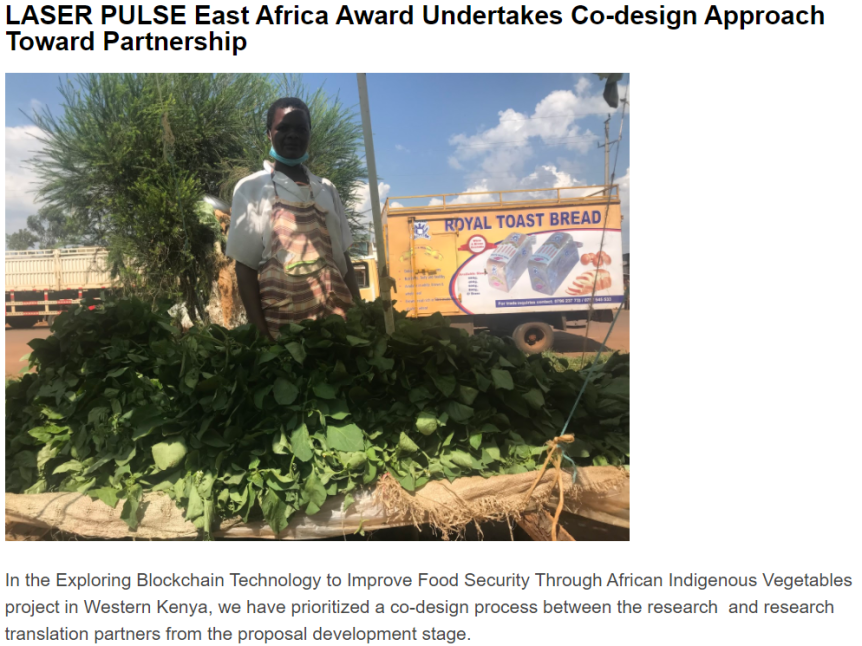
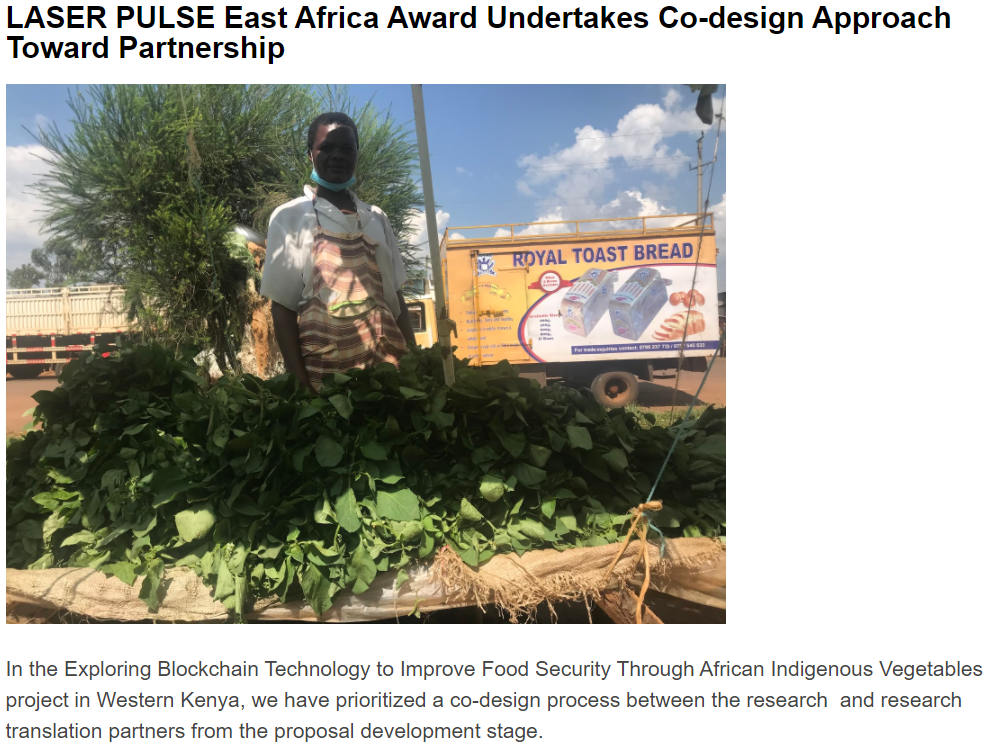
The USAID LASER PULSE Network just released the short story below on how we implemented a co-design process with our partners – AgUnity and Egerton University in Kenya – for our project entitled “Exploring Blockchain Technology to Improve Food Security Through African Indigenous Vegetables in Western Kenya.”
The story talks about our desire to blend the research and translation process from the beginning of our proposal development for the following three reasons:
(1) We expected research activities to bring up new questions that would need to be addressed to produce an impactful research translation product. The research team members are able to return to the field to get answers for the research translation team to continue to refine the app.
(2) Collaboration and partnership are essential for impact. Development in general must continue to break down silos between disciplines and professions in order to meet the needs of the individuals we are trying to serve through this research. Collaboration facilitates the rapid problem solving and creativity that impact generation requires.
(3) Working collaboratively is a lot of fun! It stimulates passions and shared interests, facilitates out of the box thinking, and learning. So far, we have been able to provide training to each other, talk about new and innovative ways to address nutrition, discuss unique avenues to scale the project and ensure sustainability, and share our own passions and interests in travel, food, and family.
In this chapter, we present an inclusive capitalism approach, which completes the environmental-production-income and distribution-consumption cycle by treating sustainable consumption and production as two sides of the same coin. There are two divides that our approach to inclusive capitalism bridges—one between income earned from capital ownership and from wages, and the other between the human production of goods and services and the impact these activities have on the environment. We analyse different mechanisms to bridge these divides and show that our proposal—broadening the distribution of capital ownership using future earnings of capital and directing this income towards sustainable production and consumption—presents a holistic solution to growing environmental problems and income inequality. In addition, we also achieve the politically desirable goal of participatory economic life through this mechanism.
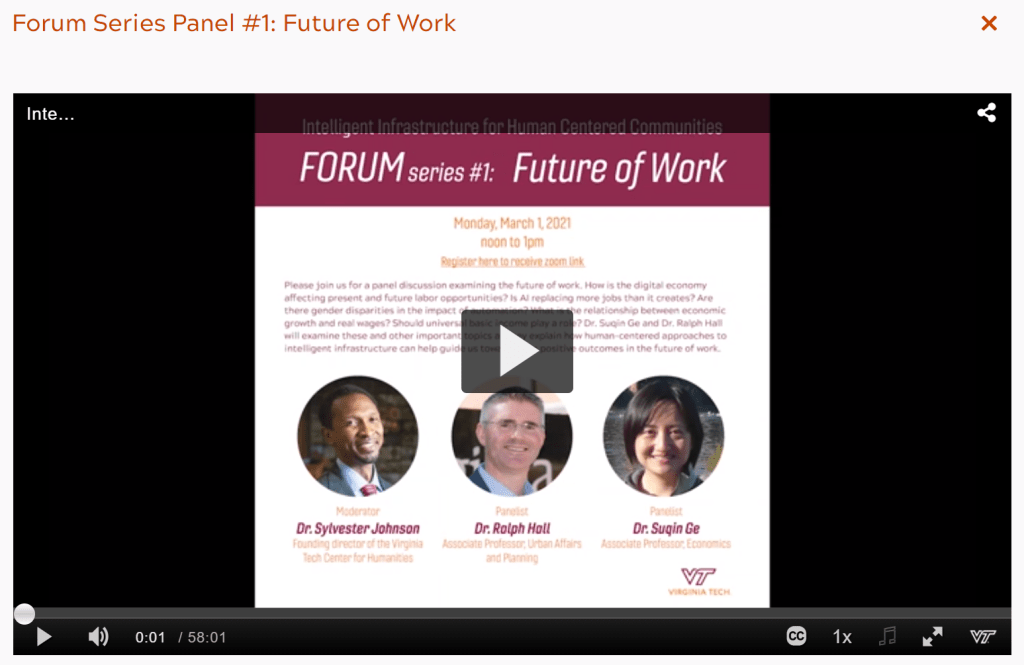
If you missed our conversation on the Future of Work last week and would like to watch a recording of the session, it can now be accessed by clicking on the image below.
If you are interested in the Future of Work, please consider joining Prof. Sylvester Johnson, Prof. Suqin Ge, and I, from 12-1pm (EST), on Monday, March 1, for a discussion that will explore the following questions:
How is the digital economy affecting present and future labor opportunities?
Is AI replacing more jobs than it creates?
Are there gender disparities in the impact of automation?
What is the relationship between economic growth and real wages?
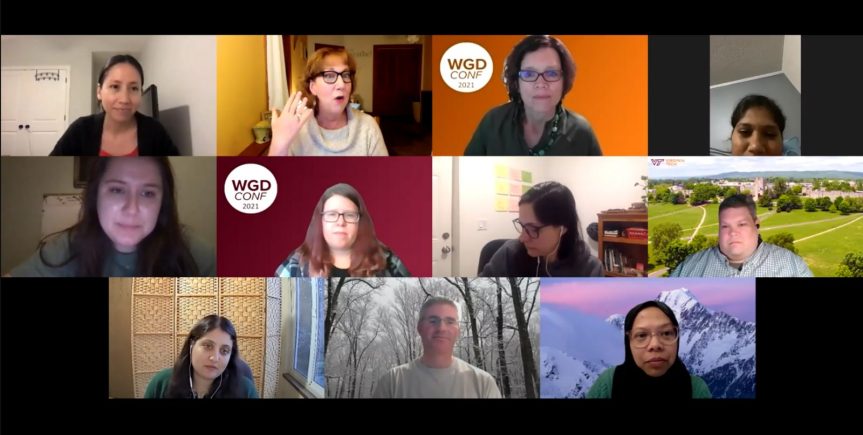
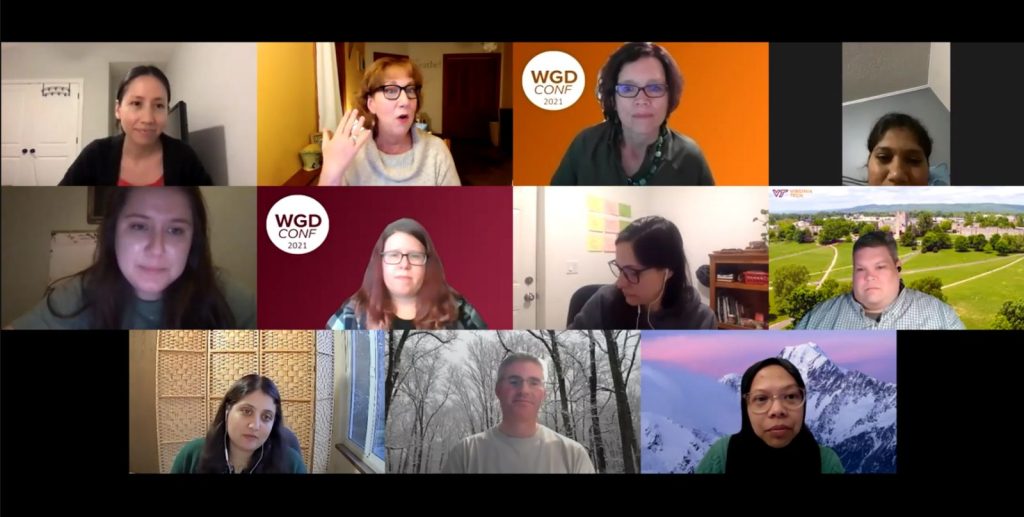
The 2021 Women and Gender in Development Virtual Conference will begin next week, during which I will announce the winners of the 4 Minute Student Flashtalks (4MFlashTalks) competition. This contest has two phases. The first included nine contestants who submitted videos that were part of a jury-judged competition. Two of the videos were selected as winners based on 10 criteria relating to (1) comprehension and context and (2) communication. I will announce these two winners at 11:50am on Feb 25 during the conference.
After concluding the first phase of the competition, the jury decided to invite all the students who submitted videos to a virtual Communicating Science Workshop at Virginia Tech. After carefully reviewing the nine videos, we realized our competition guidance had been too constraining and wanted to provide students with more freedom on how they communicated their research to a general audience. The workshop encouraged students to be personal, direct, spontaneous, responsive, and emotionally expressive. It also promoted the need to develop a story narrative that explains why their research is important to the themselves, their field of study, and the world.
Five of the students re-recorded their presentations (below) for the second phase of the competition – a People’s Choice award. Conference attendees can vote for their favorite video here. I will also announce the People’s Choice winner on Feb 25.
About the 4MFlashTalks: The 4MFlashTalks is a virtual asynchronous competition that promotes student engagement by providing opportunities to graduate students who have completed data collection for their research, to present their work through a brief 4 minute presentation. It is inspired by the 3 Minute Thesis (3MT) research communication competition developed by the University of Queensland in Australia and held in academic institutions around the world. The 4MFlashTalks is an experience intended to communicate research to a non-expert audience in a simple, concise, and articulate manner. This event in the virtual WGD Conference aims to provide a space where all attendees (students, faculty, practitioners, leaders, others) from around the country and the world can learn and connect with future professionals.
The presentation below was recorded for the International Association of Social Sciences Information Service and Technology (IASSIST), 1st African Regional Workshop, from January 11-13, 2021. In the presentation, Felix Majawa (Mzuzu University, Malawi) and Ralph Hall (Virginia Tech, USA) discuss the findings from a stakeholder survey that was sent to faculty and staff at Mzuzu University and Virginia Tech about a proposed data centre that could be located in Mzuzu University’s new library. The abstract form a report on the survey responses is provided below.
REPORT ABSTRACT
Mzuzu University lost its Library as a result of a fire that took place on 18th December 2015. In response, the university decided to establish two processes. The first was to restore information services within six months by creating an interim Library. The second was to design a new library in collaboration with Virginia Tech’s School of Architecture and Design in the…


 Ralph P Hall