Professor, Urban and Environmental Policy and Planning (UEPP), Virginia Tech; Joann Boughman Innovation Fellow at USG; Acting Director, Center for Future of Work Places and Practices (CFWPP); Head of Outreach and Engagement, Center for European and Transatlantic Studies (CEUTS)
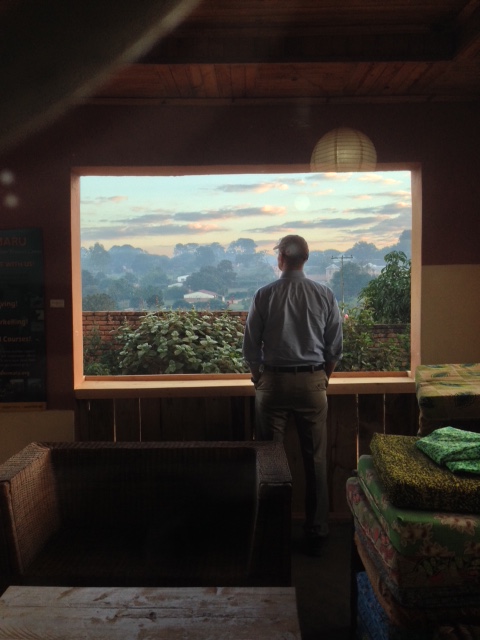
The image below was taken at 5am on Wednesday by Emily Zmak, a graduate student at the University of Denver. It captures a moment of reflection in the early morning on our first day in Mzuzu, Malawi. A day earlier, the vehicle carrying our luggage from Lilongwe to Mzuzu had a mechanical failure. I arrived at Joy’s Place (where the students have been staying) in the hope that our bags had been delivered overnight. Since the bags had not arrived, I took the opportunity to watch the sun rise and absorb a waking day in Malawi, the warm heart of Africa. Emily managed to capture this moment in her wonderful picture.
Our group from Virginia Tech and the University of Denver will be here for three weeks working alongside students from Mzuzu University as part of a WASH (Water, Sanitation, and Hygiene) study abroad course. Students from each university will work in teams in three different regions of Malawi to evaluate the impacts of a rural shallow well program that has been active in the country for more than two decades. The data they collect will help the NGO running the program better understand what aspects of the program need to be improved and which aspects are functioning well. I will say more about this research in a future post. We leave to start the fieldwork at 6am tomorrow.
During the first two days of the course, the students met with key staff from government agencies and national and international organizations in Lilongwe, who provided valuable overviews of the challenges and opportunities that face the country. For example, only 8% of the population have access to electric and around 11% of rural households use an unimproved water supply (such as surface water). In terms of income, Malawi falls among the poorest nations in the world.
This slideshow requires JavaScript.
We spent the second part of the first week at Mzuzu University where faculty and invited guests provided seminars on a range of topics from Malawian culture and practices to deforestation trends across the nation and changing fishing practices on in Lake Malawi. We are grateful for all the work of Dr. Rochelle Holm (Director of the Centre of Excellence in Water and Sanitation) in arranging these sessions. They provided an essential context to the research the students will be undertaking.
This slideshow requires JavaScript.
When reflecting at Joy’s Place on the days ahead, the richness of the study abroad experience for the students at all three universities was clear. For many, it is their first time in Africa and I’m keen for them to experience the beauty of the country and warmth of the people, as well as trying to navigate bustling taxi ranks and the local cuisine (which is some of the best I’ve eaten in Africa). There is then the experience of learning with an international student cohort at Malawi’s most northern public university. Finally, the students will be exposed to the challenges of undertaking a research project in three regions of the country. The fieldwork will provide a hands-on, minds-on experience where students will be responsible for undertaking household surveys, focus groups, key informant interviews, water quality testing, and technical assessments of the installed shallow wells. They will also be tasked with processing these data while in the field so we can begin to identify key findings from the research. Given the need to hold the interviews in the local languages, the Malawian students will take lead roles in this research with support provided by the US students. The students will need to work closely together, which should provide a unique opportunity for cross cultural exchange and learning.
After a busy first week, the students visited the Vwaza Wildlife Reserve and Nkhata Bay this weekend, where one or two students (and I!) learned to paddle board for the first time.
This past weekend I had the pleasure of accompanying the 2017 Environmental Policy and Planning (EPP) and Public and Urban Affairs (PUA) graduates at the CAUS commencement ceremony. I captured a few moments from this ceremony that are shared in the video below. Congratulations to all of our EPP and PUA graduates!
This afternoon, I had the pleasure of being a judge at the VT Engage Poster Showcase. At this annual event, students present conference-quality posters that outline how their community projects advance the core values of VT Engage and benefit community partners. Each year the quality and impact of these projects seems to increase. The students’ passion for their work is palpable and embodies the Ut Prosim spirit of Virginia Tech. The pictures below provide a sample of the students and posters that were presented at the event.
This weekend, Drs. Penny and Andy Muelenaer will be presenting the poster below at the 8th Annual CUGH Global Health Conference entitled Healthy People, Healthy Ecosystems: Implementation, Leadership, & Sustainability in Global Health. The conference will be held at the Washington Hilton Hotel, Dupont Circle.
The poster captures captures some of the work of Virginia Tech’s TEAM Malawi.
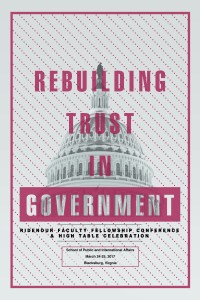
During the conference, I will moderate a panel discussion (at 2:45pm on Friday, March 24) on The Future of Work and Income in an Era of Economic Inequality.
The panelists include Dr. Virgil A. Wood(Pastor Emeritus, Pond Street Baptist Church; Former Dean, Northeastern University; Former ten-year working associate of Dr. Martin Luther King, Jr.), Dr. Joyce Rothschild (Professor, School of Public and International Affairs, Virginia Tech), and Dr. Christian Matheis(Visiting Assistant Professor, Government and International Affairs, Virginia Tech).
Dr. Virgil Wood beside Dr. Martin Luther King, Jr. (Source: Getty Images)
During the panel discussion we will explore how the forces of globalization and rapid technological change, along with an overall decline in pay and wages, have resulted in the perception of a stagnant post-recession economic recovery. Emphasis on economic inequality was persistent in the 2016 presidential election along with promises to bring back jobs and industries that once supported the American Dream. The panel members will examine these major socio-economic and political shifts, and discuss what could be done to reduce economic inequality and reestablish trust in government.
The conference sessions are free, but participants are asked to register.
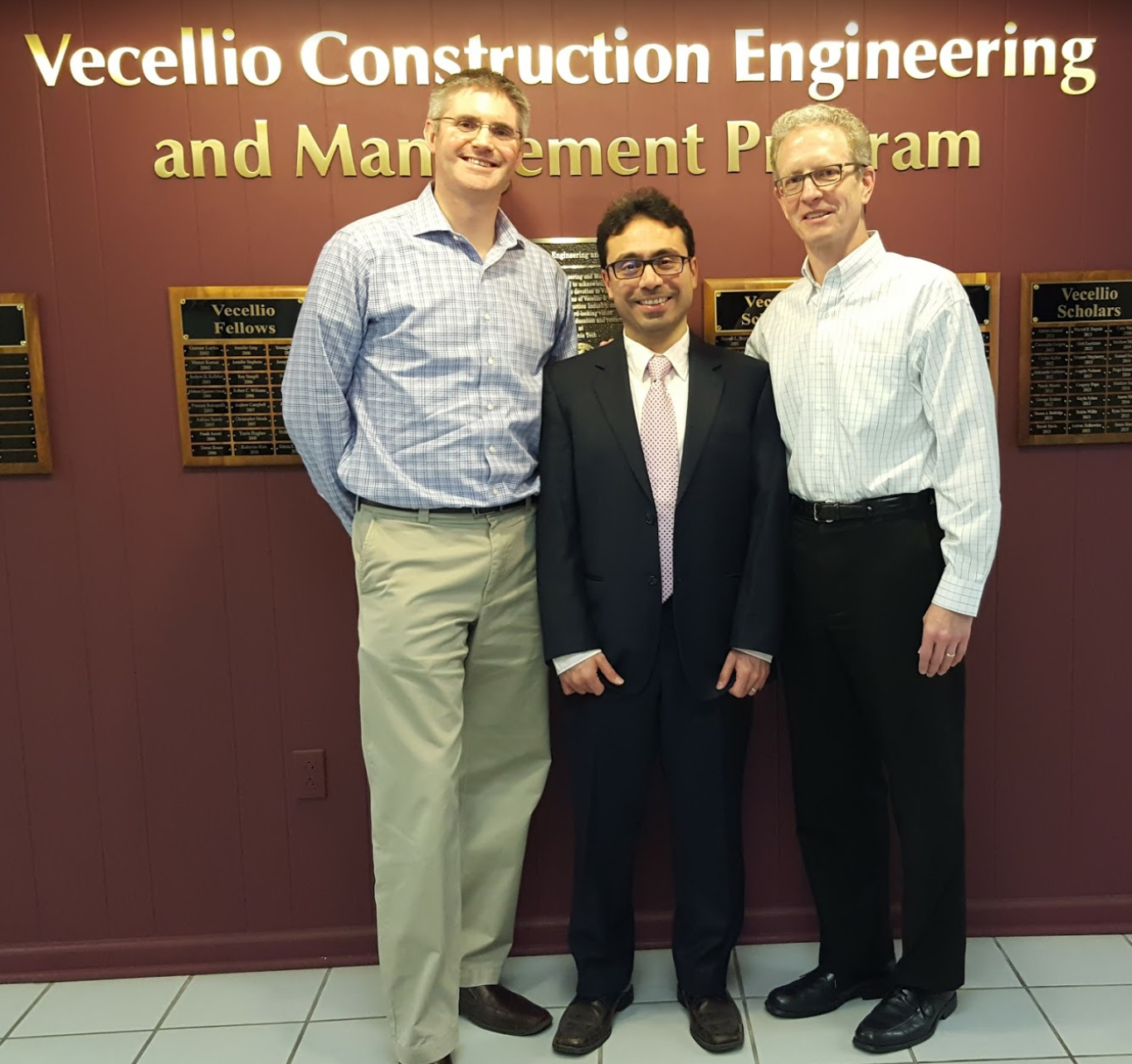
Congratulations to Behshad Ghadimi who successfully defended his PhD in Civil Engineering today. Behshad’s researched focused on the impact of project delivery methods on stakeholder issues and involvement practices in megaprojects. I served on Behshad’s PhD committee with Michael Garvin (Committee Chair, shown on the left below), Sunil Sinha, and John Taylor. The abstract to Behshad’s dissertation is provided below.
Abstract
As the scale and scope of infrastructure projects have increased, so too has the array of stakeholders either involved or impacted. Such projects often take years to come together and evolve with time through the actions of project sponsors and the engagement of various stakeholders. Stakeholders through engagement and input can help legitimize and improve large-scale project initiatives. Stakeholders can also marshal opposition that can delay or block these projects. Consequently, the significance of stakeholder involvement is critical in megaprojects.
Governments have increasingly utilized public-private partnerships (PPPs) for megaproject delivery. This method introduces characteristics that distinguish PPP megaprojects from others such as: private control, profiteering, foreign profits, and long-term concessions. This study investigates whether differences exist between PPP and non-PPP megaprojects with respect to stakeholder involvement strategies and stakeholder issues raised in such projects.
The research employs a longitudinal multiple case study approach that examines four tolled fixed crossing megaprojects; two of them are delivered as PPPs and two are delivered as design-build (i.e., non-PPP). The approach follows the design of prior studies in this area by De Schepper, Dooms, and Haezendonck (2014) and Winn (2001). Pre and post milestone event analysis captures trends and shifts in involvement strategies and stakeholder issues. Subsequently, stakeholder issue tables (organized by issue themes) and stakeholder mechanism tables (organized by mechanism type and information flow) are utilized for across case synthesis and comparison to identify similarities and differences among the cases.
Analysis of stakeholder involvements across cases shows that NEPA establishes a baseline for involvement, but its requirements are not sufficient for megaprojects; a more comprehensive strategy is necessary. Further, although participatory involvements may enhance input and legitimize projects, these mechanisms must be carefully managed in terms of process and criteria for evaluating stakeholder input. Examination of stakeholder issues indicates that issues that are common to non-PPP and PPP projects are more prevalent than PPP specific issues. In particular, issues related to tolling are dominant; moreover, toll affordability is extremely sensitive, and its severity is predictable based on affected area demographics and past toll escalation practices.
The study provides insights about how megaprojects are shaped through actions of project sponsors as well as impacted and interested stakeholders. It also demonstrates how these projects become artifacts of aspiration for politically powerful figures. Lastly, it identifies the main stakeholder issues and suggests a set of guidelines to assist future practitioners in developing better stakeholder involvement strategies, which should both enhance and legitimize megaprojects.
This year I will support two study abroad programs that will take Virginia Tech students to Malawi and to Switzerland, Senegal, and Croatia.
The Experience WASH in Malawi course will take place from July 9 – 29, 2017 (Summer II), and will provide students with an excellent opportunity to undertake WASH-related research with a cohort of students from VT, Denver University, Mzuzu University, and Texas Tech. The presentation below provides an overview of the course and includes a few images from our 2016 offering. Students can apply here.
In the Fall semester, I will be co-leading (with Thomas Archibald) a module in the Dean’s Semester on Global Challenges in Switzerland and Senegal focused on food security. During the three-week module, students will explore the causes and impacts of malnutrition and food insecurity and the various responses of international organizations and NGOs to the global food challenge. From this foundation, students will have the opportunity to engage with international agricultural organizations and NGOs in Geneva, Switzerland, before traveling to Senegal to study two agricultural development programs – the 4-H and PPP program – managed by Virginia Tech’s Office of International Research, Education, and Development (OIRED). We are developing our module around the precepts of “fair trade learning,” that include transparency, community-driven service, commitment and sustainability, deliberate diversity, intercultural contact, community preparation, local sourcing, reciprocity, and reflection.
The video below provides a brief overview of the semester that will run from August 25 – December 13, 2017. Students can apply here.
Our proposal for the MacArthur 100&Change ($100 million) grant was submitted this morning. Using the language of Virginia Tech’s Beyond Boundaries initiative, this is our ‘moonshot’ idea. If implemented it could fundamentally retool the global economy to provide everyone with a capital ownership stake in an inherently sustainable economy. Here is the executive summary of our proposal:
Boldly conquering global poverty will require an innovative economic paradigm that provides everyone on this planet with a personal ownership stake in the future. This project aims to transform our economic systems and promote sustainable enterprises by leveraging creativity and innovation. Our forward-looking mechanisms will enable all people to obtain a capital-based income that will supplement their labor income. Using the principles of binary economics, people will acquire capital with credit repayable with pre-tax future earnings of capital (future savings). The approach does not require coercive actions of government or a redistribution of existing wealth. As capital ownership becomes more broadly distributed, the economywill grow as people spend their newly acquired income on inherently sustainable goods and services. Our team’s alliance of academics and expanded-ownership pioneers will demonstrate how universalizing access to capital ownership can reduce inequality and advance sustainable development to create inclusive and sustainable prosperity for all.
In this post, I wanted to reflect a little on how we made it to this point.
My decision to advance a proposal came after listening to Regina Dugan speak at Virginia Tech in August. During her talk, Dugan commented that organizations are often limited not by what they can do, but by what they “believe” they can do. Having initially decided not to develop a 100&Change proposal due to the sheer scale of the grant and significant global competition, her comments and the Beyond Boundaries initiative made me rethink this decision.
I would put my ideas for how to spend this scale of funding into two categories. The first contains those ideas that could lead to siginfnicant progress, but largely within the existing development paradigm. One example would be the creation of an accessible and open data-rich sustainable water decision-support platform that could be expanded to include other sectors of the economy such as energy and agriculture. The second category contains those ideas that are potentially transformative in a macro sense, but are also currently on the fringe of mainstream thinking. One example, and the anchor of our 100&Change proposal, is the theory of binary economics that has been developed for over fifty years, but has yet to receive significant attention.
During her talk at Virginia Tech, Dugan commented that real innovations tend to occur when you feel uncomfortable about what you are doing – uncomfortable in the sense that there is no known pathway to success and there is a high potential of failure. While binary economics inspired the creation of employee stock ownership plans (ESOPs), its economic principles have yet to be fully implemented in a way that increasingly broadens capital ownership and creates a sustainable economy. Thus, some could argue that it is an unproven idea. Flying at Mac 20 was also an unproven idea until it was not. With regards to the high potential of failure, I view this in the context of a highly competitive grant competition, rather than failing in terms of the approach. Having spent many years exploring the approach with Prof. Robert Ashford, I feel confident it has the potential to reduce inequality and stimulate significant economic growth. The basic idea is that if everyone received an additional and growing income from capital ownership, they would spend this money on goods and services, stimulating further growth (‘binary growth’). Given the potential negative environmental impacts of this growth, our proposal developed an innovate way to finance the growth of inherently sustainable goods and services. The problem statement from our proposal clearly explains the combination of these two ideas.
Few people today produce enough to take care of themselves or their families. Labor, the main source of economic productiveness prior to the industrial revolution, has declined in relative productiveness as labor-displacing technology advances and becomes hyper-productive in comparison to labor [see the Second Machine Age]. These trends are driving the growth in inequality and the erosion in labor earning capacity, with the ownership of productive wealth being highly concentrated, and with most people owning little or nothing. Attempts to generate equitable growth via government stimulus or austerity programs have failed.
A second critical and related problem is the negative environmental impacts that accompany technology-fueled growth. The Rio+20 promise of a Green Economy has yet to truly materialize, but simply going green is not enough. A new, inherently sustainable industrial revolution is needed, where products and services are produced, used, and disposed of in closed-loop, hyper-efficient systems. A major challenge, however, is the creation of markets for these next-generation products and services. These markets need to provide all people with an equal opportunity to earn incomes from their labor and from a capital ownership stake in the inherently sustainable products and services they benefit from.
When put together, these two macro problems – i.e., inadequate income and the negative environmental impacts of growth – underlie most of the major challenges facing humankind. The fundamental problem addressed by this proposal is how to create Inclusive and Sustainable Prosperity for All.
Since we decided to advance a 100&Change proposal in the first week of September (four weeks ago!), I needed to recruit help to make this proposal happen. I decided to focus my sustainability seminar on the topic of binary economics and asked my graduate students to help structure the content of the 100&Change ‘pitch’ video. They willingly agreed to help and spent several weeks reading, learning, and struggling with the ideas before developing what I considered to be a firm understanding of binary economic principles. The pictures below capture some of the ideas we discussed during this learning process. We also developed a number of concept videos that can be viewed here and here.
This project will make the ownership of capital – a critical and growing form of income – more inclusive by using future capital earnings (future savings) to finance broadening capital acquisition to provide growing numbers of people with capital income. The new capital income will target inherently sustainable goods and services, stimulating innovation and supporting long-term sustainability. As production becomes ever more capital intensive, providing everyone with an ownership stake in capital will be critical to broadly increasing purchasing power, reducing inequality, and fostering sustainable communities.
Because most people lack the capacity to generate past savings, there must be a shift to using future savings to finance new capital. Presently, almost all capital acquired by corporations is acquired with the earnings of capital, and much of it is acquired with borrowed money. The new mechanisms developed by the project team will open to all people the techniques of corporate finance that will broaden capital ownership and provide beneficiaries with a growing capital income. Because present demand for the employment of capital and labor is dependent on expected demand for goods or services in a future period, a voluntary pattern of steadily broadening capital acquisition promises more production-based consumer demand in future years and therefore more demand for a fuller employment of labor and capital in earlier years. Further, the targeted use of newly acquired capital income to purchase inherently sustainable goods and services will significantly expand the market for these goods and services, creating powerful incentives for innovation.
What is perhaps most interesting about this experience is that while I initially viewed the challenge of creating a 100&Change proposal as a moonshot, the more we worked on the idea and began to form the team, the more it became a realistic possibility. My graduate students proved to be the best critics of the ideas we were exploring and played an important role in framing the approach to the project. In many ways, as the proposal evolved, so too did the team’s confidence in what we could accomplished with binary economics. Our final 90-second video (below) is ‘one small step’ towards a broader understanding of the approach.
After completing our proposal, I started watching the other 100&Change videos on YouTube and realized that our approach could finance those ideas focused on the creation of inherently sustainable goods and services. Thus, if you find yourself wondering what inherently sustainable means, take a look at the available videos and get inspired.
Earlier this week, I posted my reflection to Regina Dugan’s Presidential Lecture. After a couple of days of thinking, I wanted to extend one of the ideas I discussed and connect it with my research on innovation/transformation.
In my previous post, I discussed the idea of creating sandbox spaces or studios where students from any discipline can work on ‘use-inspired’ solutions to significant problems. I wanted to extend this idea by introducing the concept of “design space.”
In 1978, Allen, Utterback, et al. of MIT introduced “design space” as a cognitive concept that refers to the dimensions along which the designers of technical systems concern themselves. The basic idea is simple. Once a problem is clearly defined (or bounded), so too is the design space within which a solution to the problem can be created. A well-defined design space opens up the creativity of an engineer, designer, etc., by clarifying the dimensions of a problem that must be solved. A poorly defined problem cannot be easily solved, if at all. While the roots of the idea stem from innovation theory, Nicholas Ashford and I have argued that the idea of “design space” can be applied in a technical and regulatory setting to advance sustainable development.
If solutions to problems are sought only along traditional engineering lines, unconventional solutions – which may or may not be high-tech – are ignored. Put differently, if the design space ignores a specific factor or dimension, the solution to a problem is also likely to ignore this factor or dimension. From an organizational perspective, organizations that limit themselves to current or traditional strategies or agendas, are likely to have a constrained use of the available design space, reducing the chance they will be able to fundamentally transform their functions. Thus, organizations can become ‘locked-in’ to their own routines and ways of thinking if they do not have a process to engage with outsiders and radically new ideas. The implications of this idea for the Beyond Boundaries process should be clear.
The Presidential Lecture series provides a good example of how Virginia Tech is trying to engage with ‘outsiders’ to expand the Beyond Boundaries design space – i.e., to help us identify important factors or dimensions that we previously had not considered.
In the context of creating sandbox spaces or problem-solving studios, it would be critical to broaden the design space to capture the full scope of issues that underlie a complex problem. For example, a design space for a sustainable development problem would be necessarily broad (or multidimensional). In this case, the design space would need to be ‘opened up’ (perhaps, through engagement with ‘outsiders’) to achieve mutually supportive social goals, co-optimizing the determinants of economic welfare, environment, consumer and public health and safety, and employment, etc. A failure to do this may result in solutions that create problems in those areas excluded from the design space. I believe that limited or single-purpose design spaces are one of the reasons progress towards sustainable development has been so slow.
Finally, the way in which Virginia Tech crafts the design spaces for the Destination Areas (DAs), is likely to be critical to the type and scope of problems that the university will be able to address. We should heed Regina Dugan’s advice and not limit the DA design spaces to what we feel comfortable doing. We need to stretch our imagination and capabilities to the point of discomfort, in search of disruptive and transformative ideas. The sandbox spaces or problem-solving studios could provide safe places where students and faculty could fantastically succeed or fail, both outcomes are part of the same transformative coin.
Reference:
Allen, T. J., J. M. Utterback, et al. (1978). “Government Influence on the Process of Innovation in Europe and Japan.” Research Policy 7(2): 124– 149.





 Ralph P Hall