Stockholm Presentation

The presentation I gave during the seminar on “Scaling Pathways for Multiple-Use Services, for Food Security and Health” at the Stockholm World Water Week 2012 is posted below. Following this prezi, I have provided links to the presentations given by the other seminar participants.

2015-04-14_1551

Presentations by Seminar Participants

Background to MUS.
Barbara van Koppen, Coordinator MUS Group/IWMI, South Africa

MUS Practices and Scaling Pathways for Food Security in Ethiopia.
Deres Abdulkadir, RiPPLE, Ethiopia

What does MUS Look Like? Moving from Concept to Practice in 7 Countries.
Mary Renwick, Winrock International, USA

Guidelines for Providing and Implementing MUS.
Stef Smits, Secretary MUS Group/IRC, the Netherlands

If it is such a Good Idea, Why doesn’t Is Scale Up? Opportunities and Barriers for Scaling MUS.
Barbara van Koppen, coordinator MUS Group/IWMI, South Africa

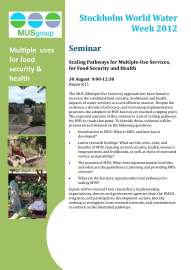
Stockholm World Water Week 2012

On August 30, 2012, I will be taking part in a seminar on “Scaling Pathways for Multiple-Use Services, for Food Security and Health,” at the 2012 Stockholm World Water Week. During my presentation, I will highlight some interesting results from our multi-country study on the productive use of rural domestic water in Senegal and Kenya. More specifically, I will discuss the relationship between the productive use of domestic water and the (technical/financial) sustainability of rural piped water systems.

Our first paper from this multi-country study on “The role of productive water use in women’s livelihoods: Evidence from rural Senegal,” will be published in the October edition of Water Alternatives. A series of other papers from this work are currently under review/development.


New Article – Administrative & Regulatory Law News

Nicholas Ashford and I recently published a short article entitled “Regulation-Induced Innovation for Sustainable Development” in the Journal of Administrative & Regulatory Law News (see pages 21-23 of the journal).

Citation: Ashford, N. A. and Hall, R. P. (2012) “Regulation-Induced Innovation for Sustainable Development.” Administrative & Regulatory Law News, Vol. 37, No. 3, pp. 21-23, Spring 2012.

A Perspective on the Right to W&S

On July 17, 2012, I attended the AAAS Science and Human Rights Coalition Meeting and took part in a panel discussion with Salman M.A. Salman (former Lead Counsel, Legal Vice Presidency, World Bank) and Eric Tars (Director of Human Rights and Children’s Rights, National Law Center on Homelessness and Poverty) on the human right to water and sanitation. The panel was moderated by Benjamin Mason Meier (Assistant Professor of Global Health Policy, University of North Carolina at Chapel Hill).

In my presentation, I raised the question of whether focusing on the human right to “drinking water” could limit development opportunities for some peri-urban/rural communities. My remarks were positioned within the context of multiple-use water services, whereby water supply systems are designed to support both domestic and productive uses of water.

If you have an interest in the subject of the human right to water and sanitation, I encourage you to listen to a recent webinar on the “Implementation of the Human Right to Safe Drinking Water and Sanitation,” held on June 5, 2012.

Ashford Talks About Our New Book

Nicholas Ashford recently created five short videos in which he explores many of the core issues we raise in our textbook Technology, Globalization, and Sustainable Development: Transforming the Industrial State (Yale University Press 2011).

The best order to view these five video clips are 4, 5, 1, 2, and 3.

New Paper in EIST

The Crisis in Employment and Consumer Demand: Reconciliation with Environmental Sustainability

Nicholas A. Ashford, Ralph P. Hall, and Robert H. Ashford

Abstract: This paper argues that a sustainable industrial system depends not only on good environmental and public health outcomes, but also on adequate employment and earning capacity in a well-functioning and equitable economic system. These concerns are likely to dominate future national political debates, requiring responses that increase the earning capacity of individuals through changes in the nature of work and employment, and in the ownership of productive capital. Making the economy greener, while certainly necessary for long-term economic and societal survival, does not necessarily mean more and better paying jobs on a large enough scale to make serious progress to reducing unemployment and underemployment. At present, national and global reforms are focused on improving the financial system, which is not synonymous with reforming the economic system or improving the economic status of individual citizens. This paper discusses specific policies and initiatives that need to be considered to ensure sustainable employment and livelihoods.

Highlights:

  • Policies and initiatives to advance sustainable employment/livelihoods are discussed.
  • Sustainable industrial systems require adequate employment and earning capacity.
  • Green growth does not necessarily mean more and better-paying jobs.
  • Both labor productivity and GDP/GNP are flawed measures of economic progress.
  • Productivity and productiveness are not the same.

Water-Related Research Presentations

Over the past two months, I have presented some results from our water-related research in Senegal and Kenya to the Multiple-Use Water Services Group, and Mozambique to the Millennium Challenge Corporation (MCC). I have provided a version of these presentations below for your interest, but have removed any sensitive information that could be used to identify the communities included in the studies or impact the integrity of the ongoing impact evaluation in Mozambique. We are currently working on a series of papers to document our findings from these large-scale empirical research projects. As soon as these papers are available, I will provide a link to them on this website.

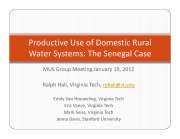
Productive Use of Domestic Rural Water Systems: The Senegal Case.” Presentation to the Multiple Use Water Services Group in Washington, D.C., January 19, 2012. 


Productive Use of Domestic Rural Water Systems: The Kenya Case.” Presentation to the Multiple Use Water Services Group in Washington, D.C., January 19, 2012. 


Results from the Baseline Study of the MCC-Funded Rural Water Supply Activity in Nampula.” Research team presentation to the Department of Policy and Evaluation, Millennium Challenge Corporation, December 15, 2011.

New Paper in TRR

Framework for Sustainability Assessment by Transportation Agencies

Tara Lakshmi Ramani, Josias Zietsman, Henrik Gudmundsson, Ralph P. Hall, Greg Marsden

Abstract: The application of the concept of sustainability by transportation agencies is often limited by agencies’ understanding of what sustainability means and how it can be integrated into the regular functions of the agencies. This paper presents a flexible approach and framework that can equip transportation agencies with the tools required to understand what sustainability means and incorporate sustainability into the organizational culture. This approach and method can also help agencies lay the groundwork for the use of performance measures so the agencies can progress toward sustainability goals and outcomes. The framework development process was an extension of findings from literature review, case studies, and interviews conducted as part of ongoing research under the NCHRP project Sustainability Performance Measures for State Departments of Transportation and Other Transportation Agencies. The proposed framework can be applied or adapted for use in a range of transportation agencies, including state departments of transportation and metropolitan planning organizations. A key feature of this framework is that it moves away from the traditional sustainable transportation perspective and instead promotes the consideration of transportation from a holistic sustainable development perspective. The framework defines broadly applicable transportation goals that can be broken down into a menu of objectives and performance measures to cover various transportation contexts. The framework is also designed to direct an agency’s strategic planning toward the practical implementation of sustainability through performance measurement.

Citation: Ramani, T. L., Zietsman, J., Gudmundsson, H., Hall, R. P. , and Marsden, G. (2011) Framework for Sustainability Assessment by Transportation Agencies. Transportation Research Record, No. 2242, 2011, pp. 9–18.

Guidebook for Sustainability Performance Measurement for Transportation Agencies

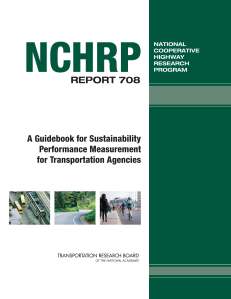
The Transportation Research Board (TRB) has just released “A Guidebook for Sustainability Performance Measurement for Transportation Agencies.” This research project was led by the Texas Transportation Institute and draws on the expertise of a diverse team of researchers and academics including Cambridge Systematics, CH2MHill, High Street Consulting, Dr. Henrik Gudmundsson, Dr. Greg Marsden, Dr. Steven Muench, and myself.

The Guidebook provides a practical approach to understanding sustainability, and identifying and applying sustainability-related performance measures. The Guidebook also discusses linkages to an agency’s mission and strategic plan, and the integration of these sustainability measures into other programs and agency business practices. The Guidebook provides a generally-applicable framework that transportation agencies can adapt and use, either in their existing performance measurement programs or as part of a new sustainability initiative. The Guidebook also contains a compendium of sustainability performance measures with a menu of goals, objectives, and performance measures that agencies can use as the basis for their performance measurement applications.

New WaterAid Publication: Off-Track, Off-Target

WaterAid has just released new policy report – Off-Track, Off-Target (with the supporting video below) – that argues that the 2015 Millennium Development Goal (MDG) target to halve the proportion of people without access to improved sanitation will not be met in Sub-Saharan Africa for two centuries if current trends persist. The provision of sustainable rural water supply services in developing regions is also identified as a major problem.

I am currently working on several papers that will be released next year that will look at the sustainability/impact of rural water supply systems in Senegal, Kenya, and Colombia that support household-level productive activities. My hope is that these studies will help advance the current approach to the provision of rural water supply systems in these regions. In addition, we plan to publish the results from a study of the willingness of rural households in Senegal to pay for a VIP (ventilated improved pit latrine).