New WaterAid Publication: Off-Track, Off-Target

WaterAid has just released new policy report – Off-Track, Off-Target (with the supporting video below) – that argues that the 2015 Millennium Development Goal (MDG) target to halve the proportion of people without access to improved sanitation will not be met in Sub-Saharan Africa for two centuries if current trends persist. The provision of sustainable rural water supply services in developing regions is also identified as a major problem.

I am currently working on several papers that will be released next year that will look at the sustainability/impact of rural water supply systems in Senegal, Kenya, and Colombia that support household-level productive activities. My hope is that these studies will help advance the current approach to the provision of rural water supply systems in these regions. In addition, we plan to publish the results from a study of the willingness of rural households in Senegal to pay for a VIP (ventilated improved pit latrine).
 

2011 WTO Public Forum

On Tuesday, September 20, Nicholas Ashford (MIT) took part in a panel discussion at the 2011 WTO Public Forum on “Encouraging Innovation and the Deployment of Environmental Technologies.” A podcast of the panel discussion can be accessed via the following link: http://www.wto.org/audio/forum11_session22.mp3.

Nicholas discussed many of the issues that we cover in our new book. In particular, he discussed the role of stringent government regulation in stimulating disruptive technological change and the importance of designing jobs into the innovation process.

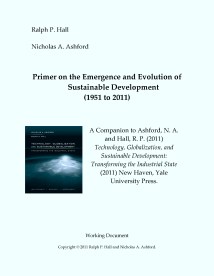
Sustainability Primer Now Available

The Emergence and Evolution of Sustainable Development (1951 to 2011)

This primer on the emergence and evolution of sustainable development provides essential supplementary material for the textbook Technology, Globalization, and Sustainable Development: Transforming the Industrial State. The primer expands on Chapter 2 of the textbook by discussing how key events in the United States, U.S. legislation, international conferences, seminal publications, and debates from the 1950s to the present have shaped the formulation of the concept of sustainable development.

The primer serves as a basic reference for scholars, researchers, students, and policy-makers concerned with sustainable development.