SOS Meeting in Washington D.C. (Jan 6)

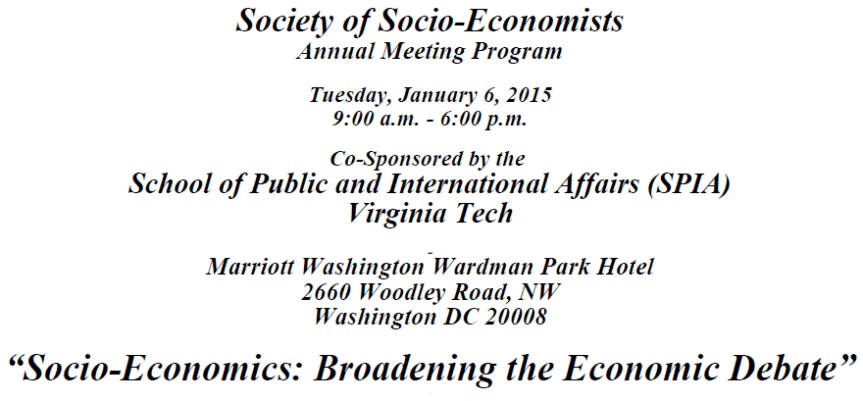
On Tuesday, January 6the Society of Socio-Economists (SOS) will be holding its annual meeting in Washington, D.C. This years meeting on “Socio-Economics: Broadening the Economic Debate” is being co-sponsored by SPIA and promises to be a valuable and thought provoking event with notable speakers (see below).2014-12-09_1345
The intent of the meeting is to provide people with an opportunity to explore how their research may connect with the ‘socio-economic’ approach to economic analysis, and to build bridges between disciplines and perhaps chart new research collaborations/projects. I have reproduced the “Statement of Socio-Economic Principles” below for those who are not familiar with this text. The principles provide both a sound epistemological foundation and set of ethical rules of fair play regarding economic analysis that could aid the formulation of public policy.

2014-12-11_0849The meeting will consist of a morning plenary followed by a series of concurrent sessions in the afternoon. The plenary is intended to provide a forum that affords everyone a chance to speak and exchange views. Whereas the concurrent sessions allow for more narrowly focused, but still broad, discussions.

The growing list of meeting participants includes the following individuals:

Statement of Socio-Economic Principles

Socio-economics begins with the assumption that economics is not a self-contained system, but is embedded in society, polity, culture, and nature. Drawing upon economics, sociology, political science, psychology, anthropology, biology, and other social and natural sciences, philosophy, history, law, management, and other disciplines, socio-economics regards competitive behavior as a subset of human behavior within a societal and natural context that both enables and constrains competition and cooperation. Rather than assume that the individual pursuit of self-interest automatically or generally tends toward an optimal allocation of resources, socio-economics assumes that societal sources of order are necessary for people and markets to function efficiently. Rather than assume that people act only rationally, or that they pursue only self-interest, socio-economics seeks to advance a more encompassing interdisciplinary understanding of economic behavior open to the assumption that individual choices are shaped not only by notions of rationality but also by emotions, social bonds, beliefs, expectations, and a sense of morality.

Socio-economics is both a positive and a normative science. It is dedicated to the empirical, reality testing approach to knowledge. It respects both inductive and deductive reasoning. But it also openly recognizes the policy relevance of teaching and research and seeks to be self-aware of its normative implications rather than maintaining the mantle of an exclusively positive science. Although it sees questions of value inextricably connected with individual and group economic choices, socio-economics does not entail a commitment to any one paradigm or ideological position, but is open to a range of thinking that treats economic behavior as involving the whole person and all facets of society within a continually evolving natural context.

Unique among interdisciplinary approaches, however, socio-economics recognizes the pervasive and powerful influence of the neoclassical paradigm on twentieth century thought. Recognizing that people first adopt paradigms of thought and then perform their inductive, deductive, and empirical analyses, socio-economists seek to examine the assumptions of the neoclassical paradigm, develop a rigorous understanding of its limitations, improve upon its application, and develop alternative, perhaps complementary, approaches that are predictive, exemplary, and morally sound. With modest amendment, this description of Socio-economics was the substance of the petition signed by more than one hundred twenty law professors from over fifty member schools of the Association of American Law Schools (AALS), to establish the AALS Section on Socio-Economics. It serves as the constitution of the Section. Source.

Additional information of socio-economics can be read in this paper on Socio-Economics – An Overview by Prof. Robert Ashford.
SPIA Conference on Resilience

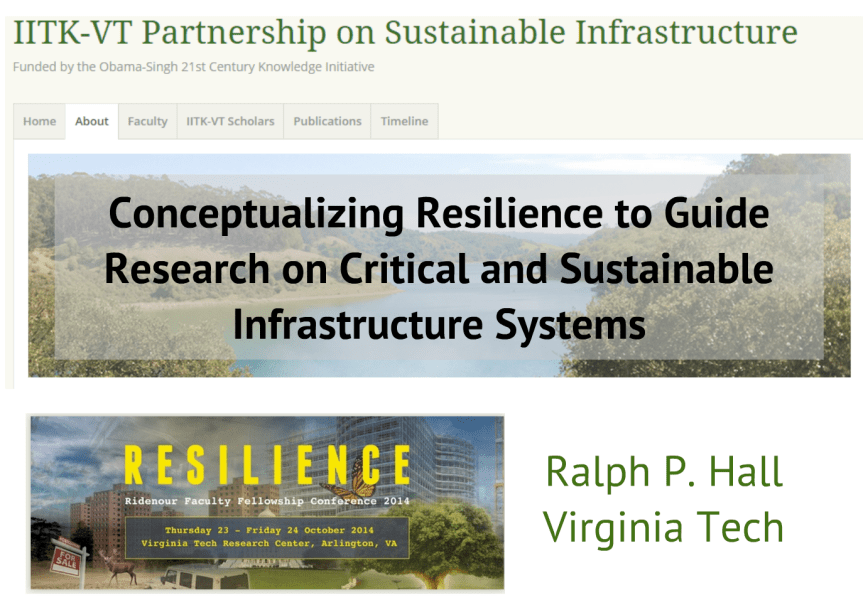
This Friday, I will be giving a presentation about the IITK-VT Partnership on Sustainable Infrastructure at Virginia Tech’s School of Public and International Affairs (SPIA) conference on resilience. The two-day conference (23-24 October) will be held at Virginia Tech’s Research Center in Arlington, Virginia. The conference can be followed on Twitter using #VTSPIA.

2014-10-22_1559


Posters for “Experience VT” Event

This weekend I will be taking part in the “Experience Virginia Tech: Learn, Explore, Engage” event that was commission by President Sand’s to showcase the university’s impact on the world around us. From 9am to noon tomorrow at the VT Inn, I will be presenting the three posters below that document the research and main findings from an impact evaluation I led of an MCC-funded rural water supply project in Nampula, Mozambique. I plan to capture key moments from the event using Google Glass and will post some images and video to this blog and to my Google+ account during the day.

Poster_1 Poster_2 Poster_3

Conversation with Prof. Misra on the IITK-VT Partnership

I had the pleasure of spending today with Prof. Sudhir Misra (Co-PI of the IITK-VT Partnership), during which we held a number of meetings with senior faculty at Virginia Tech focused on the future activities of the IITK-VT Partnership. Prof. Misra also provided a guest lecture in the graduate course on Advanced Urban Infrastructure Planning (UAP5854) – the first course at VT to be associated with the IITK-VT partnership. In between these events, we were able to find ten minutes during which I asked Prof. Misra several questions about what the IITK-VT partnership has accomplished and where we plan to take the partnership in the future. The video below captures our conversation that I recorded using Google Glass and edited in Camtasia.

New Paper in Water Alternatives on MUS

The Productive Use of Rural Piped Water in Senegal

Ralph P. Hall, Eric A. Vance, and Emily van Houweling

Abstract: Over the past decade there has been a growing interest in the potential benefits related to the productive use of rural piped water around the homestead. However, there is limited empirical research on the extent to which, and conditions under which, this activity occurs. Using data obtained from a comprehensive study of 47 rural piped water systems in Senegal, this paper reveals the extent of piped-water-based productive activity occurring and identifies important system-level variables associated with this activity. Three-quarters (74%) of the households surveyed depend on water for their livelihoods with around one-half (54%) relying on piped water. High levels of piped-water-based productive activity were found to be associated with shorter distances from a community to a city or paved road (i.e. markets), more capable water system operators and water committees, and communities that contributed to the construction of the piped water system. Further, access to electricity was associated with higher productive incomes from water-based productive activities, highlighting the role that non-water-related inputs have on the extent of productive activities undertaken. Finally, an analysis of the technical performance of piped water systems found no statistically significant association between high vs. low levels of productive activity and system performance; however, a positive relationship was found between system performance and the percentage of households engaged in productive activities.

2014-10-02_1307

Making Impact Evaluation Matter

Earlier this month I had the pleasure of attending the Making Impact Evaluation Matter conference in Manila, hosted by the Asian Development Bank (ADB), 3ie, and the Philippine Institute for Development Studies (PIDS). During the conference, I took part in a WASH Impact Evaluation Design Clinic and gave a presentation on the results of the impact evaluation I directed of the MCC-funded Rural Water Supply Program in Nampula, Mozambique. Whereas the final impact evaluation report was based on all of the data we collected, the results I presented in Manila focused only on the panel data obtained from the baseline (2011) and follow-up (2013) studies. The results from the panel data analysis (shown in the presentation below) align well with those developed from the full data set.

Ralph3ie

During the conference, Eric Vance spoke about his LISA2020 vision to create 20 statistical consulting laboratories in 20 developing countries by the year 2020. Eric is the Director VT’s Laboratory for Interdisciplinary Statistical Analysis (LISA) that was a key partner in the MCC impact evaluation. For more information on LISA2020 visit the program website.

VT doctoral student Marcos Carzolio also attended the conference and discussed his impact as the field statistician on the quality of data collected during the 2013 follow-up study. Marcos’s talk on Leveraging the Field Statistician to Ensure High Quality Impact Evaluations received the award for “Second Place Best Presentation by a Young Researcher.”

The slideshow below presents a number of images and tweets (#IEmatters) from the conference.

This slideshow requires JavaScript.

New Paper – Transportation Research Part D

A multi criteria decision analysis technique for including environmental impacts in sustainable infrastructure management business practices

James M. Bryce, Gerardo Flintsch, and Ralph P. Hall

Abstract: This paper presents a decision analysis technique to allow highway agencies to assess the tradeoffs between costs, condition and energy consumption. It is shown how the entire feasible solution space can be evaluated between multiple stakeholders with differing values to assess the desirability of the outcomes resulting from infrastructure management decisions. Furthermore, an example network-level analysis is presented using data from the Virginia Department of Transportation. The example analysis clearly shows a tradeoff between the most cost effective outcomes (i.e., minimizing the cost divided by the condition) and the outcomes where the energy consumption is minimized, and how decision analysis should account for this tradeoff. The results of the method presented in this paper show that various pavement management alternatives can be represented in terms of desirability, and that this desirability can assist the decision maker with making decisions about performance goals and targets.

2014-09-21_1545

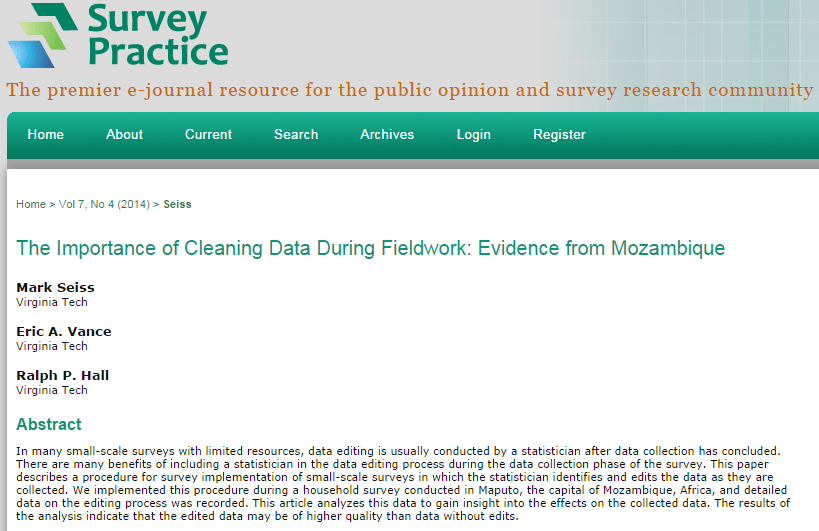
New Paper in Survey Practice

The Importance of Cleaning Data During Fieldwork: Evidence from Mozambique

Mark Seiss, Eric A. Vance, and Ralph P. Hall

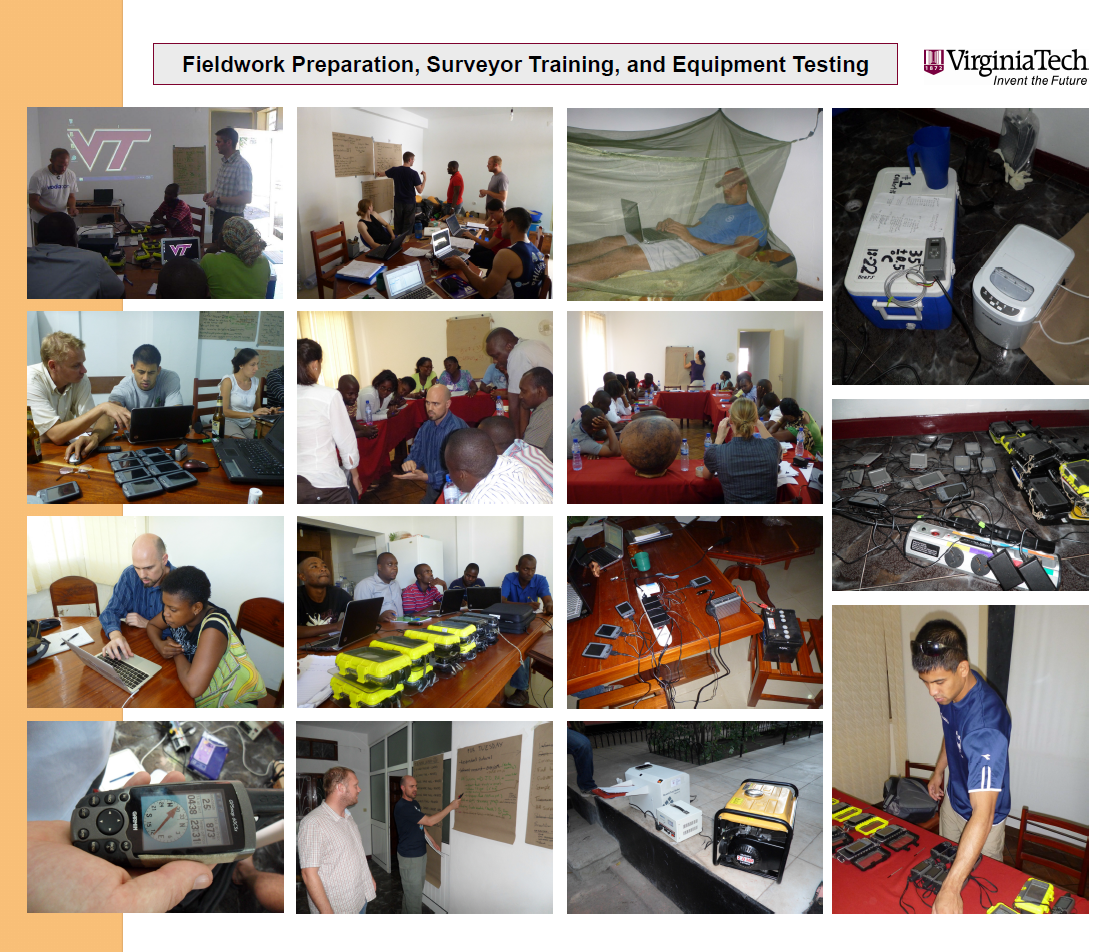
Abstract: In many small-scale surveys with limited resources, data editing is usually conducted by a statistician after data collection has concluded. There are many benefits of including a statistician in the data editing process during the data collection phase of the survey. This paper describes a procedure for survey implementation of small-scale surveys in which the statistician identifies and edits the data as they are collected. We implemented this procedure during a household survey conducted in Maputo, the capital of Mozambique, Africa, and detailed data on the editing process was recorded. This article analyzes this data to gain insight into the effects on the collected data. The results of the analysis indicate that the edited data may be of higher quality than data without edits.

Survey_Practice

MCC Impact Evaluation – Final Report

Nampula_ReportI am pleased to announce the release of the final report of our impact evaluation of the MCC-funded Rural Water Supply Activity (RWSA) in Nampula, Mozambique. This peer-reviewed report provides a comprehensive discussion of the RWSA interventions, our research design, analysis approach, major findings, and the policy implications that emerged from this work.

The report can be downloaded from the MCC’s Open Data portal. This portal also provides access to the main surveying instruments and the raw data collected from the baseline (2011) and follow-up (2013) household surveys.