Professor, Urban and Environmental Policy and Planning (UEPP), Virginia Tech; Joann Boughman Innovation Fellow at USG; Acting Director, Center for Future of Work Places and Practices (CFWPP); Head of Outreach and Engagement, Center for European and Transatlantic Studies (CEUTS)
Why do some cities adapt and thrive through disruption while others struggle to maintain coherence and identity? As urban regions confront post-pandemic recovery, climate pressure, and rapid socio-economic change, planners and scholars are increasingly asking whether cities possess a deeper organizing logic – an “urban DNA” – that shapes how they grow, stabilize, and evolve over time. Moving beyond surface-level traits or branding narratives, Dr. Manthapuri’s new paper in Frontiers of Urban and Rural Planning argues that understanding a city’s internal structure is essential for creating long-term, place-specific, and resilient urban futures.
Abstract
As cities evolve in increasingly complex ways, urban planners and researchers are focusing on creating long term and stable visions that are location-specific, sustainable, and inclusive. This visioning process often results in a fundamental question: Is there an underlying urban DNA, a foundational structure that shapes how urban areas grow, adapt, and transform? The idea of urban DNA, first articulated in the early 2000s, has gained renewed prominence since 2020, particularly in post-pandemic recovery strategies that emphasize local identity and place branding. Unlike the concept of urban identity and urban traits, which reflect external dynamics observable in a city and its performance, the concept of urban DNA focuses on the internal structures and mechanisms that shape urban identity, providing sustainable solutions over temporary remedies. Although numerous scholars have introduced conceptual frameworks for urban DNA, and many policy documents highlight cities’ interpretations of their distinctive urban DNA, these applications often lack a strong theoretical grounding. This limitation underscores the need for a more rigorous theoretical foundation that can both substantiate the concept of urban DNA and explain the sequence of urban evolutionary events, framing it as a structured process rather than a set of randomized events. This research develops the concept of urban DNA by identifying the core elements that constitute the genetic building blocks of cities and shape their emergence and evolution. Five interrelated elements, urban uniqueness, temporal variation, spatial variation, growth, and stability, form the basis of this framework. To ground these elements theoretically, 17 urban evolutionary theories were systematically assessed through a relevance matrix, comparing their conceptual alignment, explanatory power, and practical applicability to the urban DNA construct. The analysis highlights urban niche theory and French regulatory theory as particularly relevant for explaining urban DNA. Based on these insights, a grounded theoretical framework is proposed that offers urban planners and policymakers an operational tool to identify and leverage the urban DNA of their respective cities.
Citation: Manthapuri, S., Hall, R.P. Developing a conceptual framework of urban DNA using evolutionary theories. Front. Urban Rural Plan.4, 4 (2026). https://doi.org/10.1007/s44243-026-00076-7
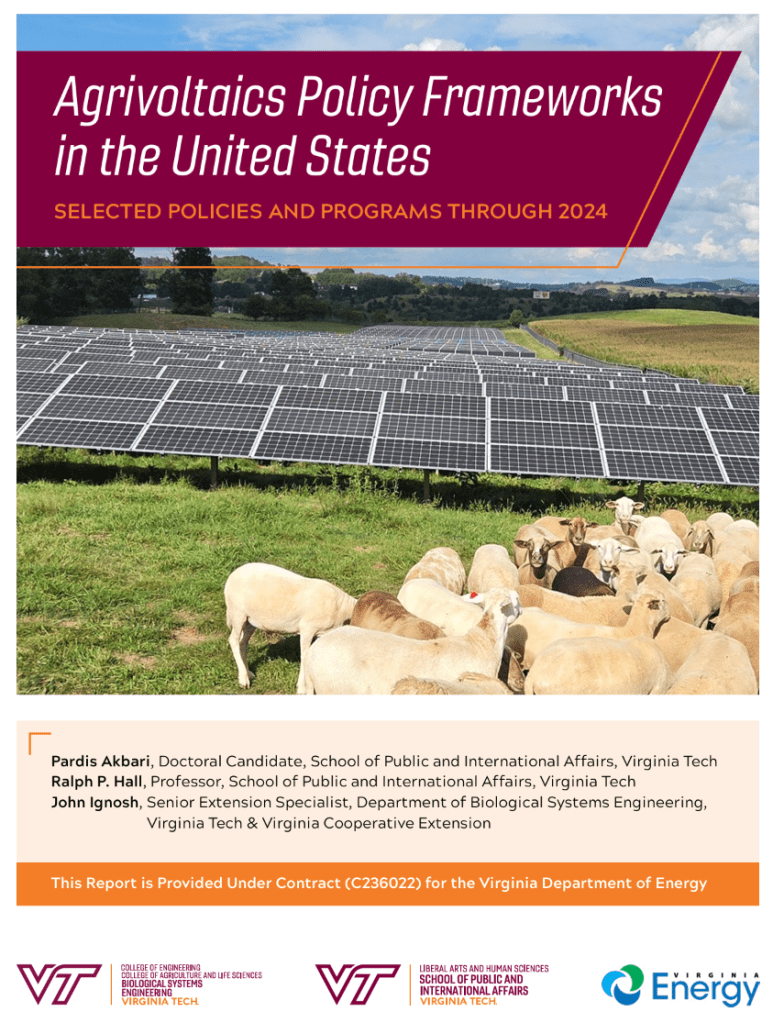
I’m pleased to share our new report on agrivoltaics that was commissioned by the Virginia Department of Energy. The report examines agrivoltaics practices, policies, and programs across the United States through 2024, highlighting emerging trends, benefits, and lessons learned. Together, these insights offer a foundation for aligning clean energy development with agricultural productivity and land stewardship in Virginia.
Akbari, P., Hall, R. P., & Ignosh, J. (2026). Agrivolatics Policy Frameworks in the United States: Selected Policies and Programs through 2024. Virginia Tech, Blacksburg. https://hdl.handle.net/10919/141096
Executive Summary
Agrivoltaics, also known as dual-use solar or agrisolar, is an integrated land-use approach that combines agricultural production and photovoltaic electricity generation on the same site, allowing crops to be cultivated, livestock to be grazed, or pollinator habitats to be maintained while producing renewable energy from solar panels (Department of Energy, 2022; Macknick et al., 2022).
Agrivoltaics presents a potential sustainable solution to land-use competition between food and energy production (Jain, 2024). By integrating solar power generation with agriculture, agrivoltaics systems optimize land use and can increase overall land productivity by 35–73% compared to traditional single-use approaches (Dupraz et al., 2011). The systems can also improve water-use efficiency beneath photovoltaic (PV) panels, reducing evaporation and conserving soil moisture (Adeh et al., 2018). Additionally, agrivoltaics can lower solar panel temperatures by 1-2°C, improving energy efficiency and extending a system’s lifespan (Patel et al., 2019). The partial shading from panels can benefit crops sensitive to heat and sunlight stresses, potentially creating a more favorable microclimate for growth in some production systems and locations (Kussul, 2020; Marucci et al., 2018). Beyond environmental benefits, agrivoltaics may enhance the economic resilience of farms by providing an additional revenue stream from energy generation (Dinesh & Pearce, 2016).
The Virginia Department of Energy commissioned this review to better understand evolving agrivoltaics practices, policies, and programs across the United States at both the federal and state levels. Its purpose is to identify emerging trends and provide an overview of current and recent efforts supporting the integration of agriculture and solar energy development. This review focuses primarily on agrivoltaics initiatives through 2024.
The United States federal government has introduced several policies and programs that indirectly support the growth of agrivoltaics as part of the country’s broader clean energy transition. Key legislative actions, including the Bipartisan Infrastructure Law of 2021 and the Inflation Reduction Act of 2022, have provided significant funding to the Department of Energy (DOE) to expand clean energy infrastructure and strengthen domestic energy resilience. Although these laws do not specifically focus on agrivoltaics, they helped to create a more favorable environment for its development. Federal incentives such as the Investment Tax Credit (ITC) and the U.S. Department of Agriculture’s (USDA’s) Rural Energy for America Program (REAP) have also encouraged the use of renewable energy within agricultural settings. In addition, research and development efforts by the Department of Energy (DOE) through its Solar Energy Technologies Office, including the FARMS and InSPIRE programs, and by the USDA’s National Institute of Food and Agriculture (NIFA), have helped improve the understanding of how agrivoltaics systems perform and how they can support both energy generation and agricultural production.
Across the states, there is growing momentum to promote agrivoltaics through new policies and incentives. Massachusetts continues to lead the way with its SMART program and Agricultural Solar Tariff Generation Unit (ASTGU) incentive, which provide payments and clear design guidelines to ensure that farmland remains in active agricultural use while supporting solar energy production. Other states have developed similar initiatives. For example, New Jersey’s Dual-Use Pilot Program offers incentives for projects that combine solar power with ongoing farming operations, while Colorado supports agrivoltaics through property tax exemptions, research funding, and pilot grant programs. In Virginia, the Department of Environmental Quality’s (DEQ’s) Permit-by-Rule framework now includes reduced project mitigation requirements when practices such as managed grazing and crop cultivation are incorporated when solar projects impact prime farmland. Collectively, these efforts show a growing commitment to balance farmland protection with renewable energy expansion.
A closer look at these initiatives reveals several common elements are emerging that shape the direction of agrivoltaics policy in the United States. Most initiatives rely on financial incentives to make agrivoltaics projects economically viable, recognizing that dual-use systems often require higher upfront costs for design and construction. In addition, many programs include pilot and demonstration projects as a central strategy, providing opportunities to test system designs, crop performance, and management practices under real-world agricultural conditions before broader implementation.
To support the effective expansion of agrivoltaics in Virginia, a harmonized policy framework and a consistent definition of the practice are necessary. Coordination among incentives, performance standards, and data-sharing mechanisms can enhance agricultural productivity and renewable energy generation goals. When properly integrated, agrivoltaics can be an effective approach toward energy production, food security, and land stewardship goals. This alignment could turn land-use conflicts into opportunities for sustainable development and resilient clean energy growth. This report summarizes various agrivoltaics initiatives across the United States. Because energy and land-use planning policies are frequently updated, the details of these initiatives are often in flux. However, this summary aims to capture the full range of efforts, even if some programs are inactive. By doing so, the compilation helps inform future work in Virginia by sharing national experiences and providing resources for further review of each approach.
References:
Adeh, E. H., Selker, J. S., & Higgins, C. W. (2018). Remarkable agrivoltaic influence on soil moisture, micrometeorology and water-use efficiency. PLoS ONE, 13(11), e0203256. https://doi.org/10.1371/journal.pone.0203256
Dinesh, H., & Pearce, J. M. (2016). The potential of agrivoltaic systems. Renewable and Sustainable Energy Reviews, 54, 299–308. https://doi.org/10.1016/j.rser.2015.10.024
Dupraz, C., Marrou, H., Talbot, G., Dufour, L., Nogier, A., & Ferard, Y. (2011). Combining solar photovoltaic panels and food crops for optimising land use: Towards new agrivoltaic schemes. Renewable Energy, 36(10), 2725–2732. https://doi.org/10.1016/j.renene.2011.03.005
Jain, S. (2024). Agrivoltaics: The synergy between solar panels and agricultural production. Darpan International Research Analysis, 12(3), 137–148. https://doi.org/10.36676/dira.v12.i3.61
Kussul, E., Baydyk, T., Garcia, N., Velasco Herrera, G., & Curtidor López, A. V. (2020). Combinations of solar concentrators with agricultural plants. Journal of Environmental Science and Engineering B, 9(5), 168–181. https://doi.org/10.17265/2162-5263/2020.05.002
Macknick, J., Hartmann, H., Barron-Gafford, G., Beatty, B., Burton, R., Choi, C. S., Davis, M., Davis, R., Figueroa, J., Garrett, A., Hain, L., Herbert, S., Janski, J., Kinzer, A., Knapp, A., Lehan, M., Losey, J., Marley, J., MacDonald, J., McCall, J., Nebert, L., Ravi, S., Schmidt, J., Staie, B., & Walston, L. (2022). The 5 Cs of agrivoltaic success factors in the United States: Lessons from the InSPIRE research study (NREL/ TP-6A20-83566). National Renewable Energy Laboratory. https://docs.nrel.gov/docs/fy22osti/83566.pdf (Archived at https://perma.cc/A7HS-SC8R)
Marucci, A., Zambon, I., Colantoni, A., & Monarca, D. (2018). A combination of agricultural and energy purposes: Evaluation of a prototype of photovoltaic greenhouse tunnel. Renewable and Sustainable Energy Reviews, 82, 1178–1186. https://doi.org/10.1016/j.rser.2017.09.029
Patel, B., Gami, B., Baria, V., Patel, A., & Patel, P. (2019). Cogeneration of solar electricity and agriculture produce by photovoltaic and photosynthesis—Dual model by Abellon, India. Journal of Solar Energy Engineering, 141(3), 031014. https://doi.org/10.1115/1.4041899
If you are a PhD student, postdoc/early-career scholar, or practitioner who is interested in sustainability, ecological economics, and macroeconomic transformations, please take a look at the following opportunities.
Where: Pisa, Italy
This summer school – now in its 5th year – is designed for PhD and post-doc students. In special cases, master’s and bachelor’s students may also be eligible. A maximum of 60 participants will be admitted.
The summer school is full-time and involves approximately 23 hours of class attendance and 52 hours of individual study. After completing the final exam, on Saturday 11 July, students will recieve 3 ECTS (European Credit Transfer and Accumulation System).
FACULTY
Keynote lecture: Giulia Romano (Università di Pisa)
Mario Biggeri (University of Florence, ITA)
Leonardo Boncinelli (University of Florence, ITA)
David Cano (University of Pisa, ITA)
Simone D’Alessandro (University of Pisa, ITA)
Tiziano Distefano (University of Florence, ITA)
Elisa Giuliani, Vice-Rector for Sustainability and the 2030 Agenda – Università di Pisa
Ralph Hall, (Virginia Tech, USA)
Tommaso Luzzati, (University of Pisa, ITA)
Igor Matutinovic, Zagreb School of Economics and Management
Emilio Padilla Rosa, Universitat Autonoma Barcelona
J. Christopher Proctor, Bocconi University – Institute for European Policymaking
Marcela Villarreal, former Director of the Partnerships and UN Collaboration Division at the Food and Agriculture Organization of the United Nations (FAO)
This summer school offers an intensive introduction to Ecological Macroeconomics, with a special focus on its relevance for the Global South. Participants will receive a solid grounding in the foundations of Ecological Economics and Post-Keynesian Macroeconomics, and will learn key modelling approaches used to analyse sustainability transitions in diverse socio-economic contexts.
The programme covers Input–Output analysis, Stock-Flow Consistent modelling, and System Dynamics, providing participants with the conceptual and technical tools needed to explore the interactions between economic structures, environmental constraints, and social outcomes. A core component of the school is hands-on training on how to build Integrated Assessment Models (IAMs) that incorporate biophysical limits, distributional dynamics, inequality, and policy scenarios.
Participants will work through practical modelling labs using Vensim and R, enabling them to implement dynamic models, run simulations, and analyse alternative development pathways. The school aims to equip a new generation of researchers—especially from and for the Global South—with state-of-the-art modelling skills to address climate, energy, and development challenges.
Ecological Macroeconomics is an emerging field at the intersection of macroeconomics, ecological economics, and complexity science. It develops modelling frameworks that embed economies within biophysical limits, explicitly address inequality and social justice, and explore de- and post-growth futures through scenario analysis rather than optimisation.
This inaugural international conference aims to bring together scholars, early-career researchers, students, and practitioners working on ecological macroeconomic theory and modelling, with a particular interest in applications to the Global South and policy design for a just transition.
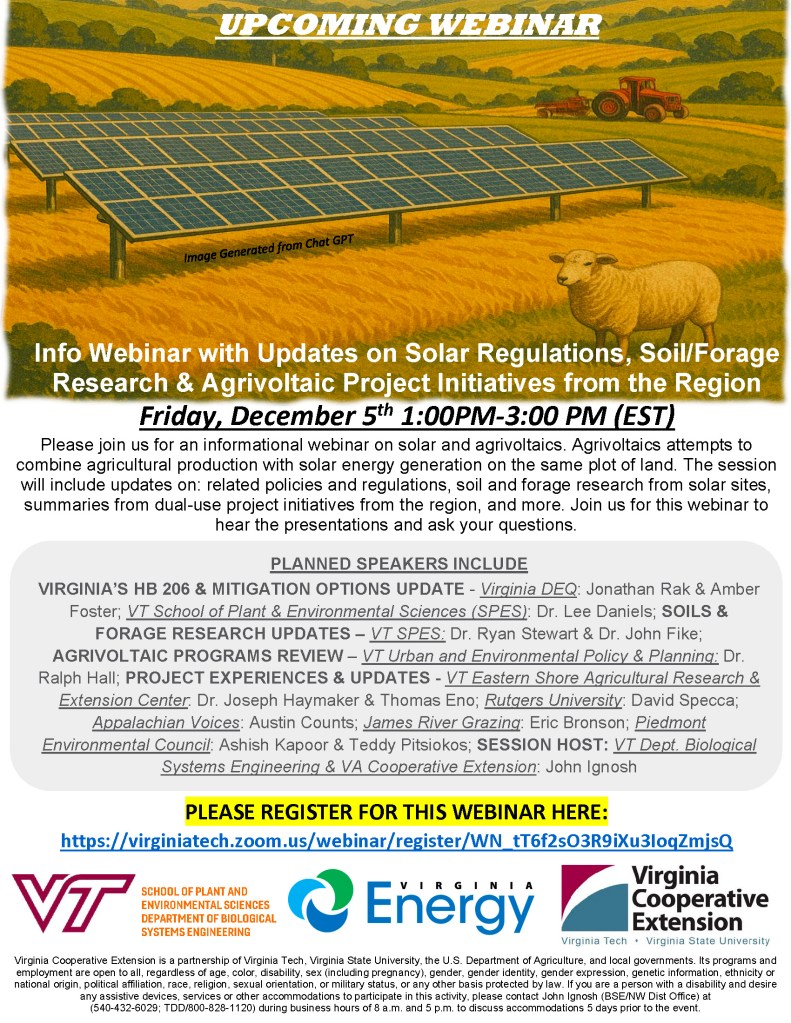
Please join us on Friday, December 5, 1:00–3:00 PM (EST) for an informational webinar exploring the intersection of agriculture and solar energy. Learn about:
Lessons from dual-use agrivoltaic projects
Solar policies & regulations affecting farmland
Soil & forage research on solar sites
Planned Speakers & Topics:
Virginia’s HB 206 & Mitigation Options Update: Jonathan Rak & Amber Foster (Virginia DEQ), Dr. Lee Daniels (VT SPES)
Soils & Forage Research Updates: Dr. Ryan Stewart & Dr. John Fike (VT SPES)
Agrivoltaic Programs Review: Dr. Ralph Hall (VT Urban and Environmental Policy & Planning)
Project Experiences & Updates: Dr. Joseph Haymaker & Thomas Eno (VT Eastern Shore Agricultural Research & Extension Center), David Specca (Rutgers University), Austin Counts (Appalachian Voices), Eric Bronson (James River Grazing), Ashish Kapoor & Teddy Pitsiokos (Piedmont Environmental Council)
The session will be recorded, and a link to the recording will be shared with all registrants.
This is a great opportunity for farmers, researchers, policymakers, and anyone interested in sustainable energy and agriculture to learn, connect, and explore new approaches in the rapidly evolving field of agrivoltaics.
Please share this announcement with colleagues or friends who may be interested in the topic.
The Center for European and Transatlantic Studies (CEUTS) will hold the next installment of its Ambassador Series on December 2, 2025, at 4:00 PM (EST). Please join us to hear Ambassador Stig P. Piras, the Deputy Chief of Mission at the Embassy of Denmark in the United States, discuss the EU Presidency, Denmark–U.S. relations, and transatlantic relations.
Opening remarks will be provided by Prof. Besnik Pula, Associate Professor in the Department of Political Science at Virginia Tech. After the talk, participants will have an opportunity to engage with Ambassador Piras through a moderated Q&A.
The online event is open to everyone! Register here.
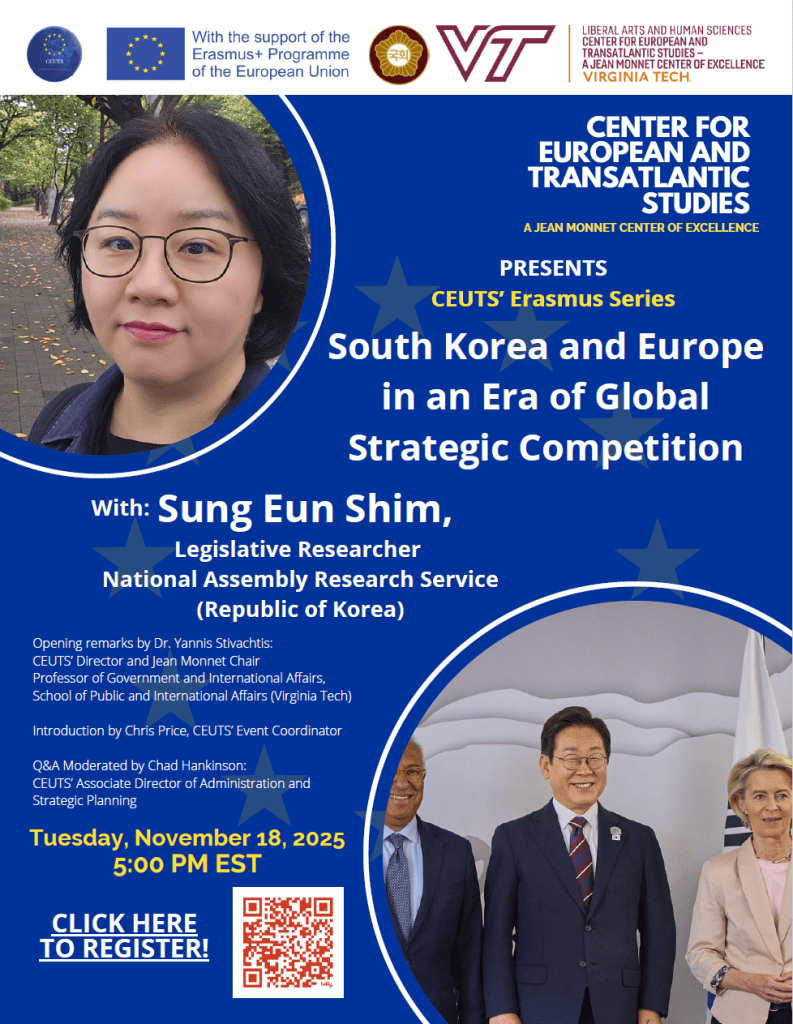
Our guest speaker will be Sung Eun Shim, a legislative researcher with the National Assembly Research Service of the Republic of Korea, who will deliver a lecture titled: “South Korea and Europe in an Era of Global Strategic Competition.”
The Zoom talk is open to everyone. Please register here.
This new initiative offers Virginia Tech early- and mid-career faculty a unique opportunity to:
Advance their research in close collaboration with one of the Smart Healthcare Hub teams.
Receive mentorship from senior faculty across CFWPP and the SHH.
Access cutting-edge research infrastructure accessible to the SHH at the Virginia Tech–Carilion School of Medicine in Roanoke.
Contribute to shaping the future of healthcare work and technology.
The Smart Healthcare Hub is advancing research at the intersection of healthcare, technology, and human-centered systems, with focus areas in:
AI as a tool for human-centered healthcare delivery
Healthcare data privacy and cybersecurity
Immersive simulation and gaming as a tool for clinical training and patient learning
The development of a Naturalistic Clinical Interaction Database (NCID)
Aligned with these themes, the CFWPP brings together technology, design, policy, and economics to explore the future of work, workplaces, and processes, with an emphasis on workforce development, responsible use of technology at work, and sustainable, health-focused work environments.
Formal engagement with SHH research teams and CFWPP leadership
Engagement in the 2026 AI and Health Conference at Virginia Tech’s Academic Building One in Alexandria
Support to pursue external funding and expand research impact
Eligibility & Application
The program seeks early- and mid-career Virginia Tech faculty eager to apply their disciplinary expertise to healthcare and the future of work. Priority will be given to proposals with strong potential for external funding, scholarly recognition, and broader impact. Applicants must submit:
The application portal for the 2025 Educators Conference is now open! The theme of this year’s conference is European Connections: The Interwoven Histories of European and American Governance.
The conference is organized by the Center for European and Transatlantic Studies (CEUTS) and the Bill of Rights Institute (BRI) and will run from November 7–9, 2025. The conference will enable high school teachers to learn about the deep historical and contemporary ties that shape transatlantic relations. Topics will include:
U.S. Government & European Influences (1700s–1945) – Explore how European ideas shaped American constitutional principles and how the U.S. government in turn influenced European political development.
The Cold War Era – Trace the shifting role of U.S. institutions during the Cold War and examine Europe’s response and evolving relationship with the United States.
Transatlantic Relations Today – Discuss how U.S.–EU cooperation and challenges shape global democracy, security, and values.
The conference will also provide opportunities for teacher feedback, collaboration, and reflection, ensuring participants leave with strategies to connect U.S.–EU history and contemporary relations to their classrooms.
Register by 11:59 p.m., September 30, 2025. Applicants will be notified of acceptance by CEUTS and BRI in the first week of October.
The motivation for the 2024 agrivoltaics summit stemmed from Virginia’s growing need to balance the conservation of agricultural land with the rapid expansion of renewable energy, particularly solar power. As land-use conflicts, economic pressures on rural communities, and the need for climate resilience intensify, agrivoltaics offers a promising solution by enabling the dual-use of land for both farming and solar energy production. The agrivoltaics summit aimed to define strategies for collaboration between industry and state agencies to support agrivoltaics during the renewable energy transition, explore opportunities and challenges from diverse perspectives, and establish a network dedicated to evaluating and advancing agrivoltaics opportunities relevant to Virginia stakeholders.
KEY FINDINGS
Farmers are open to agrivoltaics but stress the importance of balancing solar development with protecting prime agricultural land and maintaining long-term farming viability.
Early community engagement and overcoming regulatory hurdles are key to successful solar projects, with long-term benefits expected from environmentally responsible, community-focused designs.
Utility companies face challenges with grid connection for solar projects but see opportunities for collaboration with local communities to support renewable energy integration.
Clear policies, financial incentives, and collaboration among stakeholders are essential to protect farmland while promoting the sustainable development of agrivoltaics in Virginia.
Acknowledgements: This research was supported by a grant from the 4-VA program.
Recommended citation: CAIA, CFWPP, & PEC (2025). Advancing Agrivolatics in Virginia. College of Agriculture and Life Sciences, Virginia Tech, Blacksburg.
This course is designed for students in Grades 9–12. No prior experience in coding or artificial intelligence is required—just bring your curiosity and enthusiasm.
Win a Scholarship! Essay Contest for VA Students
Virginia high school students in grades 9-11 are invited to participate in an essay contest exploring AI’s future!
Theme: How AI is shaping society, education, work, or ethics
Length: 800-1,000 words
Prize: Five (5) winners will receive a full scholarship to this summer school!
Understand how generative AI works – from neural networks to transformers like GPT and DALL·E.
Create content with AI tools – use platforms like ChatGPT, Midjourney, and Llama to write stories, design graphics, and generate music.
Analyze ethical and social implications – explore bias, misinformation, creativity, authorship, and responsible AI use.
Develop your own AI mini-project – pitch and present a creative application of generative AI to solve a real-world problem or express a unique idea.
Build foundational knowledge in machine learning concepts like training data, model outputs, and prompt engineering.
Agenda/Schedule (July, 2025)
Week 1: Foundations of Machine Learning and AI Session 1: Introduction to AI and Machine Learning Session 2: How Machines Learn Session 3: Data in Machine Learning Session 4: Machine Learning with AWS Session 5: Building Our First ML Model
Week 2: Generative AI and more Session 6: Introduction to Generative AI Session 7: Neural Networks and Deep Learning Session 8: Natural Language Processing (NLP) Session 9: Ethics and Societal Impact of AI Session 10: Capstone Project and Showcase
Prerequisites: Curious, open to learning, comfortable with basic use of computers.








 Ralph P Hall