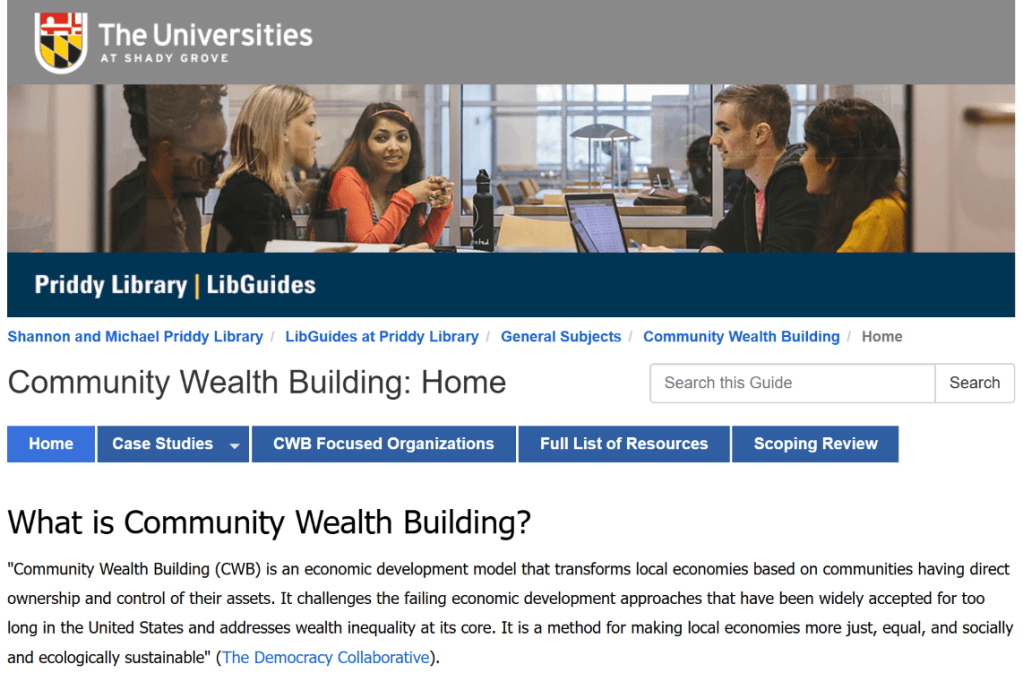
Community Wealth Building LibGuide

After a year of work, I’m pleased to announce the release of our Community Wealth Building (CWB) LibGuide (Library Guide). 
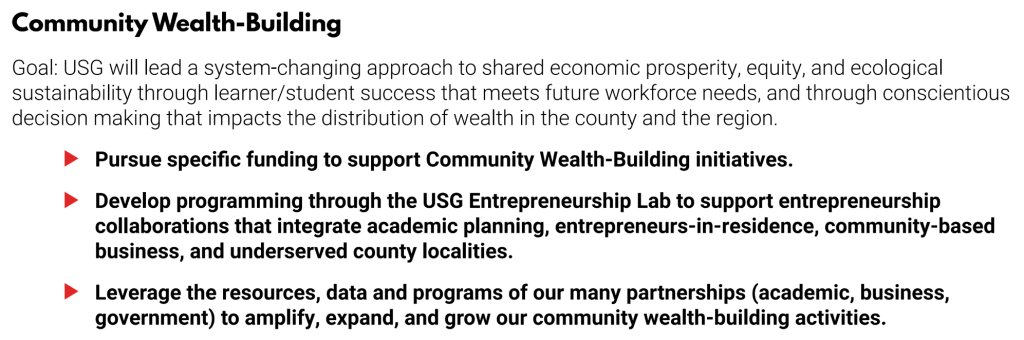
During my 2025-2026 research leave, I had the pleasure of working with the leadership of the Universities at Shady Grove (USG) in Montgomery County, Maryland. A primary objective of this placement was to help USG identify ways to advance its CWB strategic goal (below). [As an aside, USG is perhaps the only academic institution in the world – please correct me if I’m wrong – that has made advancing CWB a central part of its strategic mission. Other institutions that have centers, courses, or offices advancing CWB include the University of Central Lancashire, University of Illinois ChicagoUniversity of Birmingham, Washington University in St. Louis, New York University (course), Metropolitan State University, and University of Maryland, Baltimore, among others.]
Given USG’s strategic commitment to CWB, we decided that creating a resource on the topic for faculty, students, and partners would be essential to advancing the idea. The initial plan was to write an academic scoping review, but after working with the Priddy Library we decided that turning the scoping review into a library guide (LibGiude) would be more useful in the near term. The scoping review paper will come later. 

During the development of the LibGiude, we were fortunate to engage with members of The Democracy Collaborative’s Global Academic Research Network (GARN) who provided advice on how to structure the content for ease of access. One outcome of this engagement has been the creation of CWB case study pages documenting what has been happening in Cleveland (US), Preston (UK), Scotland (that just passed the first national CBW law), the UK (in general), and Northern Ireland. We are also tracking the emergent literature on CWB in Chicago and Richmond. In addition, the LibGuide captures the government entities, place-based organizations, and anchor collaboratives working to advance CWB. Please let me know who we have missed. 

The CWB LibGiude is a live site and will be updated as new content is published and from feedback we receive from CWB academics and actors. 

Finally, we decided to include an embedded spreadsheet that contains all of the material we have identified. This spreadsheet will be continually updated and can be downloaded by anyone interested in reading broadly on the topic. 

We (Franklin Ofsthun, Jaini Jogani, Sarah McKinley, and I) hope the CWB LibGuide is of value and would be happy to engage with anyone interested in learning more about the topic and website. 
2026 Ecological Economics Summer Schools and Conference

If you are a PhD student, postdoc/early-career scholar, or practitioner who is interested in sustainability, ecological economics, and macroeconomic transformations, please take a look at the following opportunities.

Where: Pisa, Italy

This summer school – now in its 5th year – is designed for PhD and post-doc students. In special cases, master’s and bachelor’s students may also be eligible. A maximum of 60 participants will be admitted.

The summer school is full-time and involves approximately 23 hours of class attendance and 52 hours of individual study. After completing the final exam, on Saturday 11 July, students will recieve 3 ECTS (European Credit Transfer and Accumulation System).

FACULTY

  • Keynote lecture: Giulia Romano (Università di Pisa)
  • Mario Biggeri (University of Florence, ITA)
  • Leonardo Boncinelli (University of Florence, ITA)
  • David Cano (University of Pisa, ITA)
  • Simone D’Alessandro (University of Pisa, ITA)
  • Tiziano Distefano (University of Florence, ITA)
  • Elisa Giuliani, Vice-Rector for Sustainability and the 2030 Agenda – Università di Pisa
  • Ralph Hall, (Virginia Tech, USA)
  • Tommaso Luzzati, (University of Pisa, ITA)
  • Igor Matutinovic, Zagreb School of Economics and Management
  • Emilio Padilla Rosa, Universitat Autonoma Barcelona
  • J. Christopher Proctor, Bocconi University – Institute for European Policymaking
  • Marcela Villarreal, former Director of the Partnerships and UN Collaboration Division at the Food and Agriculture Organization of the United Nations (FAO)

Learn more and apply here.

When: September 7-9, 2026

Where: Florence, Italy

This summer school offers an intensive introduction to Ecological Macroeconomics, with a special focus on its relevance for the Global South. Participants will receive a solid grounding in the foundations of Ecological Economics and Post-Keynesian Macroeconomics, and will learn key modelling approaches used to analyse sustainability transitions in diverse socio-economic contexts.

The programme covers Input–Output analysis, Stock-Flow Consistent modelling, and System Dynamics, providing participants with the conceptual and technical tools needed to explore the interactions between economic structures, environmental constraints, and social outcomes. A core component of the school is hands-on training on how to build Integrated Assessment Models (IAMs) that incorporate biophysical limits, distributional dynamics, inequality, and policy scenarios.

Participants will work through practical modelling labs using Vensim and R, enabling them to implement dynamic models, run simulations, and analyse alternative development pathways. The school aims to equip a new generation of researchers—especially from and for the Global South—with state-of-the-art modelling skills to address climate, energy, and development challenges.

FACULTY

  • Tiziano Distefano (University of Florence, ITA)
  • Simone D’Alessandro (University of Pisa, ITA)
  • Guilherme Morlin (University of Pisa, ITA)
  • David An (University of Florence, ITA)
  • Vinicius Centeno (University of Florence, ITA)

Learn more and apply here.

When: September 10-12, 2026

Where: Florence, Italy

Ecological Macroeconomics is an emerging field at the intersection of macroeconomics, ecological economics, and complexity science. It develops modelling frameworks that embed economies within biophysical limits, explicitly address inequality and social justice, and explore de- and post-growth futures through scenario analysis rather than optimisation.

This inaugural international conference aims to bring together scholars, early-career researchers, students, and practitioners working on ecological macroeconomic theory and modelling, with a particular interest in applications to the Global South and policy design for a just transition.

Learn more and apply here.

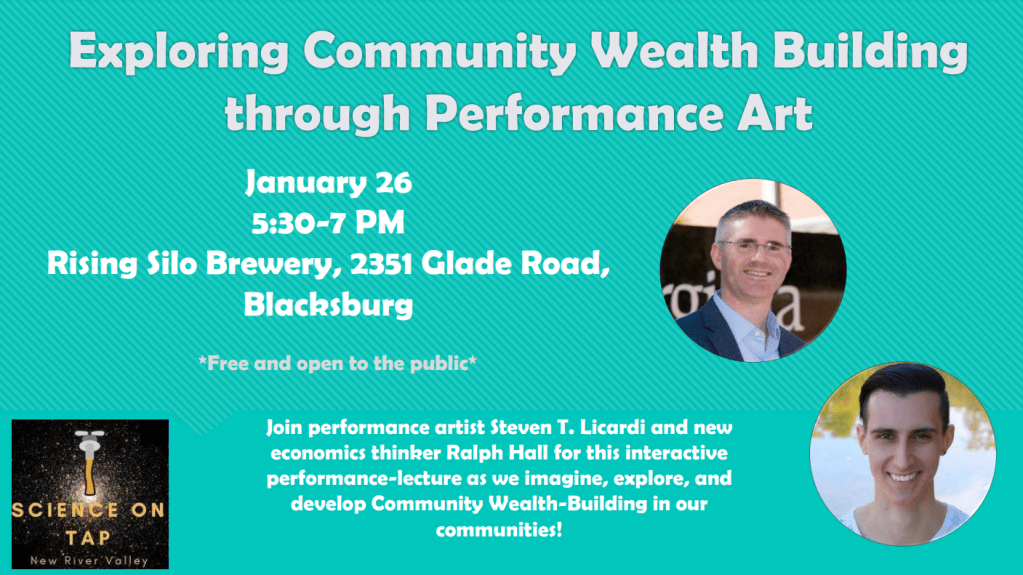
Science on Tap – Community Wealth Building

For many, our current economic models no longer ensure our basic human needs are met. However, other worlds are possible, but we can’t create those worlds without you. Please join performance artist Steven T. Licardi and I on Wednesday, January 26, from 5:30 – 7:00pm at the Rising Silo, for an interactive performance-lecture that imagines, explores, and develops a vision of Community Wealth-Building in our community.