Future of Library Space + Open Textbooks

This afternoon I attended the fourth meeting of the Dean’s Advisory Committee (DAC) for University Libraries at Virginia Tech. During this session the DAC members discussed the future of library spaces (focusing mainly on physical environments) and the type of data/information discovery and user experiences that could support research and teaching. What is evident from these discussions is the significant transformations that are underway in libraries around the world and specifically at Virginia Tech. The library experience in the coming decade is likely to be radically different – both from a physical and virtual environment perspective – to what it was a decade ago.

During the meeting, David Ernst (University of Minnesota) and Anita Walz (Virginia Tech) provided an informative discussion on the growing field of Open Textbooks. The slideshow below includes a number of images from their presentation, which outline the need for open textbooks.

This slideshow requires JavaScript.

Congratulations Yehyun An!

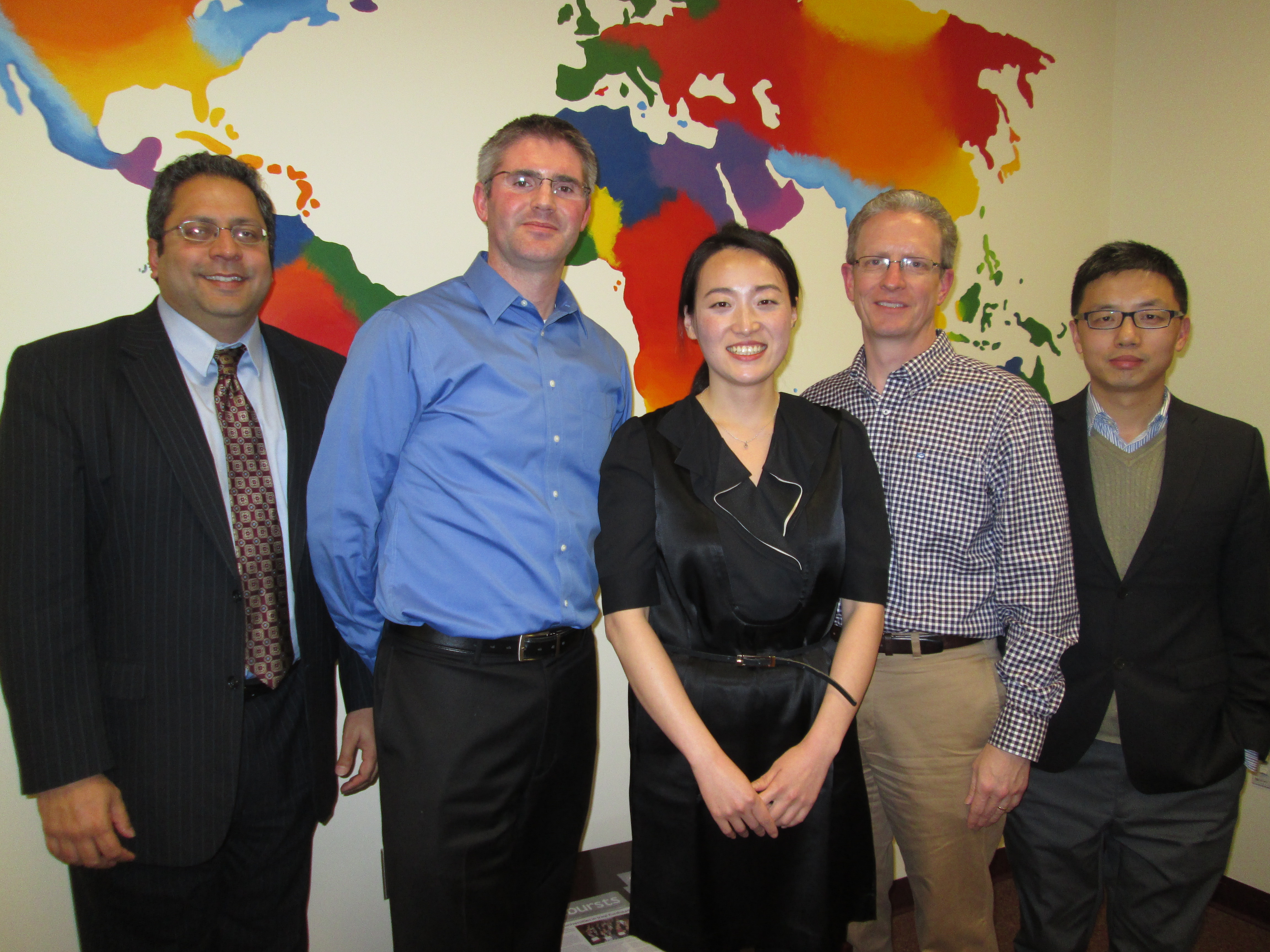
On February 24, Yehyun An successfully defended her dissertation entitled “The Operationalization of Capacity Development: The Case of Urban Infrastructure Projects in India.”

Yehyun was a doctoral candidate in the Planning, Governance, and Globalization (PGG) program at Virginia Tech, and over the past several years has been a highly valued graduate research assistant in the IITK-VT partnership on Sustainable Infrastructure Development.

IMG_1643
Guru Ghosh, Ralph Hall, Yehyun An, Michael Garvin, and Yang Zhang

Yehyun’s research explores the concept of capacity development (CD) in the context of a large urban infrastructure program in India – the Jawaharlal Nehru National Urban Renewal Mission (JNNURM). Her research utilized a unique combination of qualitative and quantitative methods and (I believe) is the first application of fuzzy-set Qualitative Comparative Analysis (fsQCA) in the field of CD.  The findings from Yehyun’s research make important contributions to both CD theory and practice. I have included the abstract of Yehyun’s dissertation below for those interested in reading more about her research.

ABSTRACT

Since the 1950s, Capacity Development (CD) has been an important component of international development agendas. It established the widespread consensus that the capacity of individuals and organizations is critical to maintaining and enhancing the effectiveness of development projects and programs. A problem, however, is that the concept has been applied without due consideration to how it should be adapted to the local context, making it more of a symbolic gesture. The application of CD to urban infrastructure projects in India is one such example. Recognizing the shortage of urban infrastructure as one of the major impediments in India’s economic growth and rapid urbanization, the Government of India (GOI) launched the Jawaharlal Nehru National Urban Renewal Mission (JNNURM) in December 2005 to provide substantial central financial assistance to cities for urban development over a period of seven years. The GOI expected the JNNURM to reform institutions and strengthen human resource capability related to many areas of project delivery. During its implementation, however, the JNNURM has been confronted by problems related to a lack of capacity. This research reviews the capacity challenges related to the JNNURM program and considers the broader implications for urban infrastructure development in other developing countries.

This research begins with the question “How can CD be operationalized?” From this starting point, the research seeks to reveal the operational values of CD. Following a detailed literature review on CD, capacity factors that are applicable to the urban sector in India are identified and a CD framework is developed. Two research methods – case studies and fuzzy-set Qualitative Comparative Analysis (fsQCA) – are adopted to answer the primary research questions. By leveraging the strength of these two methods, this research advances our understanding of the relationship between capacity and development goals such as improving project performance. In the case studies, this research investigates the gaps between CD theory and practice through the lens of practitioner perceptions of CD. In addition, unlike traditional thinking on the linear relationship between capacity and project outcomes, the case studies reveal two-way causal relationships between capacity and project outcomes that form a spiral structure between the project delivery process and capacity factors. Better capacity can enhance project performance and lead to better outcomes, and project performance and outcomes also influence and reinforce capacity in the reverse direction. Moreover, through the fsQCA, this research identified causal relationships between capacity factors and outcomes and demonstrated that the capacity factors generate different outcomes through their interactions with other capacity factors. This finding contributes to our understanding of how capacity is interconnected with development goals.

In summary, this research contributes to both CD theory and CD practice based on a comprehensive approach that not only considers CD at multiple levels (environmental, organizational/network, and individual/project), but also covers different CD subjects such as context, actors, dimensions, processes, and impacts. Through this comprehensive approach, a range of important findings are developed that can help researchers and practitioners operationalize the complex concept of CD.

I served as the chair of Yehyun’s dissertation committee along with committee members Guru Ghosh, Michael Garvin, and Yang Zhang.

Innovation in Teaching Using Google Apps

This afternoon, I had the pleasure of talking with the PGG doctoral students about life as a faculty member and how I approach the design of my courses. In this post, I thought I’d capture some of the ideas we discussed about my overall approach to teaching.

My teaching philosophy is largely a product of my own learning and research experience. I believe students should be encouraged to think—and approach problems—in an integrative and transdisciplinary manner. I believe that teaching innovation occurs through a process of creative destruction, where new ideas and ways of learning continually challenge, replace, or enhance the old. The challenge, though, is knowing when something is working and why. Thus, evaluating how I can improve my teaching and mentoring of students is a central part of my philosophy.

In 2013, I was invited to become a Google Glass Explorer, which had a profound impact on how I approach my teaching and interact with students. Prior to Glass, my engagement with students was structured, perhaps ‘constrained,’ by the VT Scholar [course management] system and by my scheduled class time with students. I believe the ability to ‘recycle’ my courses in Scholar had the effect of dampening my enthusiasm to radically revise each course. I became aware of this after making the transition to delivering all of my courses using various combinations of VT Google Apps. The ease at which an entire course can be created in Google Drive and changed while in progress is liberating. Students can also take control of the course platform and share information either via a public or private Google+ Community or in a shared Google Drive folder. This process enables students to take ownership of their learning and become teachers in the process. This enables me to focus less on identifying and mastering content, and more on helping students interpret and locate new information, ideas, and theories in their own learning frameworks or value systems.

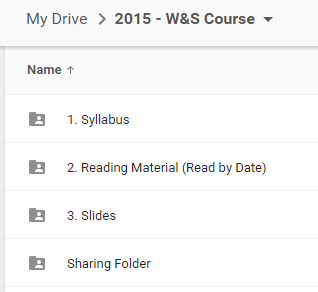
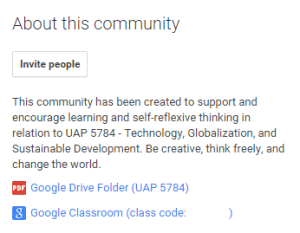
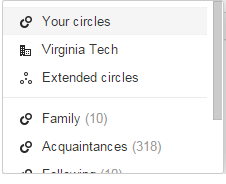
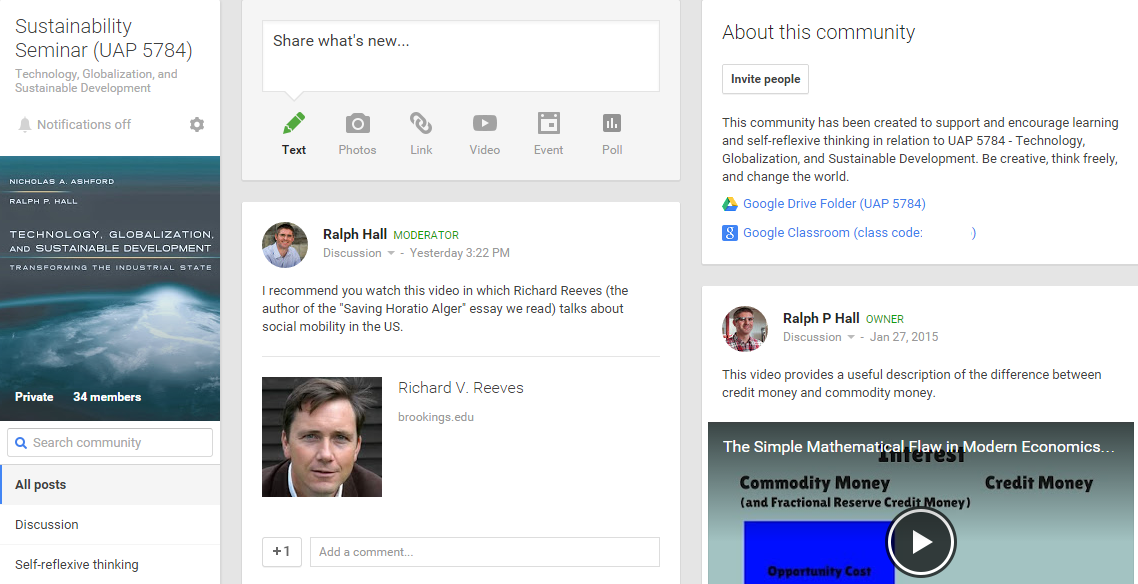
I now build each of my courses around a shared Google Drive folder and a public or private Google+ Community. I’d recommend using a private community so that links to course-related Apps can be embedded in the community (see the top right corner of the image below). All assignments are managed via Google Classroom. Course communication happens primarily in a Google+ Community or via messages I send from my Google+ account to a Google Circle created for each course. [Note to Google – it would be useful if I could also send these message directly from my VT gmail account.] The Google Circles are important since they enable me to quickly identify specific students when in YouTube so I can send them private assignment-feedback videos. Whereas I used to record these videos using Google Glass, I recently made the transition to Snagit, which enables me to capture my computer screen while providing audio feedback on a student’s assignment. After recording a video (1 to 5 minutes in length), I directly upload it to YouTube from Snagit, making sure the video has a clear label and is set to ‘private.’ From YouTube, I privately share the feedback video with each student. After viewing the video, students are able to send me private comments on my feedback (in Google+/YouTube), which creates a two way dialogue rather than a one way conveyance of information. Since January 2014, I have recorded well over 100 assignment-feedback videos that have been sent to students in six different courses. I am currently working with Mary English to evaluate the impact of this feedback and we plan to publish the results of this research later this year.
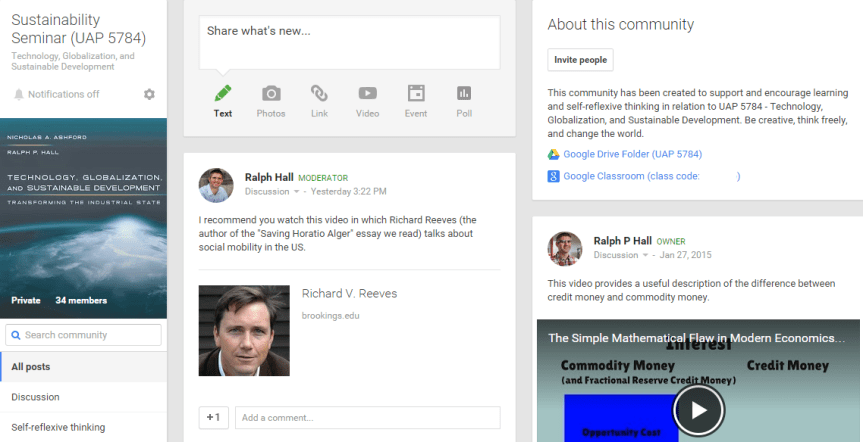
Google-Community

A benefit of the Google Apps platform is that it enables the sharing of information from any device at any time of day. I believe learning can occur at any moment, such as when riding the bus or a bike, taking a walk, or even sitting in one of my colleague’s classes! Having a platform that enables students to engage from wherever they are is important. The Google+ community is the medium where students can link the theories/ideas we discuss in the classroom to real-world events. This process deepens their understanding of the material and may result in better long-term retention due to the networked nature of the conversation and information.

As should be evident from the above description, the suite of Google Apps I’m using has ‘freed’ my approach to teaching that is now more fluid and flexible. However, now that I have complete control over my courses, I also need to manage the enrolment/disenrollment of students from each course. While this process can be a little challenging, once the Apps have been mastered the process is relatively straightforward. The autonomy of the platform has enabled me to explore the idea of letting students be a lifelong member of a course, which I am trying in my sustainability class. My hope is that as students progress through their professional careers, they will re-engage with the course when they have something to contribute or if they want to refresh or update their knowledge. This approach to delivering a course could advance a learning model that is truly lifelong.

In summary, my experience with using Google Apps has led to one significant realization. The systems we use to support our teaching can either enable or inhibit innovation in teaching. Those systems that can be easily integrated and adapted are likely to survive, whereas those that constrain creatively are likely to stifle innovation in teaching. While Google Apps are not perfect, their flexibility and ease of use means that it is more difficult to become locked-in to a system or way of delivering a course. I have full autonomy over how I administer, structure, and approach my courses, which I believe is the key to teaching innovation.

VT Assessment Showcase (Feb 9-13)

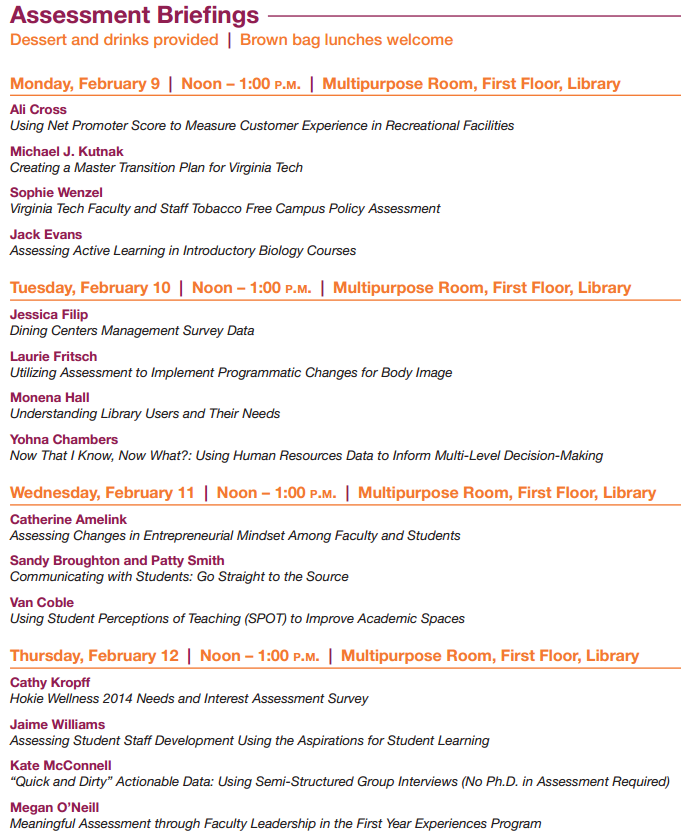
This afternoon I attended the first of five “Live Assessment Briefings” that will be held this week as part of the Virginia Tech Assessment Showcase. This inaugural event features successful assessment and evaluation initiatives from across the university. Today’s assessment briefing included the following talks (the image below provides a summary of the remaining four sessions):

  • Catherine Amelink20 – Assessing Changes in Entrepreneurial Mindset Among Faculty and Students.
  • Michael J. Kutnak – Creating a Master Transition Plan for Virginia Tech.
  • Sophie Wenzel – Virginia Tech Faculty and Staff Tobacco Free Campus Policy Assessment.
  • Jack Evans – Assessing Active Learning in Introductory Biology Courses.

Given my interest in using Google Apps to support teaching, I found the talk by Jack Evans on the ‘flipped classroom’ model being advanced for their freshman Biology Course of particular interest. I believe there is an opportunity to leverage different Google Apps to support their new model of student engagement/learning and reduce the burden of administering the class via the VT Scholar system. In particular, I believe Google Drive, a (private) Google+ Community, Google+ Circles, Google Docs (for co-creating work), and Google Classroom (to administer assignments) could be set-up as an integrated platform for the ‘flipped classroom.’ I also believe Apps like ParticiPoll could be used effectively for in-class polling (or quizzes), which would replace the current use of clickers. Other Apps like Splashtop could also be an effective way to enable instructors to control their laptops remotely from an iPAD, tablet, or smartphone. I plan to follow-up with Jack’s team in the near future to discuss these ideas and to learn more about their teaching model. I also plan to develop a wishlist of Google Apps functions that could enhance the use of this platform in a teaching environment. I’ll post the list here when its ready.

Posters from the Assessment Showcase speakers will be on display all week in Newman Library with a live “popcorn and posters” session on February 13 from noon – 2:00 p.m. I encourage anyone on campus to drop by the event to learn more about the various assessment activities that are underway at the university.

The photos below were taken during the event using Google Glass.

This slideshow requires JavaScript.

UAP Wins Exemplary Program Award

This evening, the Urban Affairs and Planning (UAP) program received Virginia Tech’s Exemplary Program Award. The three other award recipients were the Department of Chemistry in the College of Science, the Department of Psychology also in the College of Science, and  VT Engage in the Division of Student Affairs.

The 2014 award focused on recognizing groups that are developing and sustaining innovative and effective departmental approaches to fostering Ut Prosim (That I May Serve) at the undergraduate or graduate level.

I have posted a few pictures from the event below, along with a video I took through Glass of Diane Zahm receiving the award on behalf of UAP.

This slideshow requires JavaScript.

Advice to MURP and PGG Applicants

The Urban Affairs and Planning (UAP) program is looking to fill two doctoral level research assistantships in the Planning, Governance, and Globalization (PGG) Ph.D. program and one master’s level graduate research assistantship in the Master of Urban and Regional Planning (MURP) program beginning Fall 2015. We are especially interested in receiving applications from minority and first generation college students.

If you would like to apply for either of these opportunities, I encourage you to carefully review the UAP Research Needs Statement to identify the subject area and faculty with whom you would like to work. Please include this information in the personal statement submitted with your application.

2015-01-26_0920

DAC Discussion of Research and Teaching

During the third meeting of the Dean’s Advisory Committee (DAC) for the University Libraries this morning, VT faculty and staff engaged in a productive discussion of research and teaching practices at the university. The focus of the conversation was on how university libraries could support emergent trends in areas such as the measurement of research impact, the communication of scholarly material, and teaching/learning environments. The (slightly blurred) images below (taken through Glass) capture the main questions the working groups were asked to explore during the 1.5 hour session.

12

For me, the value of the DAC meetings is the exposure I have to the broad variety of research and teaching approaches that are used by faculty at VT. A key challenge facing the university (and especially university libraries) is how to support innovative approaches while ensuring the traditional models of research, teaching, and engagement are supported.

A lingering question I have is how to advance VT’s “hands on, minds on” vision via the platforms I use to support my classes. My use of Google Glass and Apps has enabled the fluid sharing of information among class participants (and with the public in some cases). It is also allowing me to provide personalized (and private) video feedback on assignments to students via YouTube. The deeper question is whether or how this platform can help me advance the “hands on, minds on” vision. In some courses it can be difficult to find ways to provide hands on experience – e.g., think about international development courses where it is not feasible to take students overseas – but technology can be leveraged to close the distance gap. This evening I plan to take part in a Twitter conversation with VT students and the author of the Crisis Caravan (see below). Such opportunities provide new ways for students to engage with professionals and the general public. While not “hands on” in the traditional sense, there are certainly aspects of this engagement process that require students to demonstrate their social media skills (=hands on) and mastery of the subject matter (=minds on).

2014-11-03_1216

SPIA Conference on Resilience

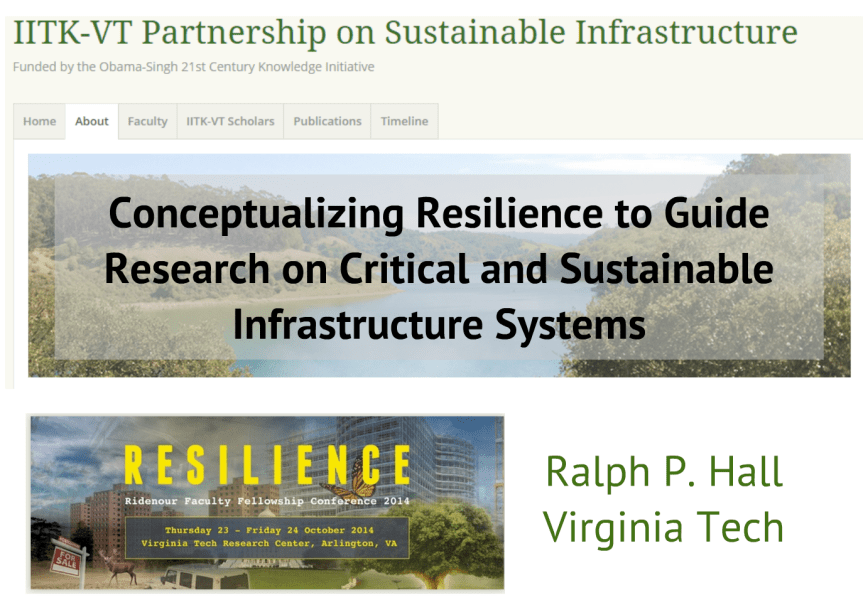
This Friday, I will be giving a presentation about the IITK-VT Partnership on Sustainable Infrastructure at Virginia Tech’s School of Public and International Affairs (SPIA) conference on resilience. The two-day conference (23-24 October) will be held at Virginia Tech’s Research Center in Arlington, Virginia. The conference can be followed on Twitter using #VTSPIA.

2014-10-22_1559


“Experience VT” Through Glass

This morning, Emily Van Houweling and I presented the results from the impact evaluation our team undertook of an MCC-funded rural water supply project in Nampula, Mozambique, at the “Experience Virginia Tech: Learn, Explore, Engage” event. During the event, I recorded (using Glass) a number of the presenters talking about their research and work at the university. The video below captures these comments and provides some insight into the breadth and depth of research that is underway at Virginia Tech.

MCC Impact Evaluation – Final Report

Nampula_ReportI am pleased to announce the release of the final report of our impact evaluation of the MCC-funded Rural Water Supply Activity (RWSA) in Nampula, Mozambique. This peer-reviewed report provides a comprehensive discussion of the RWSA interventions, our research design, analysis approach, major findings, and the policy implications that emerged from this work.

The report can be downloaded from the MCC’s Open Data portal. This portal also provides access to the main surveying instruments and the raw data collected from the baseline (2011) and follow-up (2013) household surveys.