Professor, Urban and Environmental Policy and Planning (UEPP), Virginia Tech; Joann Boughman Innovation Fellow at USG; Acting Director, Center for Future of Work Places and Practices (CFWPP); Head of Outreach and Engagement, Center for European and Transatlantic Studies (CEUTS)
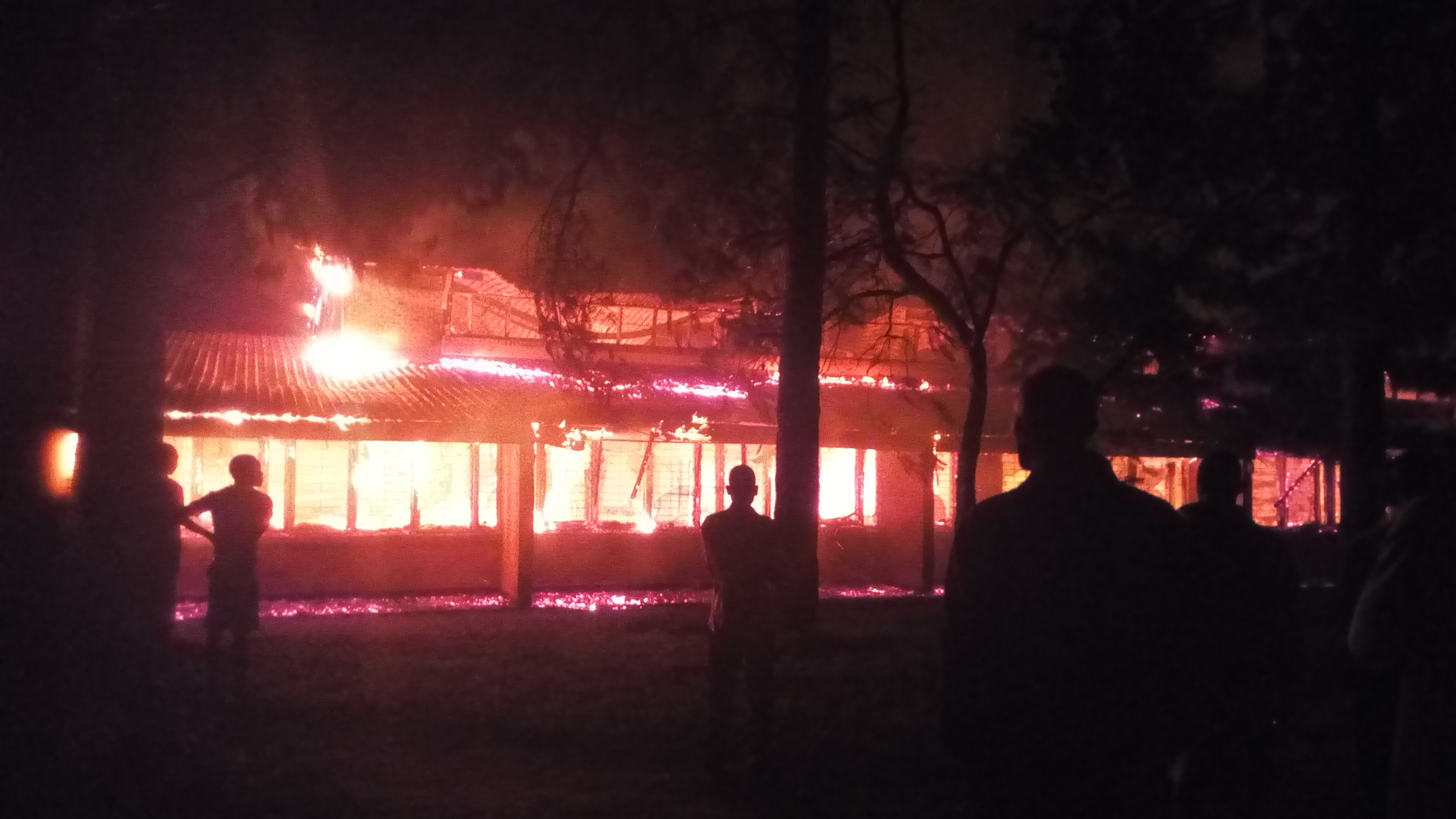
Following the devastating library fire at Mzuzu University, several people and organizations have contacted me in relation to how they can help support the effort of rebuilding the university’s library. In the past week, I was forwarded an email from Hayden Boyd, the President of the Malawi Education and Children’s Welfare Foundation, that I outlines the donation process that Mzuzu University would like groups in the U.S. to follow. I have provided a copy of this email below for your reference.
Source: Dr. Mavuto Tembo
Hello to all,
Following the devastating fire that destroyed Mzuzu University’s library, many on this list have expressed concern and willingness to help. I was privileged to serve as a research professor and director of research at the University 2002-2005, and since returning to the USA I have noted its impressive growth in size, scope, and academic quality during regular visits. The loss of the University library is a terrible setback to this progress.
Vice Chancellor Robert Ridley has written me that, despite this loss, the University intends to keep to its academic calendar and open in January for distance learning students and in March for returning face-to-face students. They are working out an interim approach over the next 12 to 24 months, as they seek to get a new library built, plus a strategy to get funds for a new library. Clearly, much needs to be done.
Dr. Ridley has asked the Malawi Education and Children’s Welfare Foundation to serve as an institutional base to promote the University’s cause, receive funds and help the University coordinate support from the USA. The Foundation is a 501(c)3 tax exempt foundation established for the support of Mzuzu University and other educational and children’s welfare institutions in Malawi. Our Board of Directors have all lived and worked in Malawi and I serve as the Foundation’s president.
On behalf of Mzuzu University, I invite you to help support the library’s rebuilding. Checks may be made to “Malawi Education and Children’s Welfare Foundation,” with “Mzuzu University library” in the memo field, and sent to:
Malawi Education and Children’s Welfare Foundation 507 Delburg Street Davidson, NC 28036
All contributions to the Foundation are tax deductible under US law.One hundred percent of all donations are used for the designated purpose in Malawi, with never a deduction for administrative or overhead expenses.
Many also have suggested donating books, computers, or other items. I believe it would be wise to hold off on in-kind donations until the University informs us of its needs and logistical challenges can be addressed.
Thank you for your consideration.
Sincerely, Hayden Boyd
In a subsequent email from a colleague at Mzuzu University, I was informed that a Library Task Force committee has been created by the Vice Chancellor and University Librarian. This task force has asked each faculty member/department to develop a list of books that they would like to see included in a new library. The Library Task Force committee will liaise with the Malawi Education and Children’s Welfare Foundation as the point of contact in the U.S. I will post updates on this process as soon as I have them.
In the coming weeks, TEAM Malawi (a group of faculty and students at Virginia Tech and Radford University) will meet to discuss the actions we can take to help Mzuzu University recover from this loss. I will post information here on any activities that colleges, schools, departments, faculty, and/or students plan to undertake in the coming months.
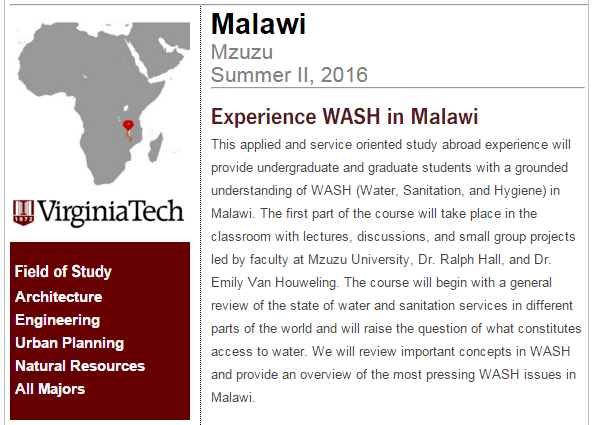
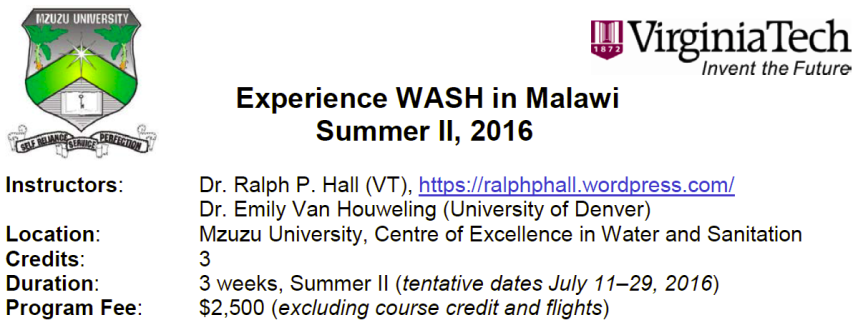
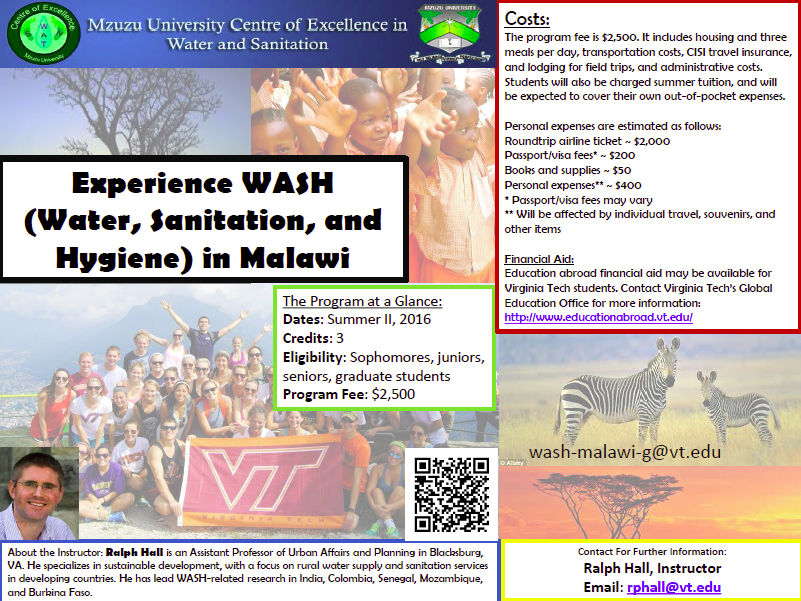
If you are a student at Virginia Tech, please consider applying to the Experience WASH in Malawi study abroad course. The course will run from July 11–29, 2016 (Summer II). The application deadline is February 1, 2016.
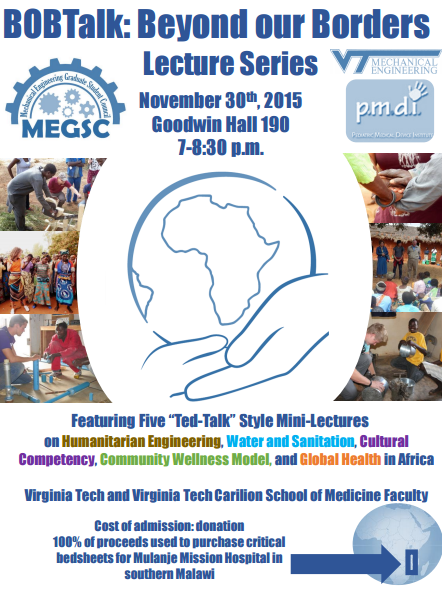
I look forward to giving a BOBTalkon November 30th to help raise funds for the Mulanje Mission in Malawi. The talks will be given in Goodwin Hall, room 190, from 7-8:30 p.m. Please come and join us if your are available.
On Monday, November 16, I will be holding two information sessions (at 9:30am and 3pm) on the “Experience WASH in Malawi” study abroad course I will be offering during the summer of 2016. The information sessions will be held in room 111 of the Architecture Annex(and via polycom in room 220, Prince Street, Alexandria, VA).
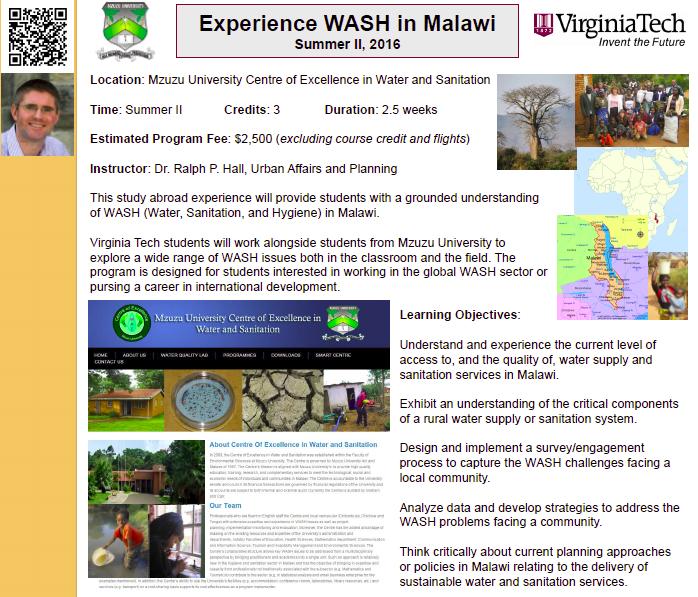
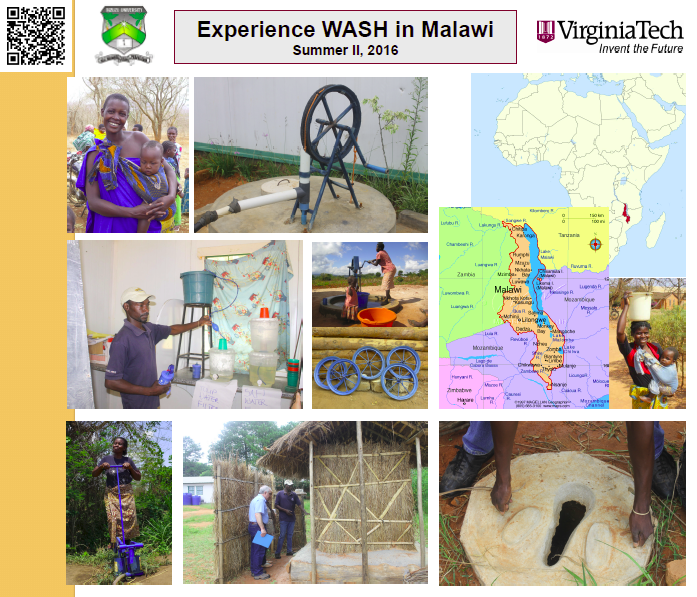
This applied and service oriented study abroad experience will provide undergraduate and graduate students with a grounded understanding of WASH (Water, Sanitation, and Hygiene) in Malawi. The first part of the course will take place in the classroom with lectures, discussions, and small group projects led by faculty at Mzuzu University, Dr. Emily Van Houweling, and I. The course will begin with a general review of the state of water and sanitation services in different parts of the world and will raise the question of what constitutes access to water. We will review important concepts in WASH and provide an overview of the most pressing WASH issues in Malawi. Following this introduction, students will study the design of relevant WASH technologies and educational programs from the perspective of public health, cultural appropriateness, and sustainability. Armed with an understanding of critical WASH issues and technologies, students will then undertake community-based fieldwork on a WASH-related problem in partnership with the Mzuzu University Centre of Excellence in Water and Sanitation.
A unique aspect of the course is that Virginia Tech and University of Denver students will work alongside students from Mzuzu University to explore a wide range of WASH issues both in the classroom and the field. This pairing of students will promote cultural exchange and enable discussions about ethics and power in the field of international development. The joint teaching model, combined student cohort, and experiential approach to learning will provide students from the U.S. and Malawi with a rich educational and cultural experience.
The course is designed for students interested in working in the global WASH sector or pursuing a career in international development.
If you are a Virginia Tech undergraduate or graduate, please come to the Drillfield today to learn about a new WASH (water, sanitation, and hygiene) course I will be offering during Summer II, 2016, in partnership with the Mzuzu University Centre of Excellence in Water and Sanitation.
To keep up to date on course news, please join the Google group.
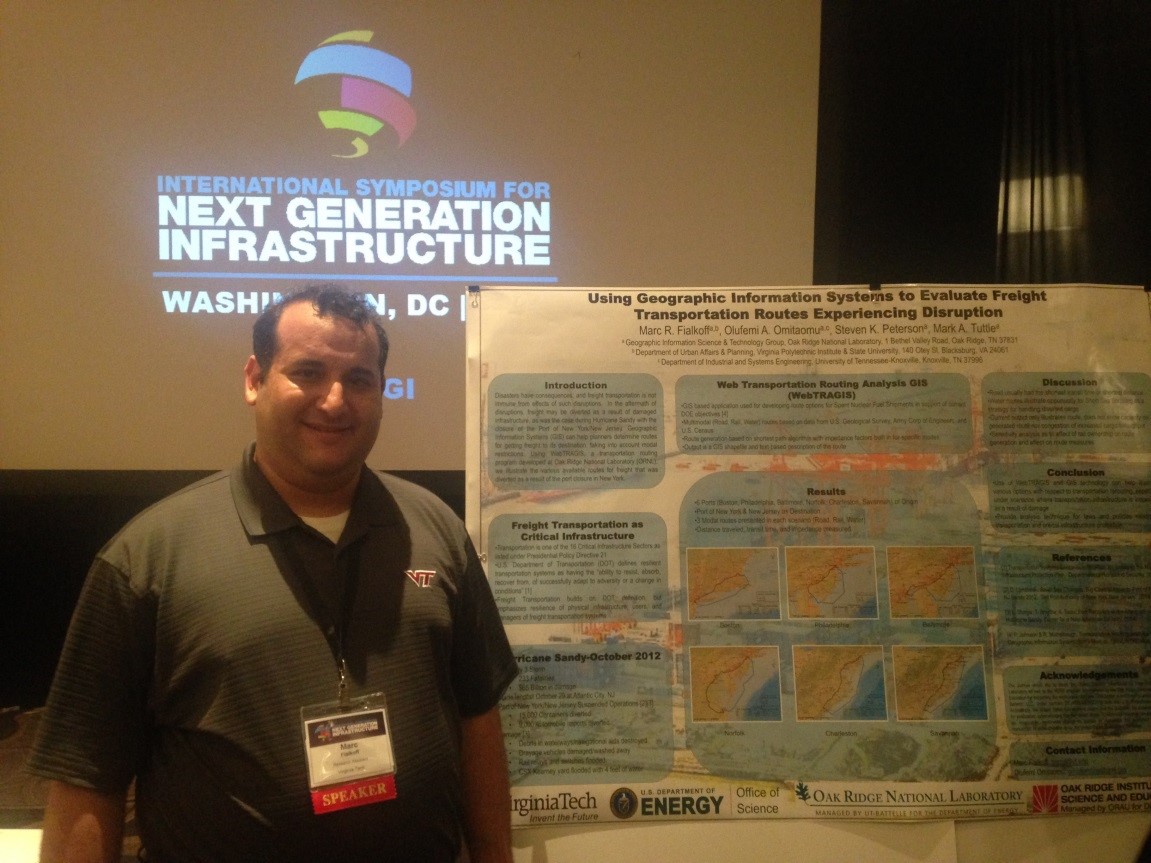
This past week, one of my PGG doctoral students, Marc Fialkoff, attended the International Symposium on Next Generation Infrastructure in Washington D.C. The conference brought together scholars from a variety of disciplines to discuss challenges in the areas of energy, transportation, water resources, and healthcare. The panel sessions focused on individual critical infrastructure sectors as well as techniques for modeling and implementing policies for more resilient infrastructure. Marc presented his work on freight transportation resilience and using GIS to evaluate legal restrictions on short sea shipping under disruptive conditions. This research was undertaken during his summer at Oak Ridge National Laboratory under guidance of Olufemi Omitaomu, the team lead for the Critical Infrastructure and Urban Resilience group at Oak Ridge National Lab.
Marc’s research provides a good example of the interdisciplinary work that is undertaken by students in the PGG program at Virginia Tech. With training in law and transportation planning, Marc’s research bridges disciplines of law, planning, civil engineering, and network analysis to explore the impact of law and policy on the movement of goods under a time of crisis – e.g., during Hurricane Sandy.
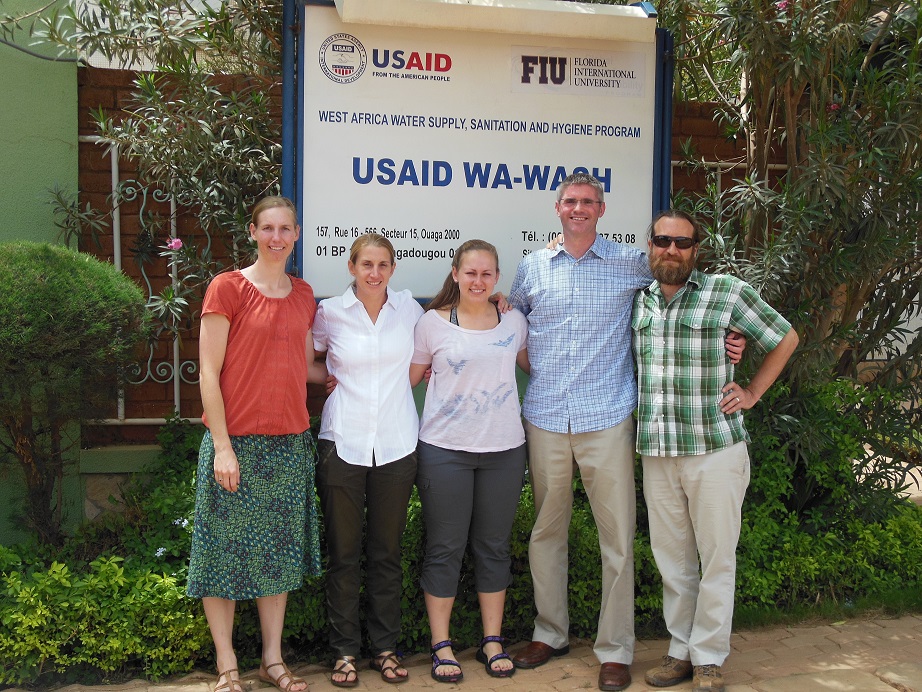
On Sunday, our research team – consisting of Emily Van Houweling, Sophie Wenzel, Nicholas Polys, Paige Williams, and I – arrived in Burkina Faso to study the water accounting process developed by Winrock International as part of their Multiple-Use Water Services (MUS) project. Our team will be here for two weeks, during which we will visit project communities and identify opportunities to further advance the water accounting process by drawing on the unique skill set of the research team.
Emily Van Houweling, Sophie Wenzel, Paige Williams, Ralph Hall, and Nicholas Polys
Winrock’s MUS project is one of several funded by the USAID WA-WASH (West Africa Water Supply, Sanitation, and Hygiene) Program. The WA-WASH program focuses on increasing sustainable access to safe water and sanitation and improved hygiene in Burkina Faso, Ghana, and Niger. The program is a complex endeavor that includes some thirteen partners and is led by Florida International University (FIU).
This year, 13 students took part in my International Development Planning Studio and developed 13 high-quality project proposals. The studio was supported a range of international development experts at Virginia Tech, who worked closely with the students to challenge and refine their ideas and help them develop the wide-range of skills needed to create an international development project proposal. I’d especially like to thank Bill Anderson,John Browder, Emily Van Houweling,Susan Marmagas,Kurt Richter,Kerry Redican,Keith Moore, James Foreman, Sophie Wenzel, andShantal Hoverfor the expertise they brought to the studio.
I have listed below the titles of the student proposals to provide an indication of the range of subjects that the students explored this semester.
Increasing Livelihood Opportunities and Productivity for Tuvalu’s Outer Islanders
Foundation of a Sanitary Pads Manufacturer in Makoko, Nigeria
The DTaP Project: Minimizing the incidence of Bordetella pertussis in Sokoto, Nigeria, through a vaccination and infectious disease education intervention
Addressing the High Incidence and Case-Fatality of Human Rabies in the Guntur District of Andhra Pradesh, India
Safe and Affordable Drinking Water in Santa María del Carbón, Honduras
Statelessness: Improving access to citizenship for stateless Dominicans of Haitian descent living in the Dominican Republic
Veron Mobile Clinic Project, Veron, Dominican Republic
Development Proposal to Reduce Iodine Deficiency in Nampula Province, Mozambique
HIV Prevention among Women in Addis Ababa, Ethiopia
Proposal for Addressing Poverty in the Department of Alta Verapaz, Guatemala
Scaling up sanitation demand in iganga district: A proposal for improved sanitation and hygiene
Improving the Access and Quality of Education in rural areas of China
Defensive Driver Education Program to Reduce Road Deaths in Georgetown, Guyana
The images below were taken during the last two studios when the students formally presented and defended their proposals to a panel of international development experts.
The video below provides a first-person view of the Virginia Tech 3.2-Mile Run in Remembrance that was held on Saturday, April 18, 2015. The video was taken using Google Glass.
On March 21-22, the IITK-VT partnership held a successful Workshop in Delhi, India, to launch the Initiative for Construction Safety Awareness (ICONSA-15). We have uploaded a series of photos from the event to the ICONSA website and have posted the presentations that were given by the participants. These items can be accessed by selecting the images below.





 Ralph P Hall