2026 Ecological Economics Summer Schools and Conference

If you are a PhD student, postdoc/early-career scholar, or practitioner who is interested in sustainability, ecological economics, and macroeconomic transformations, please take a look at the following opportunities.
Where: Pisa, Italy

This summer school – now in its 5th year – is designed for PhD and post-doc students. In special cases, master’s and bachelor’s students may also be eligible. A maximum of 60 participants will be admitted.

The summer school is full-time and involves approximately 23 hours of class attendance and 52 hours of individual study. After completing the final exam, on Saturday 11 July, students will recieve 3 ECTS (European Credit Transfer and Accumulation System).

FACULTY

  • Keynote lecture: Giulia Romano (Università di Pisa)
  • Mario Biggeri (University of Florence, ITA)
  • Leonardo Boncinelli (University of Florence, ITA)
  • David Cano (University of Pisa, ITA)
  • Simone D’Alessandro (University of Pisa, ITA)
  • Tiziano Distefano (University of Florence, ITA)
  • Elisa Giuliani, Vice-Rector for Sustainability and the 2030 Agenda – Università di Pisa
  • Ralph Hall, (Virginia Tech, USA)
  • Tommaso Luzzati, (University of Pisa, ITA)
  • Igor Matutinovic, Zagreb School of Economics and Management
  • Emilio Padilla Rosa, Universitat Autonoma Barcelona
  • J. Christopher Proctor, Bocconi University – Institute for European Policymaking
  • Marcela Villarreal, former Director of the Partnerships and UN Collaboration Division at the Food and Agriculture Organization of the United Nations (FAO)

Learn more and apply here.

When: September 7-9, 2026

Where: Florence, Italy

This summer school offers an intensive introduction to Ecological Macroeconomics, with a special focus on its relevance for the Global South. Participants will receive a solid grounding in the foundations of Ecological Economics and Post-Keynesian Macroeconomics, and will learn key modelling approaches used to analyse sustainability transitions in diverse socio-economic contexts.

The programme covers Input–Output analysis, Stock-Flow Consistent modelling, and System Dynamics, providing participants with the conceptual and technical tools needed to explore the interactions between economic structures, environmental constraints, and social outcomes. A core component of the school is hands-on training on how to build Integrated Assessment Models (IAMs) that incorporate biophysical limits, distributional dynamics, inequality, and policy scenarios.

Participants will work through practical modelling labs using Vensim and R, enabling them to implement dynamic models, run simulations, and analyse alternative development pathways. The school aims to equip a new generation of researchers—especially from and for the Global South—with state-of-the-art modelling skills to address climate, energy, and development challenges.

FACULTY

  • Tiziano Distefano (University of Florence, ITA)
  • Simone D’Alessandro (University of Pisa, ITA)
  • Guilherme Morlin (University of Pisa, ITA)
  • David An (University of Florence, ITA)
  • Vinicius Centeno (University of Florence, ITA)

Learn more and apply here.

When: September 10-12, 2026

Where: Florence, Italy

Ecological Macroeconomics is an emerging field at the intersection of macroeconomics, ecological economics, and complexity science. It develops modelling frameworks that embed economies within biophysical limits, explicitly address inequality and social justice, and explore de- and post-growth futures through scenario analysis rather than optimisation.

This inaugural international conference aims to bring together scholars, early-career researchers, students, and practitioners working on ecological macroeconomic theory and modelling, with a particular interest in applications to the Global South and policy design for a just transition.

Learn more and apply here.

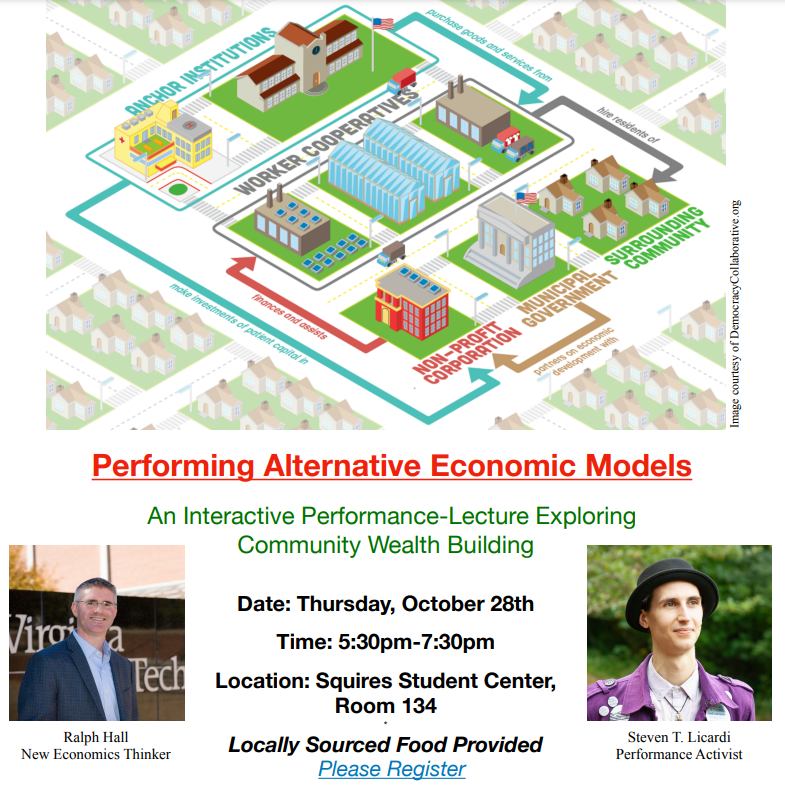
Performing Alternative Economic Models

On Wednesday, October 25, from 9-11amSteven T. Licardi and I will be hosting an event as part of the Virginia Tech Humanities Week. Please join us if you would like to engage in our “Performing Alternative Economic Models” experience.

Performing Alternative Economic Models

Ralph Hall and Steven T. Licardi

Time: 9:00 – 11:00 a.m.
Location: Squires 134 and Zoom

For many, our current economic models no longer meet our basic human needs. Over the past two years, performance artist Steven T. Licardi and SPIA faculty member Ralph Hall have been exploring ways to advance new economic thinking – related to Community Wealth Building – through a SciArts project. Through this collaboration, they arrived at “Ping-pong-omics” and performance art as an engaging way to reveal economic inequality and challenge participants to imagine, explore, and develop alternative economic models.

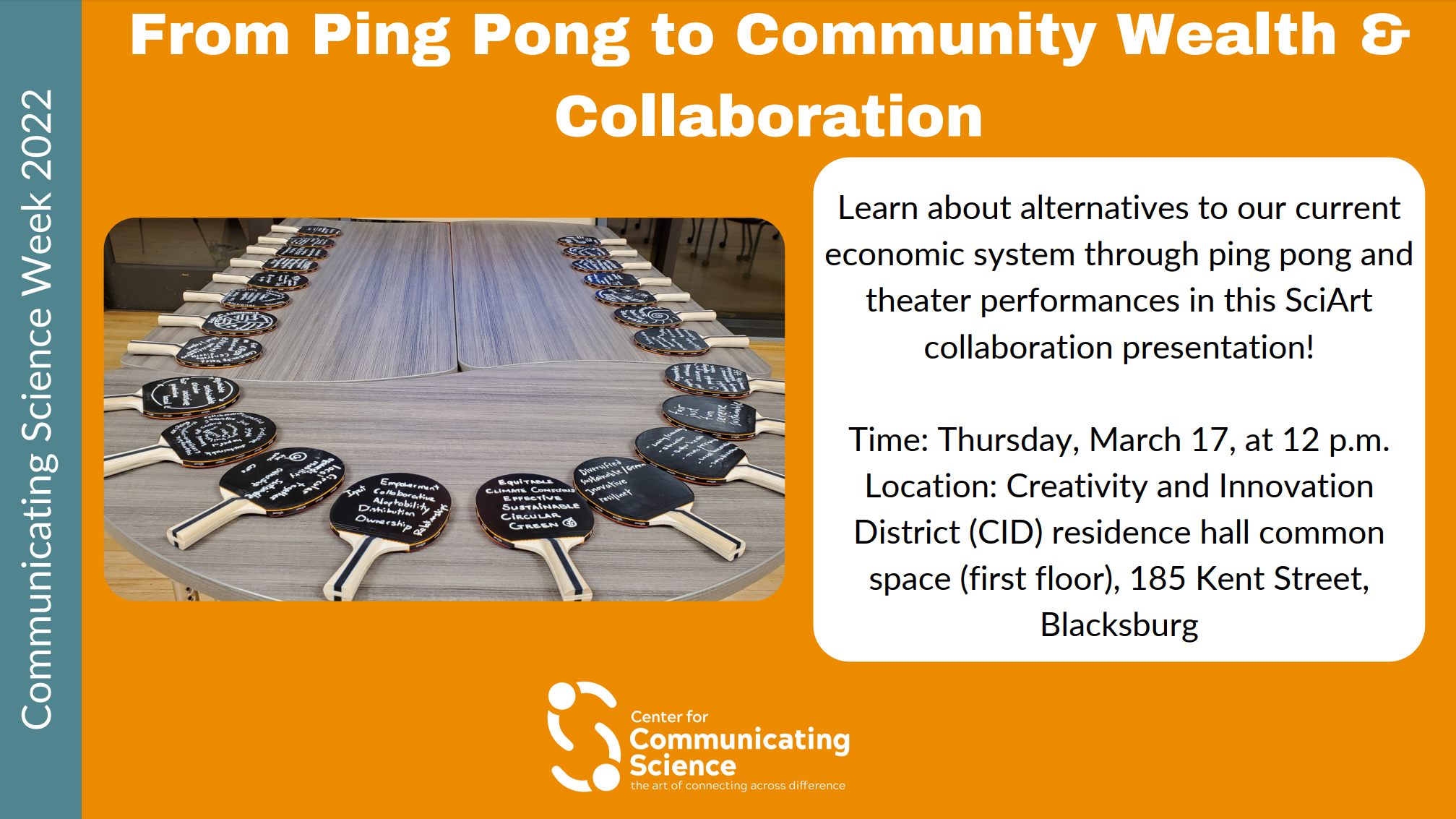
From Ping Pong to Community Wealth and Collaboration

Over the past year, performance artist Steven T. Licardi and I have been exploring ways to advance new economic thinking – related to Community Wealth Building – through a SciArts project. This project was funded by a grant from the Center for Communicating Science at Virginia Tech.

If you would like to know how ping ping and community wealth building are connected, please join us at 12pm on Thursday, March 17, at the new Creativity and Innovation District build at Virginia Tech.

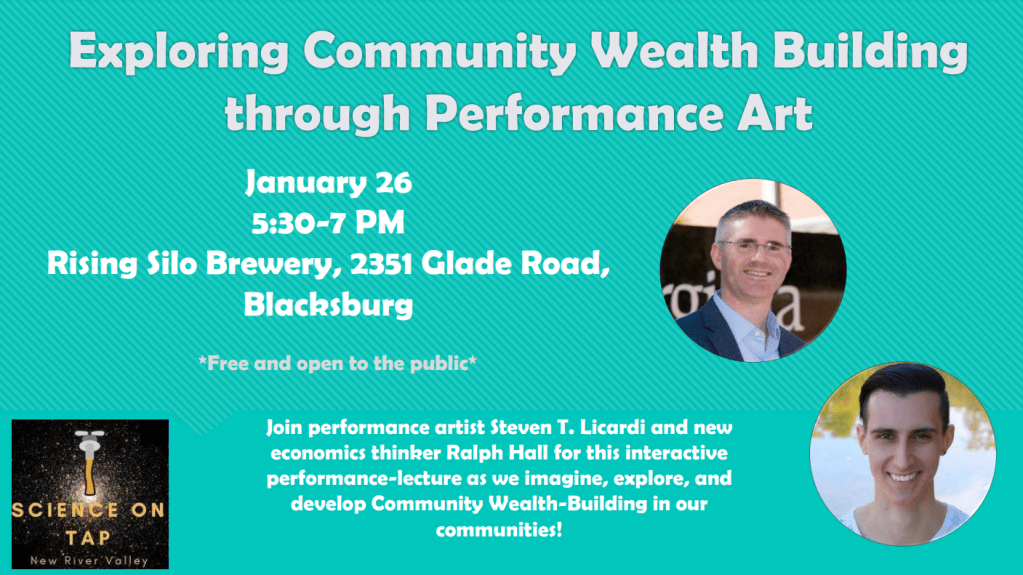
Science on Tap – Community Wealth Building

For many, our current economic models no longer ensure our basic human needs are met. However, other worlds are possible, but we can’t create those worlds without you. Please join performance artist Steven T. Licardi and I on Wednesday, January 26, from 5:30 – 7:00pm at the Rising Silo, for an interactive performance-lecture that imagines, explores, and develops a vision of Community Wealth-Building in our community.

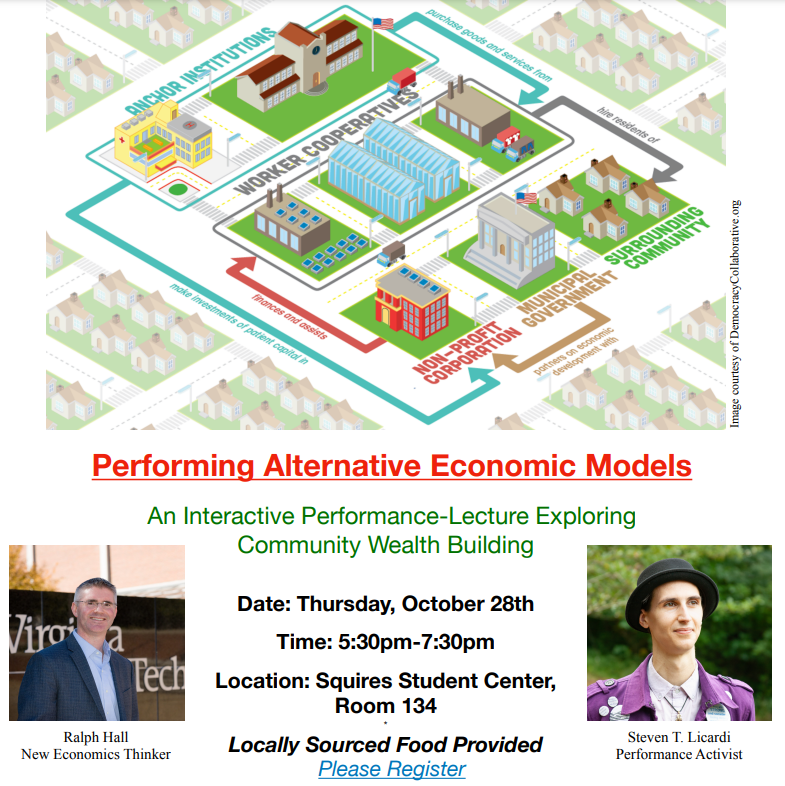
Performing Alternative Economic Models

An Interactive Performance-Lecture Exploring Community Wealth Building

For many, our current economic models no longer ensure our basic human needs are met. However, other worlds are possible, but we can’t create those worlds without you. Join performance artist Steven T. Licardi and I as we imagine, explore, and develop alternative economic models in the form of Community Wealth-Building. This performance-lecture will incorporate games, theatre pieces, and visual art making that will help us to feel our way into these new worlds. Come and be a part of the future!

Please register (for free) here.

This event is made possible by funding from the Center for Communicating Science at Virginia Tech.

USG Workshop – DEI, Sustainability, and CWB

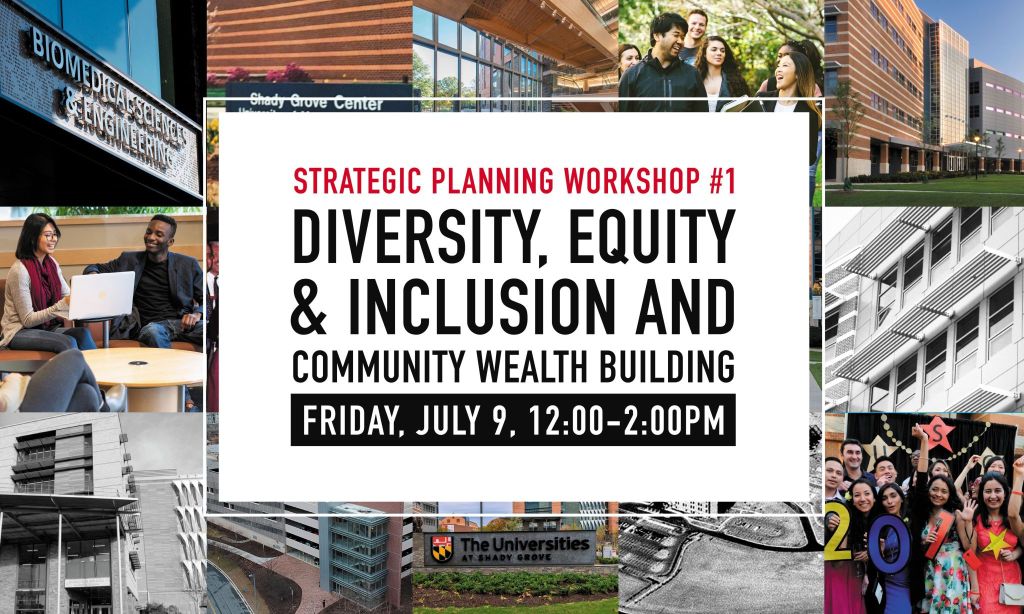
On Friday, July 9, I will be taking part in the first USG (Universities at Shady Grove) strategic planning workshop that will focus on Diversity, Equity, and Inclusion (DEI), Sustainability/Regenerability, and Community Wealth Building (CWB).  

Andrew Schell (from the Chesapeake Bay Foundation) will lead the discussion on DEI, Jessica Hardy (Virginia Tech PhD student) will lead the discussion on Sustainability/Regenerability, and I will conclude the workshop with a discussion on CWB. The workshop will be hosted by Anne Khademian (Executive Director, USG), Ike Leggett (a former executive of Montgomery County, Maryland), and Kevin Beverly (President & CEO of Social & Scientific Systems).

The workshop is open to the public, but registration is required.

“This Is USG” Video Podcast on Community Wealth Building

Earlier this week, I had the pleasure of talking with Prof. Anne Khademian, the Executive Director of the Universities at Shady Grove (USG), about a wide range of topics related to USG’s new strategic planning process. Our conversation covers why I decided to travel to the USA (over 20 years ago!) to study in the Technology and Policy Program at MIT, and how my subsequent research on sustainable development and binary economics/inclusive capitalism, led me to the emerging movement of Community Wealth Building (CWB).