Agrivoltaics Policy Frameworks in the United States

I’m pleased to share our new report on agrivoltaics that was commissioned by the Virginia Department of Energy. The report examines agrivoltaics practices, policies, and programs across the United States through 2024, highlighting emerging trends, benefits, and lessons learned. Together, these insights offer a foundation for aligning clean energy development with agricultural productivity and land stewardship in Virginia.
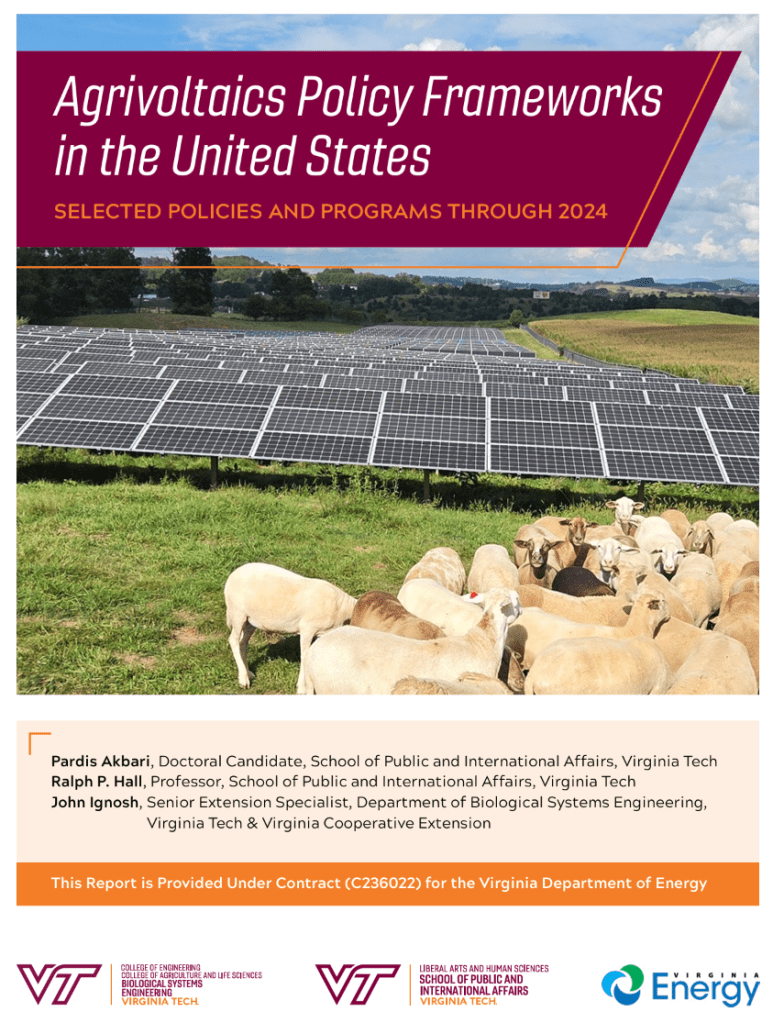
Akbari, P., Hall, R. P., & Ignosh, J. (2026). Agrivolatics Policy Frameworks in the United States: Selected Policies and Programs through 2024. Virginia Tech, Blacksburg. https://hdl.handle.net/10919/141096 

Executive Summary

Agrivoltaics, also known as dual-use solar or agrisolar, is an integrated land-use approach that combines agricultural production and photovoltaic electricity generation on the same site, allowing crops to be cultivated, livestock to be grazed, or pollinator habitats to be maintained while producing renewable energy from solar panels (Department of Energy, 2022; Macknick et al., 2022).

Agrivoltaics presents a potential sustainable solution to land-use competition between food and energy production (Jain, 2024). By integrating solar power generation with agriculture, agrivoltaics systems optimize land use and can increase overall land productivity by 35–73% compared to traditional single-use approaches (Dupraz et al., 2011). The systems can also improve water-use efficiency beneath photovoltaic (PV) panels, reducing evaporation and conserving soil moisture (Adeh et al., 2018). Additionally, agrivoltaics can lower solar panel temperatures by 1-2°C, improving energy efficiency and extending a system’s lifespan (Patel et al., 2019). The partial shading from panels can benefit crops sensitive to heat and sunlight stresses, potentially creating a more favorable microclimate for growth in some production systems and locations (Kussul, 2020; Marucci et al., 2018). Beyond environmental benefits, agrivoltaics may enhance the economic resilience of farms by providing an additional revenue stream from energy generation (Dinesh & Pearce, 2016). 

The Virginia Department of Energy commissioned this review to better understand evolving agrivoltaics practices, policies, and programs across the United States at both the federal and state levels. Its purpose is to identify emerging trends and provide an overview of current and recent efforts supporting the integration of agriculture and solar energy development. This review focuses primarily on agrivoltaics initiatives through 2024. 

The United States federal government has introduced several policies and programs that indirectly support the growth of agrivoltaics as part of the country’s broader clean energy transition. Key legislative actions, including the Bipartisan Infrastructure Law of 2021 and the Inflation Reduction Act of 2022, have provided significant funding to the Department of Energy (DOE) to expand clean energy infrastructure and strengthen domestic energy resilience. Although these laws do not specifically focus on agrivoltaics, they helped to create a more favorable environment for its development. Federal incentives such as the Investment Tax Credit (ITC) and the U.S. Department of Agriculture’s (USDA’s) Rural Energy for America Program (REAP) have also encouraged the use of renewable energy within agricultural settings. In addition, research and development efforts by the Department of Energy (DOE) through its Solar Energy Technologies Office, including the FARMS and InSPIRE programs, and by the USDA’s National Institute of Food and Agriculture (NIFA), have helped improve the understanding of how agrivoltaics systems perform and how they can support both energy generation and agricultural production. 

Across the states, there is growing momentum to promote agrivoltaics through new policies and incentives. Massachusetts continues to lead the way with its SMART program and Agricultural Solar Tariff Generation Unit (ASTGU) incentive, which provide payments and clear design guidelines to ensure that farmland remains in active agricultural use while supporting solar energy production. Other states have developed similar initiatives. For example, New Jersey’s Dual-Use Pilot Program offers incentives for projects that combine solar power with ongoing farming operations, while Colorado supports agrivoltaics through property tax exemptions, research funding, and pilot grant programs. In Virginia, the Department of Environmental Quality’s (DEQ’s) Permit-by-Rule framework now includes reduced project mitigation requirements when practices such as managed grazing and crop cultivation are incorporated when solar projects impact prime farmland. Collectively, these efforts show a growing commitment to balance farmland protection with renewable energy expansion.

A closer look at these initiatives reveals several common elements are emerging that shape the direction of agrivoltaics policy in the United States. Most initiatives rely on financial incentives to make agrivoltaics projects economically viable, recognizing that dual-use systems often require higher upfront costs for design and construction. In addition, many programs include pilot and demonstration projects as a central strategy, providing opportunities to test system designs, crop performance, and management practices under real-world agricultural conditions before broader implementation. 

To support the effective expansion of agrivoltaics in Virginia, a harmonized policy framework and a consistent definition of the practice are necessary. Coordination among incentives, performance standards, and data-sharing mechanisms can enhance agricultural productivity and renewable energy generation goals. When properly integrated, agrivoltaics can be an effective approach toward energy production, food security, and land stewardship goals. This alignment could turn land-use conflicts into opportunities for sustainable development and resilient clean energy growth. This report summarizes various agrivoltaics initiatives across the United States. Because energy and land-use planning policies are frequently updated, the details of these initiatives are often in flux. However, this summary aims to capture the full range of efforts, even if some programs are inactive. By doing so, the compilation helps inform future work in Virginia by sharing national experiences and providing resources for further review of each approach. 

References

Adeh, E. H., Selker, J. S., & Higgins, C. W. (2018). Remarkable agrivoltaic influence on soil moisture, micrometeorology and water-use efficiency. PLoS ONE, 13(11), e0203256. https://doi.org/10.1371/journal.pone.0203256 

Dinesh, H., & Pearce, J. M. (2016). The potential of agrivoltaic systems. Renewable and Sustainable Energy Reviews, 54, 299–308. https://doi.org/10.1016/j.rser.2015.10.024 

Dupraz, C., Marrou, H., Talbot, G., Dufour, L., Nogier, A., & Ferard, Y. (2011). Combining solar photovoltaic panels and food crops for optimising land use: Towards new agrivoltaic schemes. Renewable Energy, 36(10), 2725–2732. https://doi.org/10.1016/j.renene.2011.03.005 

Jain, S. (2024). Agrivoltaics: The synergy between solar panels and agricultural production. Darpan International Research Analysis, 12(3), 137–148. https://doi.org/10.36676/dira.v12.i3.61 

Kussul, E., Baydyk, T., Garcia, N., Velasco Herrera, G., & Curtidor López, A. V. (2020). Combinations of solar concentrators with agricultural plants. Journal of Environmental Science and Engineering B, 9(5), 168–181. https://doi.org/10.17265/2162-5263/2020.05.002 

Macknick, J., Hartmann, H., Barron-Gafford, G., Beatty, B., Burton, R., Choi, C. S., Davis, M., Davis, R., Figueroa, J., Garrett, A., Hain, L., Herbert, S., Janski, J., Kinzer, A., Knapp, A., Lehan, M., Losey, J., Marley, J., MacDonald, J., McCall, J., Nebert, L., Ravi, S., Schmidt, J., Staie, B., & Walston, L. (2022). The 5 Cs of agrivoltaic success factors in the United States: Lessons from the InSPIRE research study (NREL/ TP-6A20-83566). National Renewable Energy Laboratory. https://docs.nrel.gov/docs/fy22osti/83566.pdf (Archived at https://perma.cc/A7HS-SC8R)

Marucci, A., Zambon, I., Colantoni, A., & Monarca, D. (2018). A combination of agricultural and energy purposes: Evaluation of a prototype of photovoltaic greenhouse tunnel. Renewable and Sustainable Energy Reviews, 82, 1178–1186. https://doi.org/10.1016/j.rser.2017.09.029 

Patel, B., Gami, B., Baria, V., Patel, A., & Patel, P. (2019). Cogeneration of solar electricity and agriculture produce by photovoltaic and photosynthesis—Dual model by Abellon, India. Journal of Solar Energy Engineering, 141(3), 031014. https://doi.org/10.1115/1.4041899 

U.S. Department of Energy. (2022, December 8). Foundational Agrivoltaic Research for Megawatt Scale (FARMS) funding program. https://www.energy.gov/eere/solar/foundational-agrivoltaic-research-megawattscale-farms-funding-program (Archived at https://perma.cc/8SFL-4NVM)
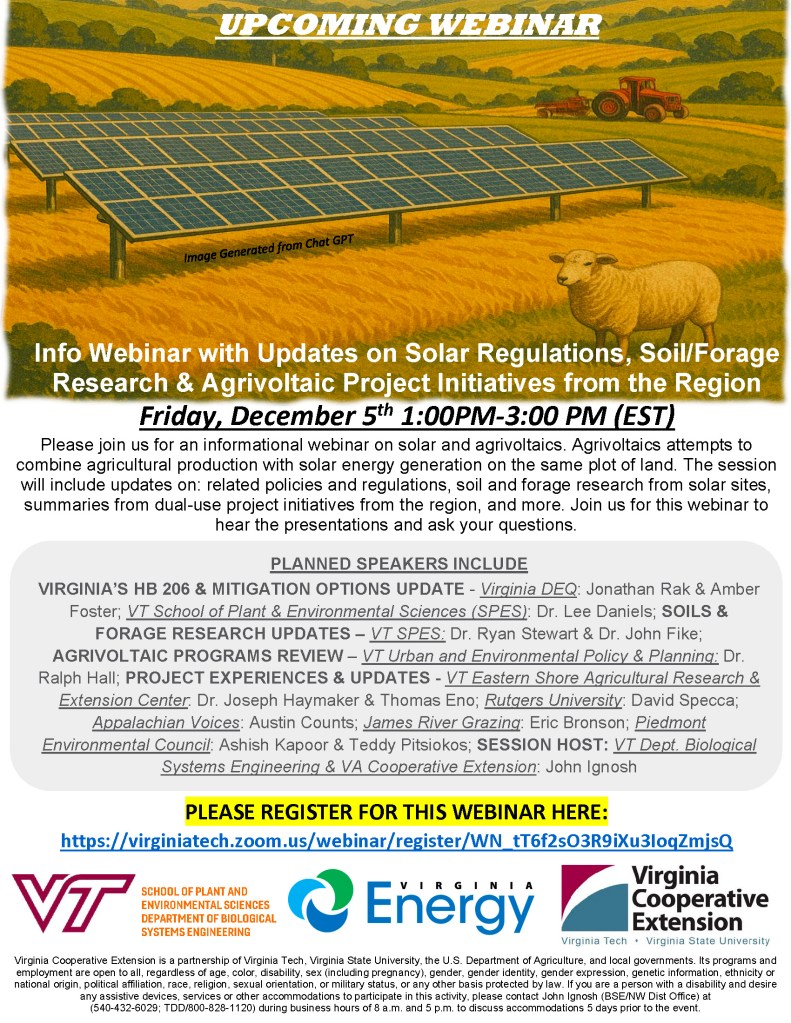
Informational Webinar on Solar Regulations, Soil/Forage Research, and Agrivoltaics Initiatives

Please join us on Friday, December 5, 1:00–3:00 PM (EST) for an informational webinar exploring the intersection of agriculture and solar energy. Learn about:

  • Lessons from dual-use agrivoltaic projects
  • Solar policies & regulations affecting farmland
  • Soil & forage research on solar sites

Planned Speakers & Topics:

  • Virginia’s HB 206 & Mitigation Options Update: Jonathan Rak & Amber Foster (Virginia DEQ), Dr. Lee Daniels (VT SPES)
  • Soils & Forage Research Updates: Dr. Ryan Stewart & Dr. John Fike (VT SPES)
  • Agrivoltaic Programs Review: Dr. Ralph Hall (VT Urban and Environmental Policy & Planning)
  • Project Experiences & Updates: Dr. Joseph Haymaker & Thomas Eno (VT Eastern Shore Agricultural Research & Extension Center), David Specca (Rutgers University), Austin Counts (Appalachian Voices), Eric Bronson (James River Grazing), Ashish Kapoor & Teddy Pitsiokos (Piedmont Environmental Council)

The session will be recorded, and a link to the recording will be shared with all registrants.

This is a great opportunity for farmers, researchers, policymakers, and anyone interested in sustainable energy and agriculture to learn, connect, and explore new approaches in the rapidly evolving field of agrivoltaics.

Please share this announcement with colleagues or friends who may be interested in the topic.

Register here.

White Paper: Advancing Agrivoltaics in Virginia

I’m pleased to announce the release of a new white paper titled “Advancing Agrivoltaics in Virginia,” prepared by the Center for Advanced Innovation in Agriculture (CAIA), the Center for Future Work Places and Practices (CFWPP), and the Power and Energy Center (PEC). This white paper captures insights from an agrivoltaics summit held at Virginia Tech in 2024.

The motivation for the 2024 agrivoltaics summit stemmed from Virginia’s growing need to balance the conservation of agricultural land with the rapid expansion of renewable energy, particularly solar power. As land-use conflicts, economic pressures on rural communities, and the need for climate resilience intensify, agrivoltaics offers a promising solution by enabling the dual-use of land for both farming and solar energy production. The agrivoltaics summit aimed to define strategies for collaboration between industry and state agencies to support agrivoltaics during the renewable energy transition, explore opportunities and challenges from diverse perspectives, and establish a network dedicated to evaluating and advancing agrivoltaics opportunities relevant to Virginia stakeholders.

KEY FINDINGS

  • Farmers are open to agrivoltaics but stress the importance of balancing solar development with protecting prime agricultural land and maintaining long-term farming viability.
  • Early community engagement and overcoming regulatory hurdles are key to successful solar projects, with long-term benefits expected from environmentally responsible, community-focused designs.
  • Utility companies face challenges with grid connection for solar projects but see opportunities for collaboration with local communities to support renewable energy integration.
  • Clear policies, financial incentives, and collaboration among stakeholders are essential to protect farmland while promoting the sustainable development of agrivoltaics in Virginia.

Acknowledgements: This research was supported by a grant from the 4-VA program.

Recommended citation: CAIA, CFWPP, & PEC (2025). Advancing Agrivolatics in Virginia. College of Agriculture and Life Sciences, Virginia Tech, Blacksburg.

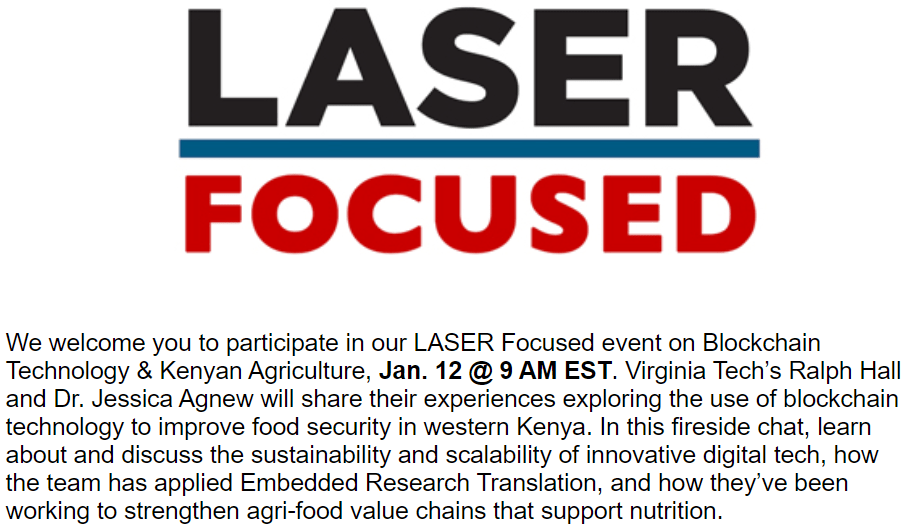
Webinar: Blockchain Technology & Kenyan Agriculture

On January 12 at 9am (EST), Dr. Jessica Agnew and I will be talking about our USAID LASER PULSE research project entitled “Exploring the Use of Blockchain Technology to Promote the Production and Consumption of African Indigenous Vegetables in Western Kenya.” The event description is provided below. The Zoom link to the webinar can be accessed here.

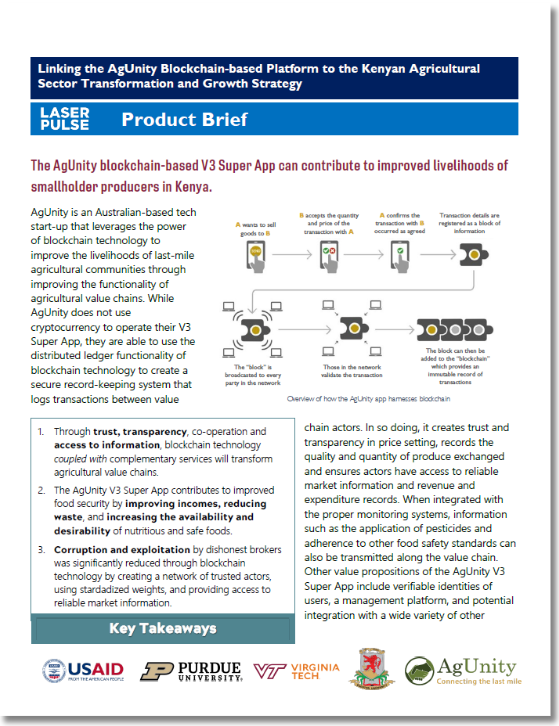
USAID LASER PULSE Policy/Product Briefs

The final policy and product briefs from our USAID LASER PULSE project entilted “Exploring the Use of Blockchain Technology to Promote the Production and Consumption of African Indigenous Vegetables in Western Kenya” are now available.

Agnew, J., & Hall, R. P. (2022). Policy Brief: Research evidence of the impacts of blockchain technology on improving food security through African Indigenous Vegetables in Western Kenya. USAID LASER PULSE, 4 pages. http://hdl.handle.net/10919/111580
Agnew, J., Hall, R. P., & Kristofikova, N. (2022). Product Brief: Linking the AgUnity Blockchain-based Platform to the Kenyan Agricultural Sector Transformation and Growth Strategy. USAID LASER PULSE, 4 pages, 4 pages. http://hdl.handle.net/10919/111581

Research Reports from our USAID LASER PULSE Project in Kenya

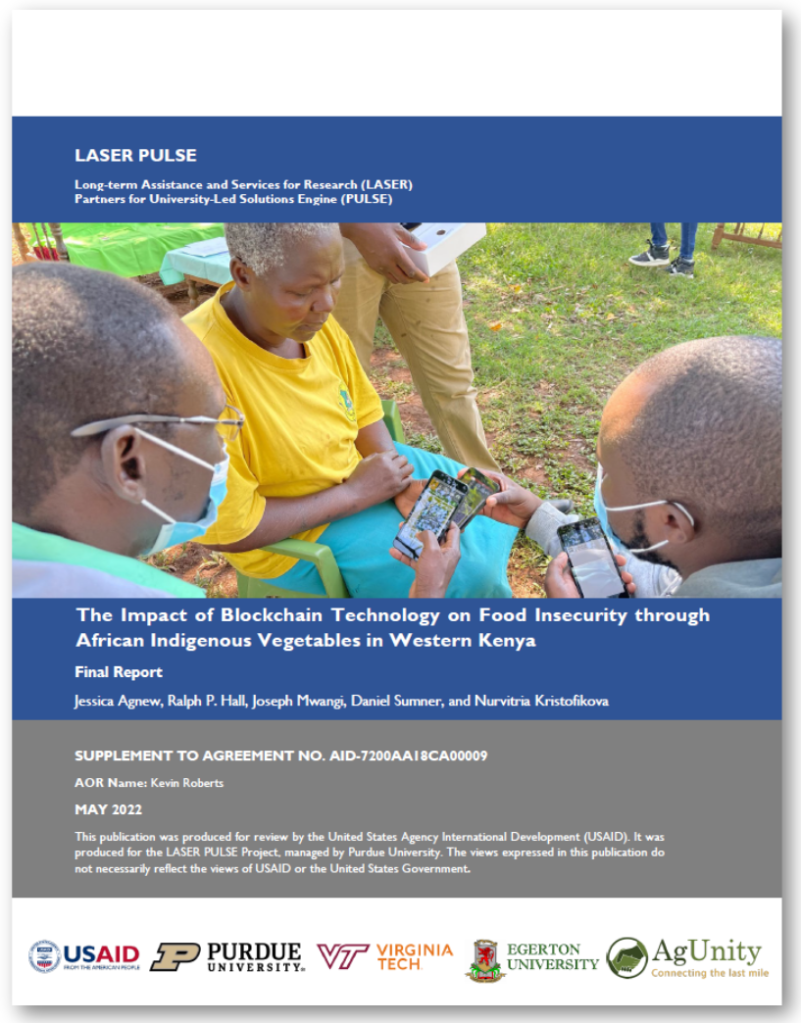
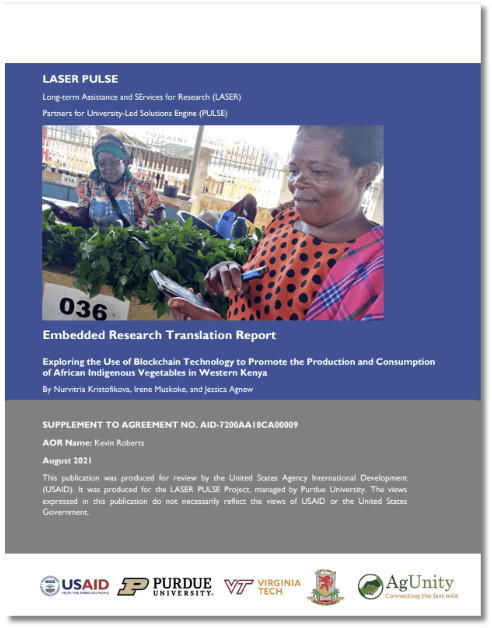
The three main reports from our USAID LASER PULSE research project entilted “Exploring the Use of Blockchain Technology to Promote the Production and Consumption of African Indigenous Vegetables in Western Kenya,” are now available. I have also included below the 4-minute video we developed to help explain the research and its main findings.

Agnew, J., Hall, R. P., Mwangi, J., Sumner, D., & Kristofikova, N. (2022). The Impact of Blockchain Technology on Food Insecurity through African Indigenous Vegetables in Western Kenya: Final Report. USAID LASER PULSE, 73 pages. http://hdl.handle.net/10919/110444

This study is one of the first to explore how blockchain technology (BCT) could be used to improve food security in communities that are reliant on agriculture but are the last to receive services or access to markets, known as the ‘last-mile’. The goal was to determine how BCT could contribute to improving the income of African indigenous vegetable (AIV) value chain actors (e.g., producers, traders, and retailers) and to the affordability, availability, and accessibility of nutritious foods like AIVs for consumers. It finds that BCT can simultaneously strengthen the functionality of an entire agri-food value chain by increasing the efficiency of transactions among value chain actors, improving cooperation along the value chain, and enhancing access to information. A decrease in post-harvest loss, reduction in negotiation and search costs, and traceability of Grade A vegetables were facilitated by the blockchain functionality of the AgUnity V3 SuperApp. Producer income was improved by better meeting market demand, time savings on AIV activities, increasing the supply of Grade A vegetables, and making information on the vegetables more available to consumers. Increased incomes led to improved food security among producers by facilitating their ability to procure more food, especially higher quality proteins and fruits. Participants and consumers reported an increase in the consumption of AIVs over the study period because of increased quality, availability, and awareness of their nutritional importance.

Agnew, J., Mwangi, J., Hall, R. P., Sumner, D., & Kristofikova, N. (2021). Transaction and Information Pain Points in African Indigenous Vegetable Value Chains in Western Kenya: A Gender-Responsive AIV Value Chain and Market Analysis Report. USAID LASER PULSE, 46 pages. http://hdl.handle.net/10919/111357

The use cases for blockchain technology (BCT) have taken off since its initial development for the cryptocurrency Bitcoin. In agricultural value chains, BCT has been developed for agri-food products from source to retail outlets, increasing transparency between value chain actors, and creating secure transaction platforms. However, BCT is not a magic bullet for addressing all value chain inefficiencies and challenges. This study, Exploring the Use of Blockchain Technology to Improve Food Security Through African Indigenous Vegetables in Western Kenya, aims to investigate the types of challenges within the value chain for African indigenous vegetables (AIVs) that BCT is appropriate to address. It also aims to investigate if deploying a BCT-based digital platform in AIV value chains will lead to improved food security for all value chain actors.

This gender-responsive participatory value chain analysis (PVCA) investigates the transactional, informational, and other types of pain points within AIV value chains to identify where BCT is needed. AIVs are known as ‘female’ crops, as women are primarily responsible for their production, marketing, and preparation. This PVCA also investigates gender disparities in the value chain with the view to understanding how a BCT-based digital platform might help to secure the place of women in the value chain as it is upgraded.

According to the findings of the PVCA, the main pain points that need to be addressed in order to improve income-earning opportunities and availability of and demand for AIVs are the lack of coordination throughout the value chain, assurance of vegetable safety for consumers, improved transmission of information through the value chain, standardization of grading and pricing, improving the market power of women, and technical assistance for producers in pest and disease management and production practices to improve yield. BCT cannot address all of these pain points. However, it is well suited for improving vertical coordination between actors by organizing and standardizing transactions and making information on the AIVs accessible at all stages of the value chain. It will also provide women a safe and secure platform for transacting that will protect the revenues earned from their respective activities.

This study also finds that while smartphone ownership is low, value chain actors are willing to pay for a smartphone as well as a monthly subscription fee to use a digital platform if it will address their key pain points.

This study will continue to investigate key knowledge gaps such as how technology use might more effectively engage youth in AIV value chains, how information on the blockchain can be certified, and how to scale up the use of a BCT-based digital platform. However, this PVCA demonstrates there is potential for BCT to offer important solutions to address transactional and informational inefficiencies along AIV value chains.

Kristofikova, N., I. Muskoke, and J. Agnew. (2021). Embedded Research Translation Report: Exploring the Use of Blockchain Technology to Promote the Production and Consumption of African Indigenous Vegetables in Western Kenya. AgUnity, Australia, 39 pages. http://hdl.handle.net/10919/111503

AgUnity worked with Virginia Tech and Egerton University on the LASER PULSE-funded project entitled Exploring the Use of Blockchain Technology to Promote the Production and Consumption of African Indigenous Vegetables (AIVs) in Western Kenya. AIV value chains are characterized by transactional and informational inefficiencies that contribute to inconsistent supply and mismatched demand in Kenya. This research program explores how digital applications built on blockchain technology (BCT) can be deployed in AIV value chains in western Kenya in a way that improves food and nutrition security for all value chain actors. Specifically, there was interest in understanding how the BCT-based smartphone application could assist groups of individuals who typically face constraints in accessing economic or nutritional benefits from value chain upgrading (i.e., smallholder producers, women, youth, low-income consumers).

This project was one of the first times the AgUnity app was not deployed in a centralized supply chain context (i.e., with a union or cooperative supplied by hundreds of farmers). We have found that in decentralized supply chains, there is a particular need to ensure that the system supports the users’ values and needs for conducting their respective value chain activities. When this is achieved, trust that is garnered through the use of the technology shall translate directly into more cooperative and coordinated value chains. Both the value chain app adaptation and configuration and the technology service design were built around this premise, using embedded research translation (ERT) processes to ensure that it was achieved in the target population and value chain.

This report outlines the steps taken by AgUnity to translate Virginia Tech and Egerton University’s research into the adaptation and deployment of our proprietary BCT-based smartphone application. It is directed toward readers interested in understanding the product and service design of the AgUnity application, the use of BCT in digital platforms designed for last-mile users, and those interested in successful examples of ERT. It walks the reader through the value chain mapping and community immersion processes, the steps needed to adapt the technology to fit the local value chain context, and the development and selection of app functionalities for the target users and value chain. The report may be of interest to researchers, farming associations, and cooperatives or agricultural non-governmental organizations interested in the AgUnity solution as well as stakeholders involved in strengthening agricultural market systems, AgTech, or FinTech.

Final LASER-PULSE Report – Impact of Blockchain Technology on Food Insecurity through African Indigenous Vegetables in Western Kenya

The final (peer-reviewed) report from our USAID LASER PULSE project on how blockchain technology impacts food security through African indigenous vegetables in Western Kenya is now available.

This study is one of the first to explore how blockchain technology (BCT) could be used to improve food security in communities that are reliant on agriculture but are the last to receive services or access to markets, known as the ‘last-mile’. The goal was to determine how BCT could contribute to improving the income of African indigenous vegetable (AIV) value chain actors (e.g., producers, traders, and retailers) and to the affordability, availability, and accessibility of nutritious foods like AIVs for consumers. It finds that BCT can simultaneously strengthen the functionality of an entire agri-food value chain by increasing the efficiency of transactions among value chain actors, improving cooperation along the value chain, and enhancing access to information. A decrease in post-harvest loss, reduction in negotiation and search costs, and traceability of Grade A vegetables were facilitated by the blockchain functionality of the AgUnity V3 SuperApp. Producer income was improved by better meeting market demand, time savings on AIV activities, increasing the supply of Grade A vegetables, and making information on the vegetables more available to consumers. Increased incomes led to improved food security among producers by facilitating their ability to procure more food, especially higher quality proteins and fruits. Participants and consumers reported an increase in the consumption of AIVs over the study period because of increased quality, availability, and awareness of their nutritional importance.