Analysis of TRB RNS Database for Sustainability Research

As part of my role as the research chair for the TRB Transportation and Sustainability Committee (ADD40), I undertook with the support of my graduate research assistant Erin Puckett, an analysis of the TRB Research Needs Statements (RNS) database (http://rns.trb.org/) to determine the extent to which the topic of sustainable transportation is addressed in the proposed research projects listed in the database.
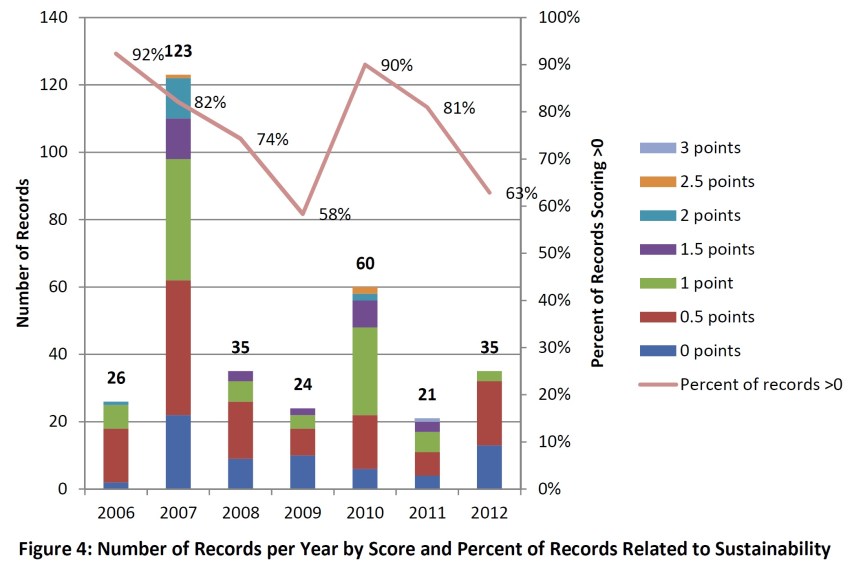
Figure for blogThe intention of this exploratory analysis was to identify the type and scope of projects being proposed and which TRB committees are supporting sustainability-related research proposals in one or more areas. The results from this analysis should help the Transportation and Sustainability Committee (ADD40) determine which proposed research needs to support, which committees to initially engage with, and where opportunities exist to propose new research projects.

Overall, it was found that many RNS records address some area of sustainability, whether openly acknowledged or not. It was much less common to find records proposing research that truly addresses sustainability in a comprehensive way, with emphasis on environmental, social, and economic impacts.

Over the last six years there does not appear to have been a steady increase in the number of records that are related to sustainability (see Figure 4 above). Further, while there seems to be an overarching idea that transportation research should have some sustainability-related focus, individual records do not always address this explicitly in their goals or objectives. Perhaps this is partially due to the lack of an overall guiding definition of sustainability/sustainable transportation that all TRB committees can adopt.

This analysis has led to several recommendations for advancing the research portfolio of the Transportation and Sustainability Committee that are included in the full report. The raw data that was used to support the analysis is also provided below.

Full Report (PDF)

Raw Data (Excel file)

Presentation (PDF)

Water Supply and Sanitation in Developing Countries

UAP 5324 / BSE 4394, 2013 Spring Semester
Instructor: Dr. Ralph Hall
Meets: Tuesdays 12:30pm to 3:15pm
Location: Architecture Annex 111

Course Description

In this course, we will examine the planning process for the provision of water supply and sanitation (W&S) services in developing countries. The course is structured to provide both an engineering and policy perspective on the subject. Thus, the readings, class discussions, and assignments will require students to think as both an engineer and planner/analyst. The course will begin with a review of the state of water and sanitation services in different parts of the world and will raise the question of what constitutes access to water. Following this introduction, we will study the design of important W&S technologies. We will then examine the broader environmental and public health considerations in water W&S planning. Armed with an understanding of critical W&S issues and technologies, in the final section of the course we will examine key ideas/topics such as multiple-use water services, demand-oriented planning, service pricing, decentralization vs. centralization of W&S services, community participation in the planning process, and post-construction support.

Learning Objectives

Having successfully completed this course you will be able to:

1. Describe the current level of access to, and the quality of, water supply and sanitation services in one or more developing regions.

2. Outline the planning process for the provision of water supply and sanitation services in the developing region(s) studied.

3. Define the various roles of local, national, and international agencies and donors in the provision of water supply and sanitation services in developing regions.

4. Use planning-based tools to evaluate existing and proposed water supply and sanitation services in the developing region(s) studied.

5. Design policies and/or infrastructure to address identified problems with the provision/adequacy of existing water supply and sanitation services in the developing region(s) studied.

Syllabus

International Development Planning Studio

UAP 5764, 2013 Spring Semester
Instructor: Dr. Ralph Hall
Meets: Thursdays 12:30pm to 3:15pm
Location: Architecture Annex 111

Studio Overview

Concepts and practices in the field of international development have changed dramatically over the past few decades and even the past few years. This studio course is designed to prepare students with the most current approaches to the practice of international development as implemented by leading actors today. Students will learn the traditional project planning tools used by multi-lateral and financial institutions as well as alternative processes. They will be equipped with a variety of skills necessary for working on development projects in the real world.

Throughout the studio, elements of project development, planning, management, implementation, and monitoring and evaluation will be covered from the perspective of the prevalent development sectors. Emphasis will be placed on synthesizing and practicing skills through the preparation of a proposal for an international development project/program. During the studio, students will work on, present, and critique different elements of their project proposals. To complement the theoretical discussions, several studios will be led by experienced practitioners and academics in the field of international development.

Studio Objectives

Upon completion of the studio, students will be able to:

  1. develop a complete proposal for an international development project/program – which will include a problem analysis, a needs assessment/stakeholder analysis, a gender analysis/discussion, a clear set of goals/objectives (supported by a logframe analysis), an assessment of resources and organizational ability, a proposed work plan and timeframe, a budget, a monitoring and evaluation plan, and a plan for the successful implementation of the project; and
  2. undertake a financial analysis of a proposed development project.

Syllabus

New Papers in The European Financial Review

Nicholas Ashford, Robert Ashford, and I recently published two articles in the European Financial Review that extend some of the ideas we have discussed previously in our textbook and related papers.

Addressing the Crisis in Employment and Consumer Demand: Reconciliation with Environmental and Financial SustainabilityThe earning capacity of ordinary people can be enhanced by some combination of two contributions; wages earned through employment, and money earned through the ownership of productive capital. The latter includes ordinary investment from wage savings that people might make through the purchasing of stocks, bonds, and property; changes in ownership structures of businesses, employee stock ownership plans (ESOPs), and enabling people to acquire capital with the earnings of capital based on binary economics. This article focuses on employment and the restructuring of work to enhance the contributions and productiveness of labor – as opposed to increasing labor productivity by enhancing the productiveness of physical capital.

Broadening Capital Acquisition with the Earnings of Capital as a Means of Sustainable Growth and Environmental SustainabilityThis article expands on the first by taking an explicit look at increasing earning capacity through the ownership of productive capital. The article focuses on the binary economic approach and explains how this approach can enhance not only the capital earning capacity of poor and middle-class people, but also the demand for employment and the prospects for achieving environmental sustainability. The binary economic approach envisions an implementation of an ownership-broadening system of corporate finance that would require no taxes, redistribution, or government command. Corporations would be free to continue to meet their capital requirements as before, but they would have an additional, potentially more profitable, market means to do so.

During the Spring 2013 semester, Robert Ashford will join other scholars at Virginia Tech to take part in a seminar that will debate how a binary economics approach could lead to sustained and sustainable economic development.

PhD for On-the-ground Statisticians

If you are interested in pursuing a PhD in statistics and would like to apply your skills to evaluation work in developing countries, I highly recommend you take a close look at the Laboratory for Interdisciplinary Statistical Analysis (LISA) in the Department of Statistics at Virgina Tech. Please see the flyer below for more information about being an “on-the-ground” statistician for LISA.

New Paper in Water Alternatives

The first paper from our research on the productive use of rural domestic water in Senegal will be published in Water Alternatives (Volume 5, Issue 3). The abstract to the paper is included below.

ABSTRACT: Enhancing livelihoods and promoting gender equity are primary goals of rural development programmes in Africa. This article explores the role of productive water use in relation to these goals based on 1860 household surveys and 15 women’s focus groups conducted in four regions of Senegal with small-scale piped water systems. The piped systems can be considered ‘domestic plus’ systems because they were designed primarily for domestic use, but also accommodate small-scale productive uses including livestock-raising and community-gardening. This research focuses on the significance of productive water use in the livelihood diversification strategies of rural women. In Senegal, we find that access to water for productive purposes is a critical asset for expanding and diversifying rural livelihoods. The time savings associated with small piped systems and the increased water available allowed women to enhance existing activities and initiate new enterprises. Women’s livelihoods were found to depend on productive use activities, namely livestock-raising and gardening, and it is estimated that one half of women’s incomes is linked to productive water use. While these findings are largely positive, we find that water service and affordability constraints limit the potential benefits of productive water use for women and the poorest groups. Implications for targeting women and the poorest groups within the domestic plus approach are discussed.

Citation: Van Houweling, E.; Hall, R.P.; Sakho Diop, A.; Davis, J. and Seiss, M. (2012) The role of productive water use in women’s livelihoods: Evidence from rural Senegal. Water Alternatives 5(3): 658-677.