Update from the Field

I started writing this post a week ago while flying from Maputo to Nampula in Mozambique, but the usual challenges of setting up a large-scale research project delayed my intentions. One challenge is finding/installing a good Internet connection, which we overcame by purchasing a number of Movitel USB modems that are working surprisingly well.

I’m in Nampula with a team of researchers from Virginia Tech (Eric Vance, Emily Van Houweling, and Marcos Carzolio), Stanford University (Jenna Davis and Kory Russel), and WE Consult (our in-country partner) to undertake a follow-up study for an evaluation of the Millennium Challenge Corporation’s rural water program in the province. We undertook the baseline study in 2011 and plan to complete the follow-up study over the next two months.

Over the past week, we have begun our enumerator training that has focused primarily on reviewing each module of the household survey (which consists of more than 600 questions that will be navigated using logic) and practicing skills such as how to measure a child and use GPS devices (that are needed to find the same households we surveyed in 2011). Next week we will continue to refine the various surveying instruments with the enumerators (who are mostly local to Nampula) and begin practicing how to take water samples, among other activities. We will soon select our team leaders from the twenty enumerators we are training, who will each receive specific training on the various research protocols we will be using.

We have established a base camp in a house in the city of Nampula, which is proving to be a pleasant place to work/live, even if there is no water most days. There are several major construction projects happening in the city that have severely constrained the water supply that only comes once a day for several hours if we are lucky.

I have included some pictures below of the activities so far. I will post some more following the pilot study that is planned for later next week.

This slideshow requires JavaScript.

Leveraging Statistics to Improve Data Quality

In the video below, Eric Vance and I are joined by several of our graduate students to describe how we developed the concept of an “on-the-ground statistician” to advance our data collection and cleaning practices in relation to large-scale household surveys.

Congratulations Emily Van Houweling!

On March 29, Emily Van Houweling successfully defended her dissertation entitled “Gender, Water, and Development: The multiple impacts and perspectives of a rural water project in Nampula, Mozambique.”

Emily was a doctoral candidate in the Planning, Governance, and Globalization (PGG) program at Virginia Tech, and over the past several years has become a highly valued team member on two large-scale research projects in Senegal and Mozambique. The slide show below provides a few pictures of Emily in the field.

This slideshow requires JavaScript.

Development organizations claim that rural water projects deliver a wide variety of benefits – from poverty reduction to women’s empowerment. Emily’s research explores these claims in the context of a rural water project (RWP) in Nampula, Mozambique. From August of 2011 to July of 2012, Emily spent 11 months conducting ethnographic research in five communities where handpumps were installed as part of the RWP. The goal of her research was to describe how the water project unfolds “on the ground” from the perspective of men and women in Nampula, and illuminate the social and gender related impacts of the project that are not captured in standard evaluations. Emily’s research contributes to theoretical debates about the relationship between gender, water, and development, and also offers practical suggestions for designing water projects that are more equitable, culturally sensitive, and sustainable.

I served as the chair of Emily’s dissertation committee along with committee members Maria Elisa Christie, Keith Moore, and Brett Shadle.

Analysis of TRB RNS Database for Sustainability Research

As part of my role as the research chair for the TRB Transportation and Sustainability Committee (ADD40), I undertook with the support of my graduate research assistant Erin Puckett, an analysis of the TRB Research Needs Statements (RNS) database (http://rns.trb.org/) to determine the extent to which the topic of sustainable transportation is addressed in the proposed research projects listed in the database.

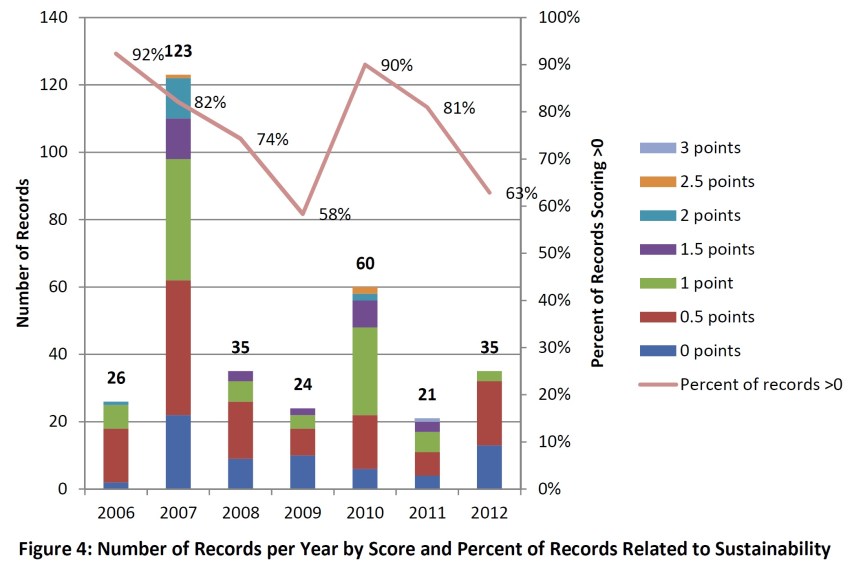
Figure for blogThe intention of this exploratory analysis was to identify the type and scope of projects being proposed and which TRB committees are supporting sustainability-related research proposals in one or more areas. The results from this analysis should help the Transportation and Sustainability Committee (ADD40) determine which proposed research needs to support, which committees to initially engage with, and where opportunities exist to propose new research projects.

Overall, it was found that many RNS records address some area of sustainability, whether openly acknowledged or not. It was much less common to find records proposing research that truly addresses sustainability in a comprehensive way, with emphasis on environmental, social, and economic impacts.

Over the last six years there does not appear to have been a steady increase in the number of records that are related to sustainability (see Figure 4 above). Further, while there seems to be an overarching idea that transportation research should have some sustainability-related focus, individual records do not always address this explicitly in their goals or objectives. Perhaps this is partially due to the lack of an overall guiding definition of sustainability/sustainable transportation that all TRB committees can adopt.

This analysis has led to several recommendations for advancing the research portfolio of the Transportation and Sustainability Committee that are included in the full report. The raw data that was used to support the analysis is also provided below.

Full Report (PDF)

Raw Data (Excel file)

Presentation (PDF)

New Papers in The European Financial Review

Nicholas Ashford, Robert Ashford, and I recently published two articles in the European Financial Review that extend some of the ideas we have discussed previously in our textbook and related papers.

Addressing the Crisis in Employment and Consumer Demand: Reconciliation with Environmental and Financial SustainabilityThe earning capacity of ordinary people can be enhanced by some combination of two contributions; wages earned through employment, and money earned through the ownership of productive capital. The latter includes ordinary investment from wage savings that people might make through the purchasing of stocks, bonds, and property; changes in ownership structures of businesses, employee stock ownership plans (ESOPs), and enabling people to acquire capital with the earnings of capital based on binary economics. This article focuses on employment and the restructuring of work to enhance the contributions and productiveness of labor – as opposed to increasing labor productivity by enhancing the productiveness of physical capital.

Broadening Capital Acquisition with the Earnings of Capital as a Means of Sustainable Growth and Environmental SustainabilityThis article expands on the first by taking an explicit look at increasing earning capacity through the ownership of productive capital. The article focuses on the binary economic approach and explains how this approach can enhance not only the capital earning capacity of poor and middle-class people, but also the demand for employment and the prospects for achieving environmental sustainability. The binary economic approach envisions an implementation of an ownership-broadening system of corporate finance that would require no taxes, redistribution, or government command. Corporations would be free to continue to meet their capital requirements as before, but they would have an additional, potentially more profitable, market means to do so.

During the Spring 2013 semester, Robert Ashford will join other scholars at Virginia Tech to take part in a seminar that will debate how a binary economics approach could lead to sustained and sustainable economic development.

New Paper in Water Alternatives

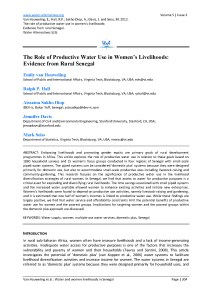
The first paper from our research on the productive use of rural domestic water in Senegal will be published in Water Alternatives (Volume 5, Issue 3). The abstract to the paper is included below.

ABSTRACT: Enhancing livelihoods and promoting gender equity are primary goals of rural development programmes in Africa. This article explores the role of productive water use in relation to these goals based on 1860 household surveys and 15 women’s focus groups conducted in four regions of Senegal with small-scale piped water systems. The piped systems can be considered ‘domestic plus’ systems because they were designed primarily for domestic use, but also accommodate small-scale productive uses including livestock-raising and community-gardening. This research focuses on the significance of productive water use in the livelihood diversification strategies of rural women. In Senegal, we find that access to water for productive purposes is a critical asset for expanding and diversifying rural livelihoods. The time savings associated with small piped systems and the increased water available allowed women to enhance existing activities and initiate new enterprises. Women’s livelihoods were found to depend on productive use activities, namely livestock-raising and gardening, and it is estimated that one half of women’s incomes is linked to productive water use. While these findings are largely positive, we find that water service and affordability constraints limit the potential benefits of productive water use for women and the poorest groups. Implications for targeting women and the poorest groups within the domestic plus approach are discussed.

Citation: Van Houweling, E.; Hall, R.P.; Sakho Diop, A.; Davis, J. and Seiss, M. (2012) The role of productive water use in women’s livelihoods: Evidence from rural Senegal. Water Alternatives 5(3): 658-677.

Updated Primer on Sustainable Development

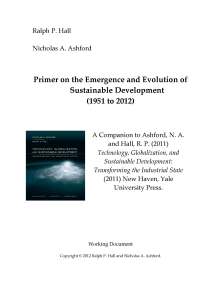
Primer_SustDev_2012-09-11I recently updated the Primer on the Emergence and Evolution of Sustainable Development (1951 to 2012), to include a discussion of the United Nations Conference on Sustainable Development (known as Rio+20), held in Rio de Janeiro, Brazil, June 20-22, 2012. The updated text takes a close look at the idea of the green economy, which was endorsed by delegates at the conference as a flexible mechanism for advancing sustainability.

A Week in Bellagio

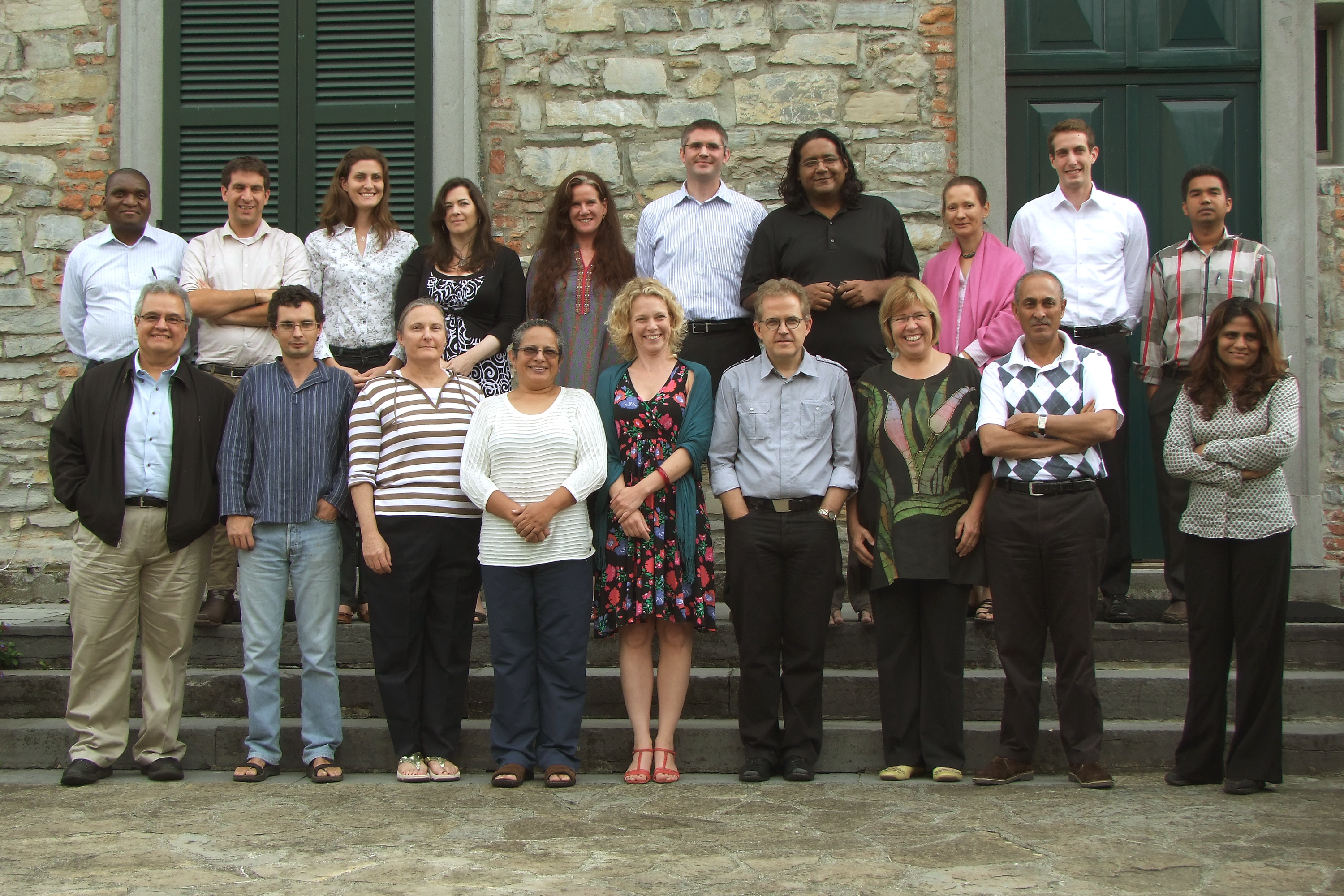
I write this post sitting in a beautiful villa at the Rockefeller Foundation’s Bellagio Center in Italy. During this past week, I have taken part in a workshop on Multiple-Use Water Services (MUS) attended by some 19 practitioners and academics from around the world. The objectives of the meeting were to: develop a common understanding and framework for MUS; elaborate a common direction and goal for the next five years around MUS; elaborate strategies for the MUS Group and its core members to reach this success; elaborate how best MUS can be moved forward; and develop a broad road-map for the way forward and clear commitments for action among the members.

The workshop was facilitated by Dr. Jürgen Hagmann and Dr. Joe Ramaru – professional facilitators from the Institute for People, Innovation, and Change in Organisations (PICOTeam) in South Africa. I mention the PICOTeam because of the superb facilitation they provided. I learnt much from watching how they worked with the group and managed the workflow as the meeting progressed.

The workshop participants developed a comprehensive agenda that will be developed further in the coming months. What was encouraging was the emphasis given to the need for a robust evidence base from which further MUS activities and programs can be built.

In addition to the workshop, we had the opportunity to meet many of the Rockefeller Fellows in residence at the Bellagio Center. I had the privilege with speaking with Geoffrey West, Ellen Silbergeld, and David Freedman and learning about the research and writing projects they are pursing at the center.

Below are several photos from the workshop and grounds of the Bellagio Center, which is now my new favorite place to work in the world. The location has a unique way of relaxing and freeing the mind.

This slideshow requires JavaScript.