Professor, Urban and Environmental Policy and Planning (UEPP), Virginia Tech; Joann Boughman Innovation Fellow at USG; Acting Director, Center for Future of Work Places and Practices (CFWPP); Head of Outreach and Engagement, Center for European and Transatlantic Studies (CEUTS)
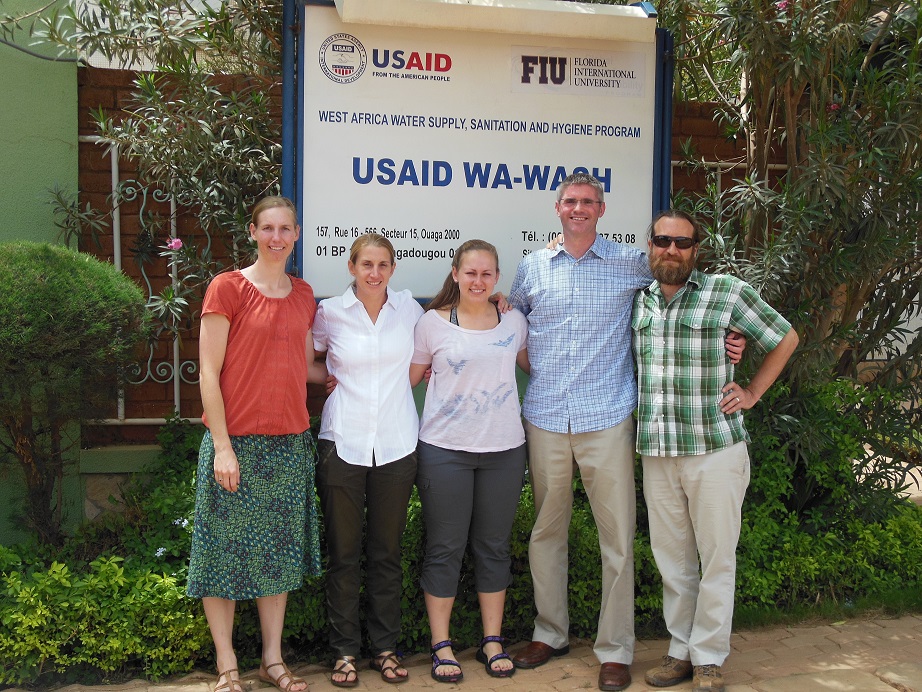
On Sunday, our research team – consisting of Emily Van Houweling, Sophie Wenzel, Nicholas Polys, Paige Williams, and I – arrived in Burkina Faso to study the water accounting process developed by Winrock International as part of their Multiple-Use Water Services (MUS) project. Our team will be here for two weeks, during which we will visit project communities and identify opportunities to further advance the water accounting process by drawing on the unique skill set of the research team.
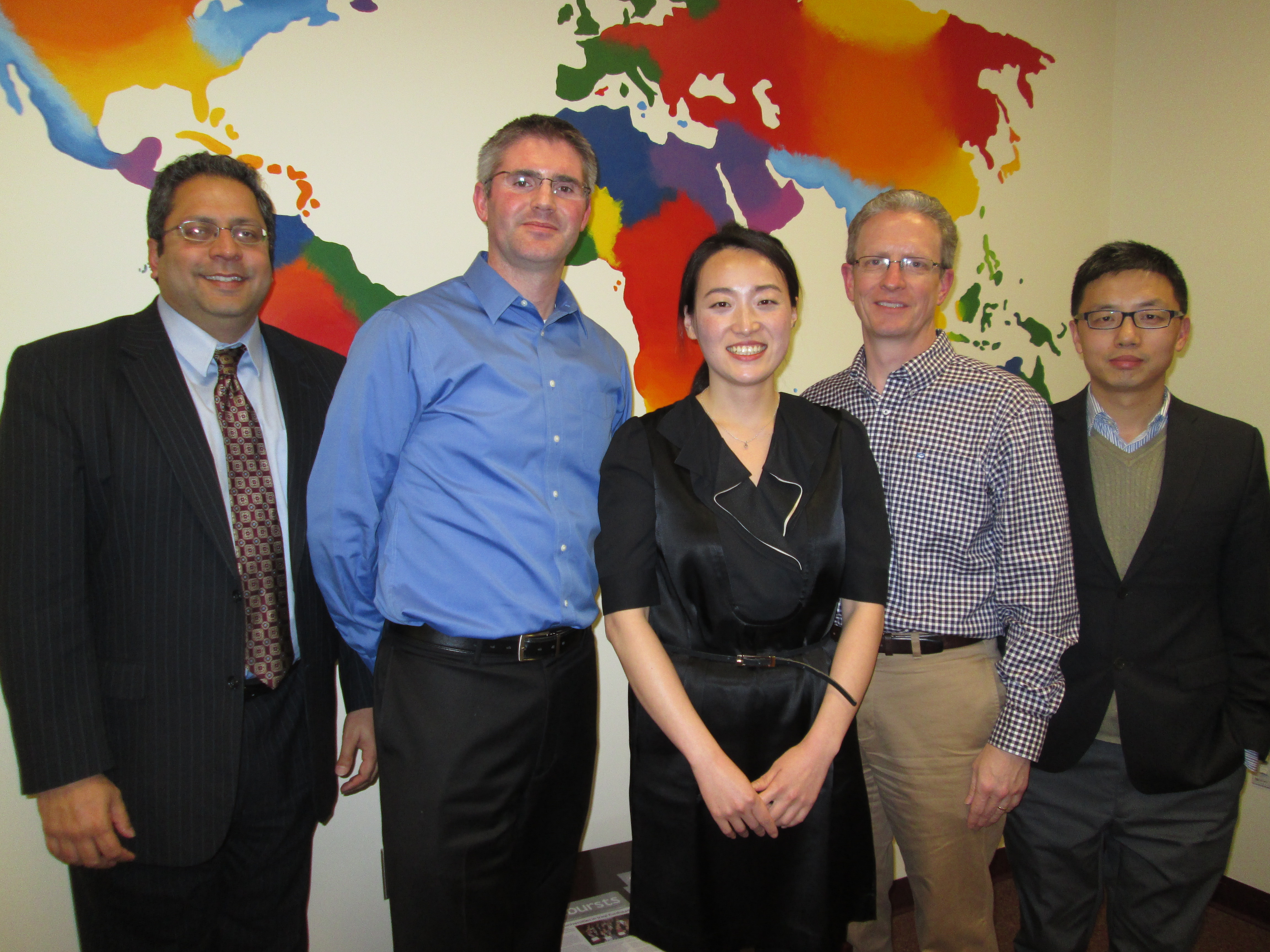
Emily Van Houweling, Sophie Wenzel, Paige Williams, Ralph Hall, and Nicholas Polys
Winrock’s MUS project is one of several funded by the USAID WA-WASH (West Africa Water Supply, Sanitation, and Hygiene) Program. The WA-WASH program focuses on increasing sustainable access to safe water and sanitation and improved hygiene in Burkina Faso, Ghana, and Niger. The program is a complex endeavor that includes some thirteen partners and is led by Florida International University (FIU).
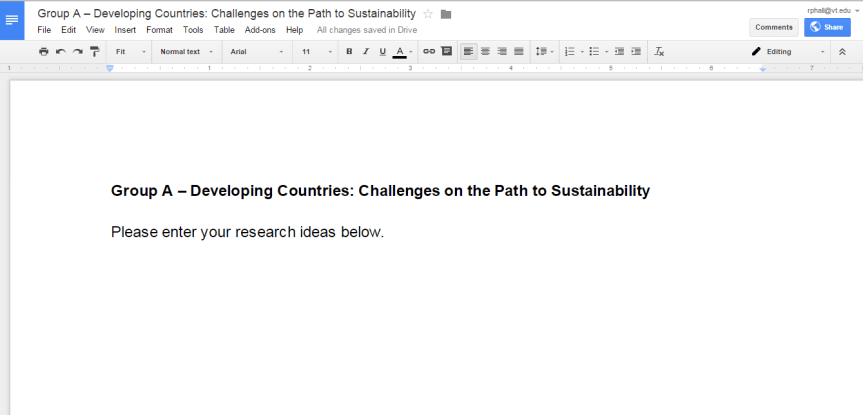
Please click on the image below to access the shared Google Doc that we will use during the working group discussion from 10:15am to 12:00pm on Friday, May 8, 2015.
TRB is sponsoring the Transportation for Sustainability–An International Conference on May 7-8, 2015 in Washington, D.C. The conference is designed to draw attention to the global and international aspects of transportation and sustainability, including problems of transportation and sustainability that are common to many nations.
The conference will provide an opportunity to showcase state-of-the-art solutions that can be applied in the United States and other countries; address sustainability and international relations that arise when transportation modes cross country borders; and highlight issues of global sustainability related to transportation that may be hard to effectively address because of a lack of knowledge and research capacity.
Key sessions during the conference will be webcast, including all plenary sessions, breakout sessions, and two working group discussions on Developing Countries: Challenges on the Path to Sustainability (which I will be chairing) and Practitioner’s Guidance on Implementing Sustainability). The webcast option is complimentary for federal, state, and local government employees as well as students. Otherwise a webcast fee of $129 is due when registering for the conference.
On March 21-22, the IITK-VT partnership held a successful Workshop in Delhi, India, to launch the Initiative for Construction Safety Awareness (ICONSA-15). We have uploaded a series of photos from the event to the ICONSA website and have posted the presentations that were given by the participants. These items can be accessed by selecting the images below.
With India poised to make a significant investment of resources in the creation and maintenance of infrastructure, there is an urgent need to ensure that this investment does not come at the expense of worker health and safety. On March 21-22, the IITK-VT partnership will be holding a Workshop on the Initiative for Construction Safety Awareness (ICONSA-15)that will bring together national and international stakeholders – contractors, owners, regulators, and academic institutions – to explore different aspects of construction safety and identify strategic opportunities to advance awareness and research on this critical issue. The participation of this broad stakeholder group will ensure a discussion on the latest state of practice with regards to the formulation and compliance of appropriate standards and legal frameworks.
On February 24, Yehyun An successfully defended her dissertation entitled “The Operationalization of Capacity Development: The Case of Urban Infrastructure Projects in India.”
Yehyun was a doctoral candidate in the Planning, Governance, and Globalization (PGG) program at Virginia Tech, and over the past several years has been a highly valued graduate research assistant in the IITK-VT partnership on Sustainable Infrastructure Development.
Guru Ghosh, Ralph Hall, Yehyun An, Michael Garvin, and Yang Zhang
Yehyun’s research explores the concept of capacity development (CD) in the context of a large urban infrastructure program in India – the Jawaharlal Nehru National Urban Renewal Mission (JNNURM). Her research utilized a unique combination of qualitative and quantitative methods and (I believe) is the first application of fuzzy-set Qualitative Comparative Analysis (fsQCA) in the field of CD. The findings from Yehyun’s research make important contributions to both CD theory and practice. I have included the abstract of Yehyun’s dissertation below for those interested in reading more about her research.
ABSTRACT
Since the 1950s, Capacity Development (CD) has been an important component of international development agendas. It established the widespread consensus that the capacity of individuals and organizations is critical to maintaining and enhancing the effectiveness of development projects and programs. A problem, however, is that the concept has been applied without due consideration to how it should be adapted to the local context, making it more of a symbolic gesture. The application of CD to urban infrastructure projects in India is one such example. Recognizing the shortage of urban infrastructure as one of the major impediments in India’s economic growth and rapid urbanization, the Government of India (GOI) launched the Jawaharlal Nehru National Urban Renewal Mission (JNNURM) in December 2005 to provide substantial central financial assistance to cities for urban development over a period of seven years. The GOI expected the JNNURM to reform institutions and strengthen human resource capability related to many areas of project delivery. During its implementation, however, the JNNURM has been confronted by problems related to a lack of capacity. This research reviews the capacity challenges related to the JNNURM program and considers the broader implications for urban infrastructure development in other developing countries.
This research begins with the question “How can CD be operationalized?” From this starting point, the research seeks to reveal the operational values of CD. Following a detailed literature review on CD, capacity factors that are applicable to the urban sector in India are identified and a CD framework is developed. Two research methods – case studies and fuzzy-set Qualitative Comparative Analysis (fsQCA) – are adopted to answer the primary research questions. By leveraging the strength of these two methods, this research advances our understanding of the relationship between capacity and development goals such as improving project performance. In the case studies, this research investigates the gaps between CD theory and practice through the lens of practitioner perceptions of CD. In addition, unlike traditional thinking on the linear relationship between capacity and project outcomes, the case studies reveal two-way causal relationships between capacity and project outcomes that form a spiral structure between the project delivery process and capacity factors. Better capacity can enhance project performance and lead to better outcomes, and project performance and outcomes also influence and reinforce capacity in the reverse direction. Moreover, through the fsQCA, this research identified causal relationships between capacity factors and outcomes and demonstrated that the capacity factors generate different outcomes through their interactions with other capacity factors. This finding contributes to our understanding of how capacity is interconnected with development goals.
In summary, this research contributes to both CD theory and CD practice based on a comprehensive approach that not only considers CD at multiple levels (environmental, organizational/network, and individual/project), but also covers different CD subjects such as context, actors, dimensions, processes, and impacts. Through this comprehensive approach, a range of important findings are developed that can help researchers and practitioners operationalize the complex concept of CD.
If you would like to apply for either of these opportunities, I encourage you to carefully review the UAP Research Needs Statement to identify the subject area and faculty with whom you would like to work. Please include this information in the personal statement submitted with your application.
Following the announcement that Google will no longer be selling Glass, I thought I’d provide an update on my plans for using Google Glass and Apps this coming semester. Essentially, not much will change. I will continue to use the platform to support my courses and plan to test new ways of interacting with students in the classroom, such as using ParticiPoll to ask questions during a presentation.
My experience with learning and using Glass and Google Apps has transformed the way I approach my teaching. I no longer use VT’s Scholar system and run all of my courses using VT-supported Google Apps. I’m more willing to try new things and can easily walk away from ideas that simply didn’t work. I’m sure the spirit of the Explorer program had something to do with this. Below is the welcome message from Google that came with Glass device.
During the Fall 2014 semester, I tested Google Classroom in one of my courses and will now rollout this App in all of my courses. I would describe the App as a useful assignment management tool that eliminates the need to download/upload assignments and streamlines this aspect of administering a course. While it took a while to understand exactly how files were being shared – this process is managed in the Classroom App – I’d recommend the App to anyone who is comfortable using Google Drive.
Towards the end of this semester, I plan to conclude an assignment-feedback study I have been undertaking with Mary English that should reveal the value of providing video feedback in addition to written comments. With Glass being phased out for now, I plan to start testing alternative video recording devices and software to capture my feedback. The suite of Google Apps I use to support my courses will not change.
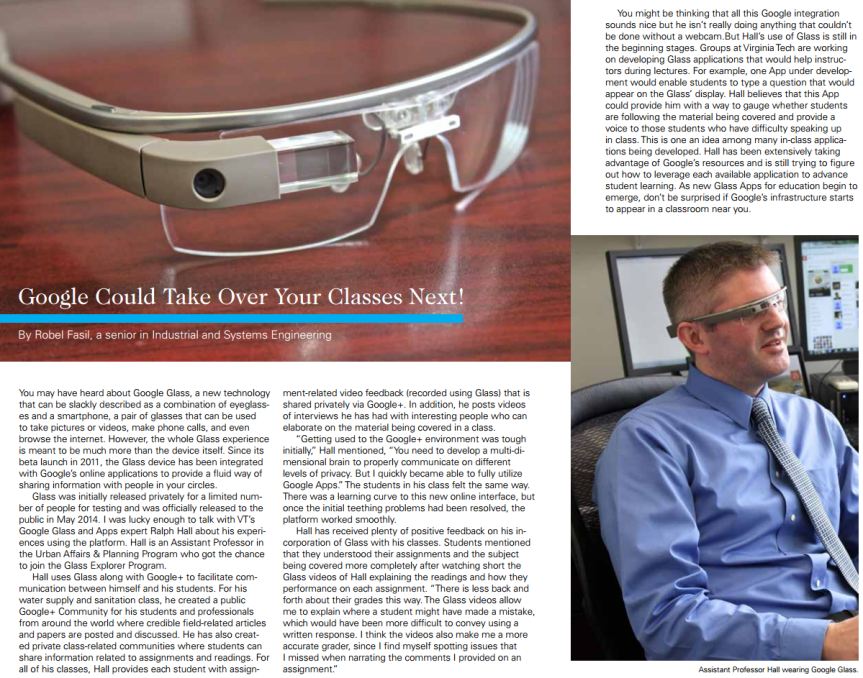
I have included a short article below that was published in the Engineers’ Forum magazine (pp. 14-15) that talks about my use of Google Glass and Apps. The title of the article reflects my jump into the Google Inc. universe. A jump that I have yet to regret.
While ADD40 is supporting a number of workshops, sessions, and meetings at the annual meeting, the following list outlines the committee-led events:
Monday
8:00AM- 9:45AM: Climate Change Joint Subcommittee of ADC70, ADC80, ADD40. Adam Millard-Ball, University of California, Santa Cruz, presiding. Richard W. Baldauf, U.S. Environmental Protection Agency, presiding. Practice Ready Papers.
10:45AM- 12:30PM:SESSION 305: Transportation and Sustainability. John MacArthur, Oregon Transportation Research and Education Consortium, presiding. Poster Session | Practice Ready Papers.
The information below outlines the agenda for the annual meeting of the Society of Socio-Economists (SOS) on Tuesday, January 6, in Washington, D.C. A series of concurrent sessions will follow a morning plenary that is intended to provide a forum to discuss how the ‘socio-economic’ approach to economic analysis can help connect disciplines and perhaps chart new research collaborations/projects.
The meeting is open to professionals, academics, and students. The registration fee is $75 for professionals and academics and $10 for students. This fee can be reduced or waived if needed.
9:00 a.m. – 11:45 a.m. Plenary Session
Topics to be discussed include…
Socio-Economic Theory
Sustainable Economic Growth
Wealth and Income Distribution
Poverty, Race, Gender, and Class
Corporate Fiduciary Duties, Governance, and Social Responsibility






 Ralph P Hall