New Paper – WTP for VIP Latrines

We recently published in the Journal of Water, Sanitation and Hygiene for Development the final paper related to our MUS research in Senegal. I have provided the abstract to the paper below.2016-01-15_1157

Abstract: In 2015, African ministers established the Ngor Declaration to achieve universal access to adequate sanitation and hygiene services and eliminate open defecation by 2030. Realizing this target will require significant public and private investment. Over the last two decades, there has been increasing recognition that sanitation programs should be demand driven, yet limited information exists about how much rural residents in developing countries are willing to pay for sanitation improvements. This paper applies the contingent valuation approach to evaluate how much households in rural Senegal are willing to pay for a ventilated improved pit (VIP) latrine. The analysis uses data from 1,635 household surveys that were conducted in 47 rural communities across four regions in Senegal. The willingness to pay model found that respondents were more willing to pay for a VIP latrine if they had plans to improve their existing latrine, lived in districts located nearer to the capital city of Dakar, were dissatisfied with their existing sanitation service, and were male. The analysis also indicates that the current household contribution of 5% of the costs of constructing a VIP latrine could be increased to 30% with only a modest decline in the number of households willing to pay this amount.
TRB 2016 Annual Meeting Workshop

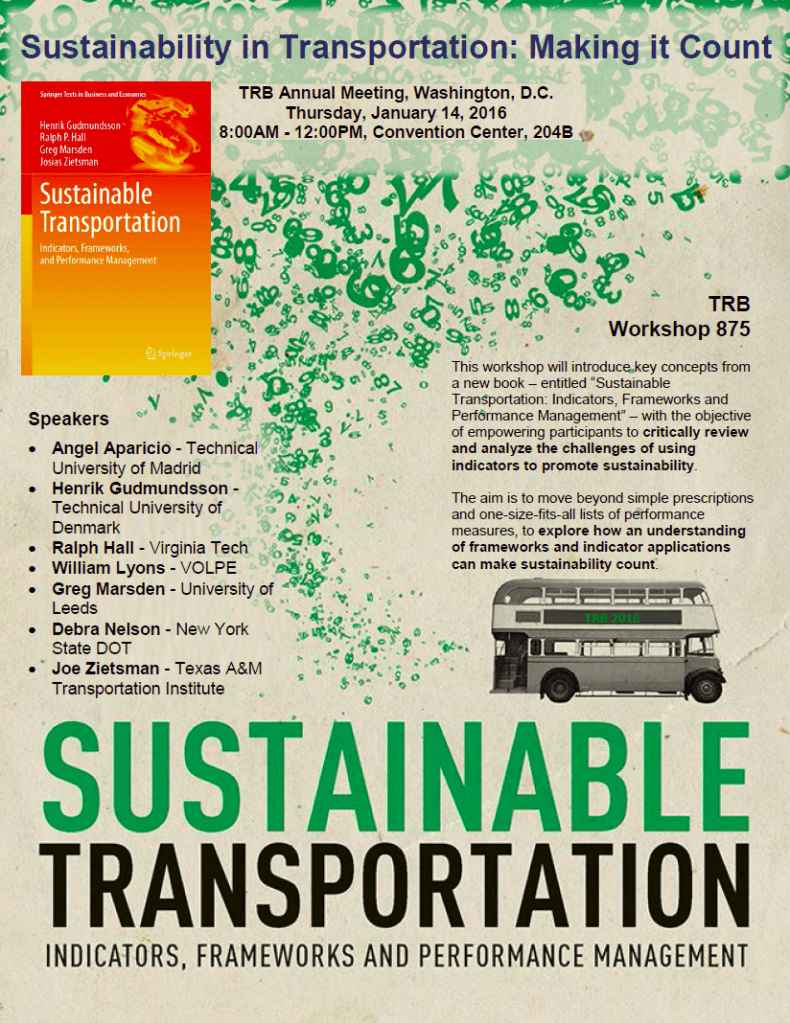
At the 2016 TRB Annual Meeting, I will be taking part in a workshop entitled Sustainability in Transportation – Making it Count. This workshop will introduce key concepts from our new book – Sustainable Transportation: Indicators, Frameworks and Performance Management – with the objective of empowering participants to critically review and analyze the challenges of using indicators to promote sustainability. The aim is to move beyond simple prescriptions and one-size-fits-all lists of performance measures, to explore how an understanding of frameworks and indicator applications can make sustainability count.

Time/Location:

Thursday, January 14, 2016, 8:00AM – 12:00PM

Convention Center, 204B

Speakers:

2015-12-05_2013

Public Health Grand Rounds Seminar – 12pm, Oct 22 (Webcast)

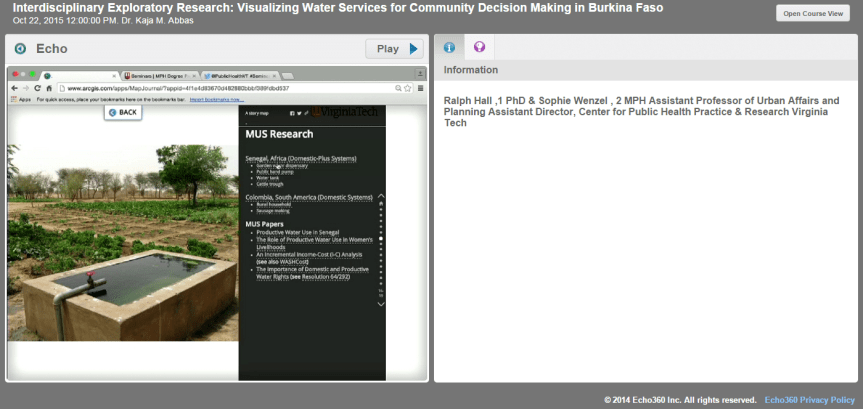
At 12pm on Thursday, October 22, Sophie Wenzel and I will give a seminar on our research group’s work relating to rural water services planning. We will support the presentation with a story map that can be accessed by clicking on the image below.

2015-10-17_1405

Since the webcast will not enable viewers to ask questions, I have set up a public Google Doc in which viewers can ask questions or provide feedback/comments. We will do our best to respond to these questions at the end of our presentation. If we run out of time, I will post a written response to questions we were unable to address on this blog.

2015-10-17_1424

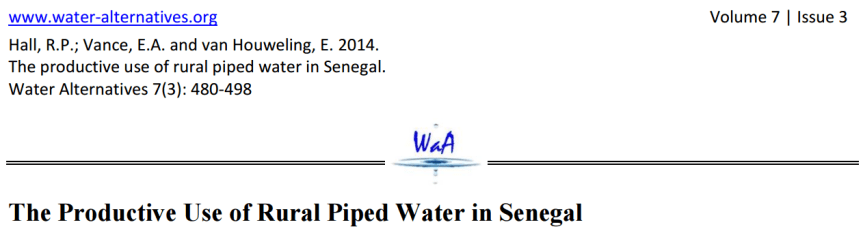
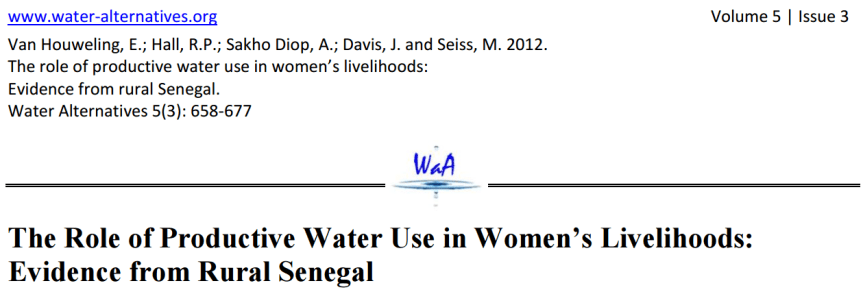
The MUS-Senegal Trilogy

Our final paper related to multiple-use water services (MUS) in Senegal was recently published in Water Alternatives. This paper completes our trilogy of papers in which we [1] explore the extent of piped-water-based productive activity occurring in Senegal and how this relates to system performance, [2] study the role of productive water use in women’s livelihoods, and [3] undertake an incremental income-cost (I-C) analysis of whether the theoretical financial benefits to households from additional piped-water-based productive activities would be greater than the estimated system upgrade costs.

These three papers capture the main findings from our study of MUS in Senegal and offer some important empirical research on the emerging concept of MUS.21
3

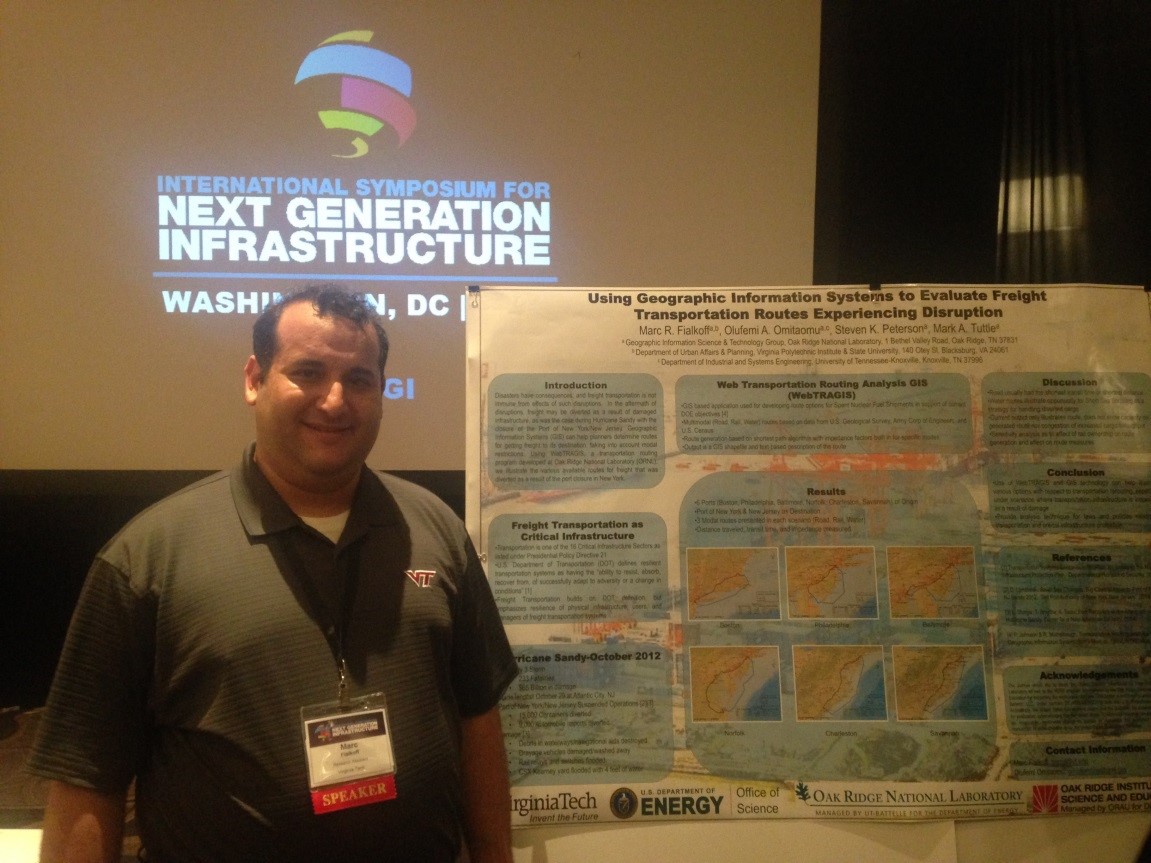
VT PGG Student Presents at ISNGI 2015

This past week, one of my PGG doctoral students, Marc Fialkoff, attended the International Symposium on Next Generation Infrastructure in Washington D.C. The conference brought together scholars from a variety of disciplines to discuss challenges in the areas of energy, transportation, water resources, and healthcare. MarcThe panel sessions focused on individual critical infrastructure sectors as well as techniques for modeling and implementing policies for more resilient infrastructure. Marc presented his work on freight transportation resilience and using GIS to evaluate legal restrictions on short sea shipping under disruptive conditions. This research was undertaken during his summer at Oak Ridge National Laboratory under guidance of Olufemi Omitaomu, the team lead for the Critical Infrastructure and Urban Resilience group at Oak Ridge National Lab.

2015-09-16_1544

Marc’s research provides a good example of the interdisciplinary work that is undertaken by students in the PGG program at Virginia Tech. With training in law and transportation planning, Marc’s research bridges disciplines of law, planning, civil engineering, and network analysis to explore the impact of law and policy on the movement of goods under a time of crisis – e.g., during Hurricane Sandy.

I co-chair Marc’s PhD committee with Ralph Buehler. Kathleen Hancock, Henning Mortveit, and Jonathan Gutoff also serve on Marc’s committee.

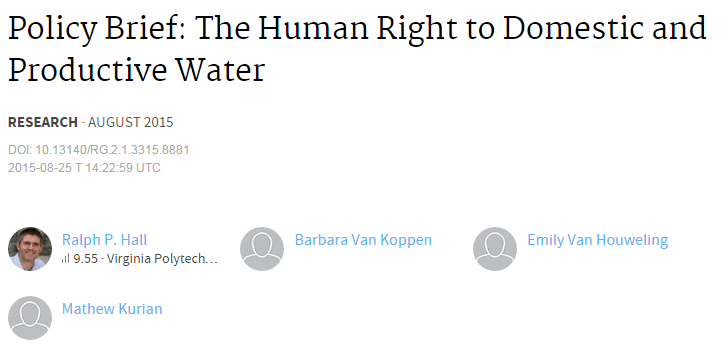
Policy Brief: The Human Right to Domestic and Productive Water

In 2010, a milestone was reached when the UN General Assembly recognized the human right to safe and clean drinking water and sanitation. Yet, water also plays an important role in realizing other human rights such as the right to food and livelihoods, and in realizing the Convention on the Elimination of All Forms of Discrimination Against Women. These broader water-related rights have been recognized but not operationalized. This (draft) policy brief argues for a more holistic interpretation of existing international human rights law that supports a broader range of water-related rights. In addition, it raises the question of whether the current formulation of the human right to safe and clean drinking water, could limit development opportunities for people in rural and peri-urban communities who also use water for productive activities around the homestead.

We would welcome any comments you might have on this policy brief that should be viewed as a working draft.

2015-08-25_1030

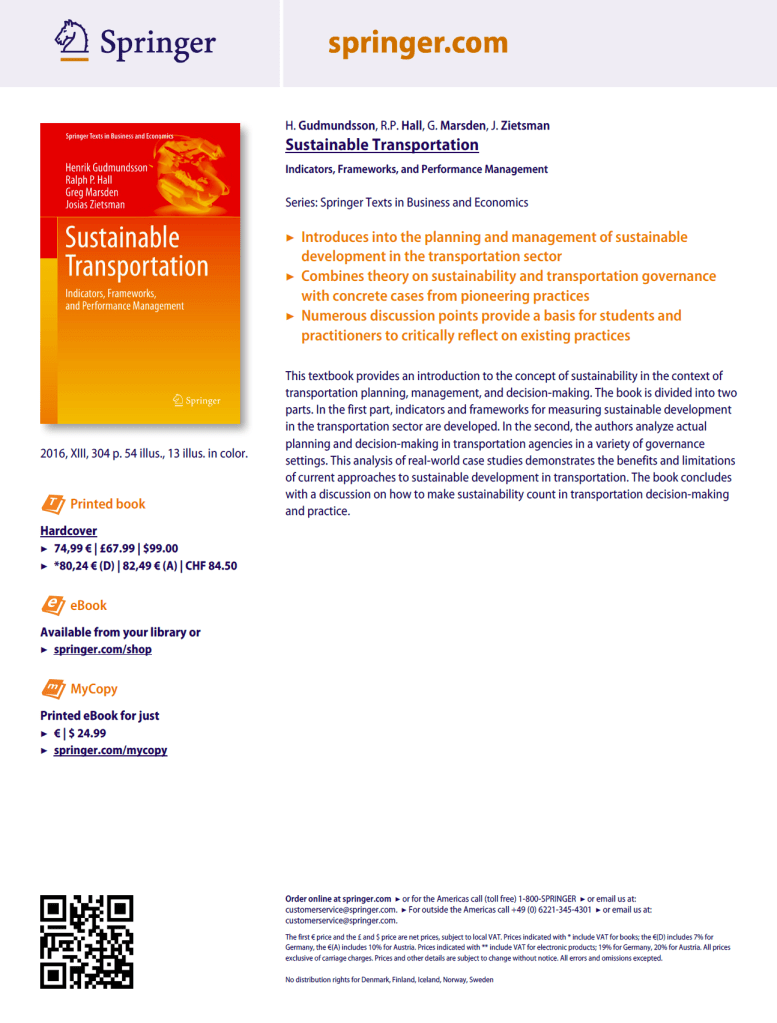
Sustainable Transportation – Flier

Here are a few key points about our new book on Sustainable Transportation that are also captured on the flier below:

▶ Introduces the planning and management of sustainable development in the transportation sector.

▶ Combines theory on sustainability and transportation governance with concrete cases from pioneering practices.

▶ Numerous discussion points provide a basis for students and practitioners to critically reflect on existing practices.

Sustainable Transportation

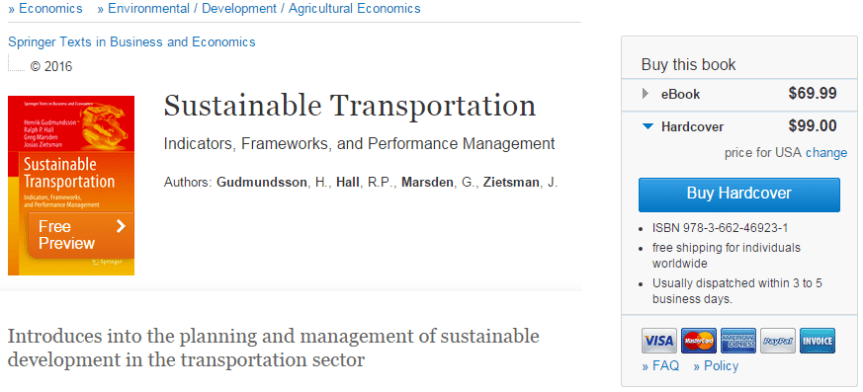
New Sustainable Transportation Book

I’m pleased to announce the publication of our new book on “Sustainable Transportation: Indicators, Frameworks, and Performance Management.”

book
This book is the result of six years of collaboration between Dr. Henrik Gudmundsson (Technical University of Denmark), Dr. Greg Marsden (University of Leeds), Dr. Josias Zietsman (Texas A&M University), and I. It draws from decades of collective experience in the areas of sustainable development and sustainable transportation, focused on research, teaching, and practice.

The book is intended to provide students and practitioners with a deep understanding of the basic concepts of sustainability as well as a coherent framework for how to apply them consistently in the context of transportation planning, management, and decision making at different levels.

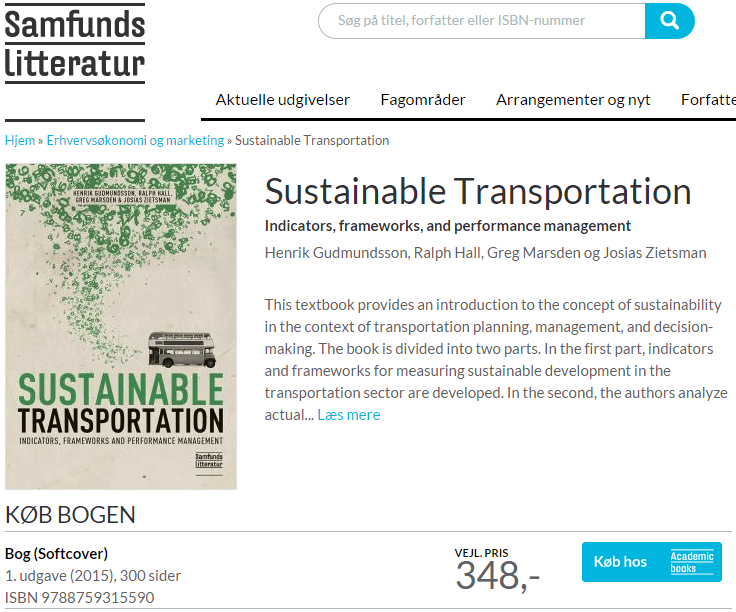
A version of the book will also be published by Samfundslitteratur for the nordic market.

book2

In the coming weeks we will launch a book website that will contain additional information and updates.