Posters for “Experience VT” Event

This weekend I will be taking part in the “Experience Virginia Tech: Learn, Explore, Engage” event that was commission by President Sand’s to showcase the university’s impact on the world around us. From 9am to noon tomorrow at the VT Inn, I will be presenting the three posters below that document the research and main findings from an impact evaluation I led of an MCC-funded rural water supply project in Nampula, Mozambique. I plan to capture key moments from the event using Google Glass and will post some images and video to this blog and to my Google+ account during the day.

Poster_1 Poster_2 Poster_3

New Perspectives on Resilience

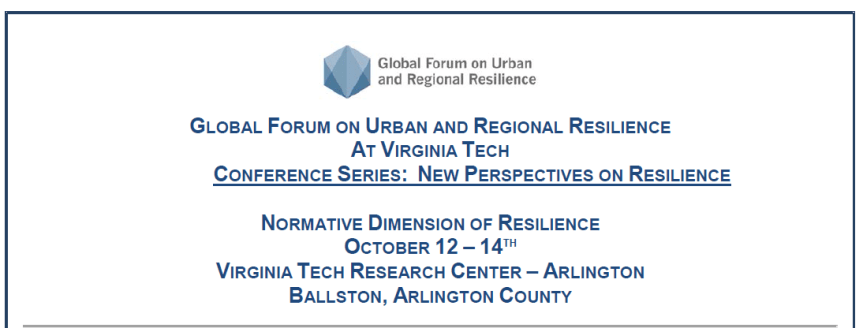
This afternoon, the Global Forum on Urban and Regional Resilience began its inaugural conference on Normative Aspects of Resilience. Click on the image below to view the conference agenda. Follow the conference via Twitter (on Oct 13 and 14) using the hashtag #GFURR. 2014-10-12_2238

This slideshow requires JavaScript.

Hokie BugFest

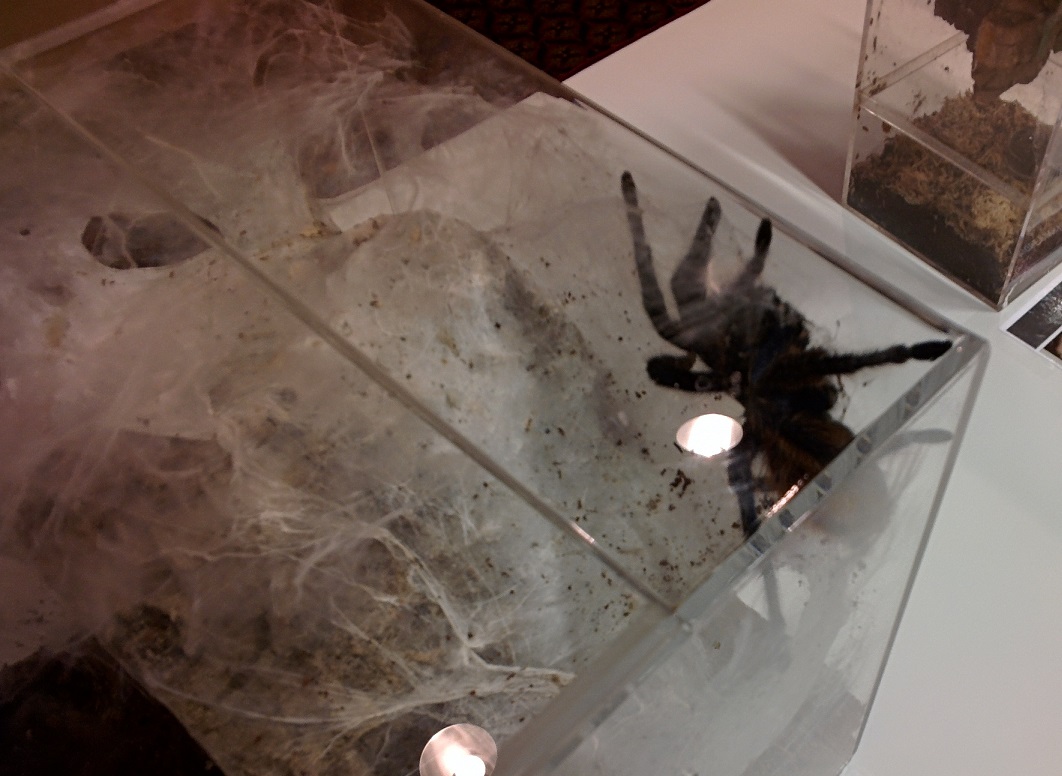
2014-10-11 11.44.36One of the great things about living in Blacksburg are the events that the university hosts. I spent this morning at the 4th Annual Hokie BugFest held at the VT Inn. This extension outreach event is hosted by the Department of Entomology in cooperation with Virginia 4-H and the W. B. Alwood Entomological Society. The images below (taken through Glass) provide a sample of the event’s installments and activities.

This slideshow requires JavaScript.

Conversation with Prof. Misra on the IITK-VT Partnership

I had the pleasure of spending today with Prof. Sudhir Misra (Co-PI of the IITK-VT Partnership), during which we held a number of meetings with senior faculty at Virginia Tech focused on the future activities of the IITK-VT Partnership. Prof. Misra also provided a guest lecture in the graduate course on Advanced Urban Infrastructure Planning (UAP5854) – the first course at VT to be associated with the IITK-VT partnership. In between these events, we were able to find ten minutes during which I asked Prof. Misra several questions about what the IITK-VT partnership has accomplished and where we plan to take the partnership in the future. The video below captures our conversation that I recorded using Google Glass and edited in Camtasia.

Second Meeting of the DAC

This morning we held the second meeting of the Dean’s Advisory Committee (DAC) for the University Libraries. The committee was asked the following questions which led to an engaging conversation that touched on the opportunities and challenges facing colleges, departments, programs, research institutions, faculty, and students:

  • What will research and teaching look like in ten years?
  • Is there anything you wish you could change about your research practices and the way you teach?
  • What barriers or obstacles prevent you from teaching differently and approaching research differently?
  • What core research, teaching, and learning skills, literacies, abilities, or mindsets could faculty and students develop at Virginia Tech? (How do we prepare students for jobs that don’t exist yet?)

6

Since I have been using Google Glass and Apps to advance the way I teach and undertake research, I have been confronted with a number of these types of questions over the past year. From this experience, I believe the future of teaching will be heavily influenced by “teaching analytics” that will enable faculty (and students) to identify how, where, and when student learning occurs. I also believe these data will enable faculty to become better teachers by identifying those techniques that effectively engage students.

As a relatively junior faculty member, I would also like to see the creation of “teaching coaches” who mentor faculty in the art of pedagogy. These coaches could be identified through VT’s awards for teaching or through projects funded by TLOS (Technology-enhanced Learning and Online Strategies and be compensated (either financially or through a reduction in duties) for their mentoring work. The creation of an environment where faculty can experiment with new techniques, approaches, platforms, etc. is likely to be critical to advancing teaching and learning.

This slideshow requires JavaScript.

Welcome PGG and MURP Graduates!

I enjoyed meeting the new graduates in the Planning, Governance, and Globalization (PGG) doctoral program and the Urban Affairs and Planning (UAP) program this afternoon. We have a diverse group of students this year who come to Virginia Tech from various U.S. states and countries such as China, India, Russia, and Colombia. I look forward to getting to know them this coming semester. The images below were taken #throughglass.

This slideshow requires JavaScript.
Global Planning and Int. Dev. Studies

Certificate Flyer2If you are a VT graduate student and have an interest in international development, I highly recommend the Graduate Certificate in Global Planning and International Development Studies.

This fall, I will be co-teaching a class on Advance Urban Infrastructure Planning that can be counted as an elective for the certificate. Jocelyn Widmer will also be offering this fall the first required class for the certificate – International Development Policy and Planning (UAP 5764G).

Next Spring, I will be offering the second required certificate course – the International Development Planning Studio (UAP5764).

Happy Retirement Sandy!

Tomorrow, Sandy Graham will be retiring from her position as office manager for the Urban Affairs and Planning (UAP) program at Virginia Tech. Sandy has been working at Virginia Tech for 25 years and has been with UAP for the past five years. Prior to coming to UAP, Sandy worked for the Department of Hospitality and Tourism Management. The images below were taken at her retirement party last night at the University Club.

On behalf of all the UAP faculty and students, I’d like to congratulate Sandy on reaching this milestone and thank her for all of her years of service and dedication to our program and the university.

This slideshow requires JavaScript.

Teaching Sustainability

Last Wednesday, I joined Joe Zietsman (Texas A&M), Damon Fordham (Cadmus), and Ann Xu (Georgia Tech) in New York for a discussion of Education and Practitioner Training to Promote Sustainability. We were invited to speak at the TRB ADC60 summer conference on Sustainable and Resilient Infrastructure.

To prepare for my presentation on “Teaching Sustainable Development/Transportation in Institutions of Higher Education,” I reviewed the past decade of research captured in the International Journal of Sustainability in Higher Education. I also read papers from journals such as Sustainability Science and the Journal of Cleaner Production. For those new to this subject area, I recommend the following articles that provide useful frameworks or discuss important pedagogical approaches:

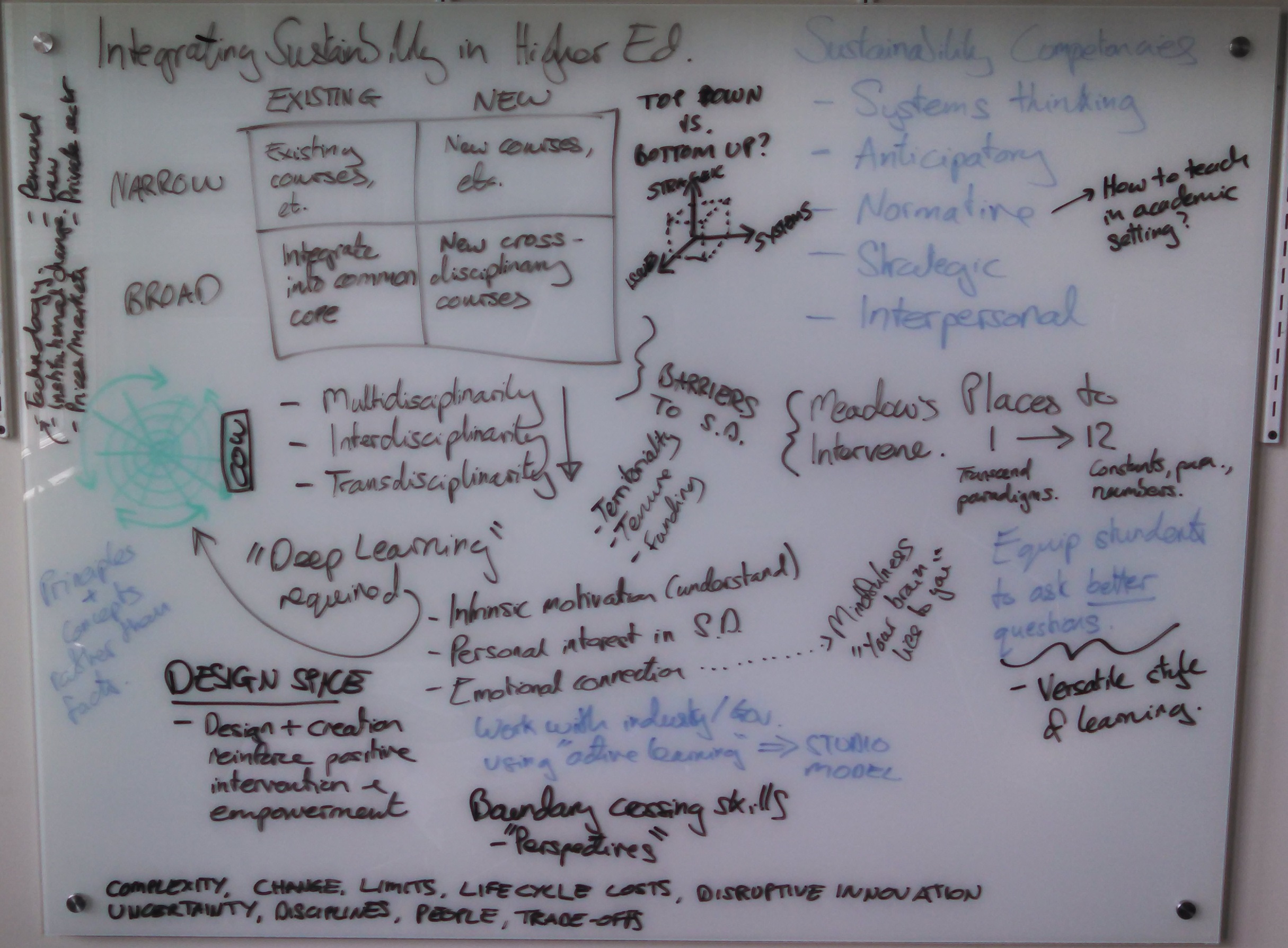
BrainstormingAfter absorbing this material, I tried to visually capture the various approaches, theories, competence areas, etc. that emerged (see photo). This visual patchwork of ideas laid the foundation for my presentation that focused on the following four questions:

  • —What knowledge and skills do students need to learn?
  • —How should we promote ‘Sustainability in Higher Education’ (SHE) – e.g., top down vs. bottom up?
  • —How do we change the hearts and minds of faculty?
  • —What should be the role of non-academic entities – e.g., government agencies, private businesses, and NGOs?

While I was only able to briefly respond to these questions in my presentation (below), the literature I cite on my slides (and listed above) should provide a useful starting point for anyone interested in learning more about theories on how to teach sustainability.

ADC60