
UAP graduate Erin Puckett recently received a Certificate of Appreciation from the Transportation Research Board (TRB) for her analysis of the TRB Research Needs Statements (RNS) database. Erin’s analysis focused on determining the extent to which the topic of sustainable 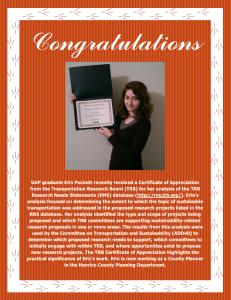 transportation was addressed in the proposed research projects listed in the RNS database. Her analysis identified the type and scope of projects being proposed and which TRB committees are supporting sustainability-related research proposals in one or more areas. The results from this analysis were used by the Committee on Transportation and Sustainability (ADD40) to determine which proposed research needs to support, which committees to initially engage with within TRB, and where opportunities exist to propose new research projects. The TRB Certificate of Appreciation highlights the practical significance of Erin’s work. Erin is now working as a County Planner in the Henrico County Planning Department.
Category: General Interest
UAP Wins Exemplary Program Award
This evening, the Urban Affairs and Planning (UAP) program received Virginia Tech’s Exemplary Program Award. The three other award recipients were the Department of Chemistry in the College of Science, the Department of Psychology also in the College of Science, and VT Engage in the Division of Student Affairs.
The 2014 award focused on recognizing groups that are developing and sustaining innovative and effective departmental approaches to fostering Ut Prosim (That I May Serve) at the undergraduate or graduate level.
I have posted a few pictures from the event below, along with a video I took through Glass of Diane Zahm receiving the award on behalf of UAP.
TRB 2015 Annual Meeting
Having just returned from a intellectually stimulating SOS meeting in Washington, D.C., I’m looking forward to traveling back to DC next week for the 2015 TRB Annual Meeting. During this meeting I will be supporting the work of the ADD40 Committee on Transportation and Sustainability.
 While ADD40 is supporting a number of workshops, sessions, and meetings at the annual meeting, the following list outlines the committee-led events:
Monday
- 8:00AM- 9:45AM: Climate Change Joint Subcommittee of ADC70, ADC80, ADD40. Adam Millard-Ball, University of California, Santa Cruz, presiding. Richard W. Baldauf, U.S. Environmental Protection Agency, presiding. Practice Ready Papers.
- 10:45AM- 12:30PM: SESSION 305: Transportation and Sustainability. John MacArthur, Oregon Transportation Research and Education Consortium, presiding. Poster Session | Practice Ready Papers.
- 1:30PM- 3:15PM: Sustainability Research Subcommittee, ADD40(2). Ralph Hall, Virginia Polytechnic University and State University (Virginia Tech), presiding – AGENDA.
- 1:30PM- 3:15PM: Health and Transportation Joint Subcommittee of ADD50, ADD40, ADB10, ABJ30. Ed Christopher, Federal Highway Administration, presiding. Eloisa Tigre Raynault, Planning Communities, LLC, presiding.
Tuesday
- 3:45PM- 5:30PM: SESSION 677: Sustainable Transportation Indicators & Measures – From Meta to Local Perspectives. Todd Alexander Litman, Victoria Transport Policy Institute, Canada, presiding. Lectern Session | AICP Certification Maintenance Session.
- 5:45PM- 7:15PM: International Sustainability Subcommittee, ADD40(4). April Marchese, Federal Highway Administration, presiding.
Wednesday
- 8:00AM- 12:00PM: Transportation and Sustainability Committee. Josias Zietsman, Texas A&M Transportation Institute , presiding.
- 2:30PM- 4:00PM: SESSION 829: Department of Transportation Experience with Sustainability Tools. Tina Hodges, Federal Highway Administration, presiding. Lectern Session | AICP Certification Maintenance Session.
- 4:30PM- 6:00PM: Sustainability Measurement Subcommittee, ADD40(1). Henrik Gudmundsson, Technical University of Denmark, presiding. Dan Hardy, Renaissance Planning Group, presiding.
SOS Meeting – Agenda
The information below outlines the agenda for the annual meeting of the Society of Socio-Economists (SOS) on Tuesday, January 6, in Washington, D.C. A series of concurrent sessions will follow a morning plenary that is intended to provide a forum to discuss how the ‘socio-economic’ approach to economic analysis can help connect disciplines and perhaps chart new research collaborations/projects.
 A list of meeting participants can be found here.
The meeting is open to professionals, academics, and students. The registration fee is $75 for professionals and academics and $10 for students. This fee can be reduced or waived if needed.
9:00 a.m. – 11:45 a.m. Plenary Session
Topics to be discussed include…
- Socio-Economic Theory
- Sustainable Economic Growth
- Wealth and Income Distribution
- Poverty, Race, Gender, and Class
- Corporate Fiduciary Duties, Governance, and Social Responsibility
- Social Entrepreneurship
- Economic, Financial, and Environmental Regulation
- Economics of War and Peace
- Tax Policy
- Ethical Dimensions of Economic Analysis
12:15 – 1:15 p.m. Luncheon Panel
- Robert Ashford (Syracuse) (Moderator)
- Nicholas Ashford (M.I.T.)
- William Black (University of Missouri – Kansas City)
- June Carbone (Minnesota)
1:30 p.m. – 3:00 p.m. Concurrent Sessions
- 1-A Connecting and Integrating Strategies for an Economic Transformation
Nicholas Ashford (M.I.T.) (Organizer/Moderator)
Ralph Hall (Virginia Tech)
Katherine McFate (Center for Effective Government)
- 1-B Reinventing the State in an Era of Inequality
June Carbone (Minnesota) (Organizer/Moderator)
Sara Jordan (Virginia Tech)
Nina Kohn (Syracuse)
Katie Wells (Virginia Tech)
- 1-C Socio-Economic Theory
Robert Ashford (Syracuse) (Organizer/Moderator)
Stephan Padfield (Akron)
3:15 p.m. – 4:45 p.m. Concurrent Sessions
- 2-A Governing Environmental Justice in the Context of Climate Change
Susan M. Sterett (Virginia Tech) (Organizer/Moderator)
Jalonne White-Newsome (WE ACT)
- 2-B Financial Services Regulation in Times of Financial Crisis
Michael Malloy (McGeorge) (Organizer/Moderator)
Colleen Baker (Illinois)
- 2-C Socio-economics Perspectives on Economic Theory
Stefan Padfield (Akron) (Moderator)
David Bieri (Virginia Tech)
Robert Kirsch (Salisbury University)
6:00 p.m. Concluding Plenary
- David Cay Johnston (Pulitzer Prize Winning Author)
SOS Meeting in Washington D.C. (Jan 6)
On Tuesday, January 6, the Society of Socio-Economists (SOS) will be holding its annual meeting in Washington, D.C. This years meeting on “Socio-Economics: Broadening the Economic Debate” is being co-sponsored by SPIA and promises to be a valuable and thought provoking event with notable speakers (see below).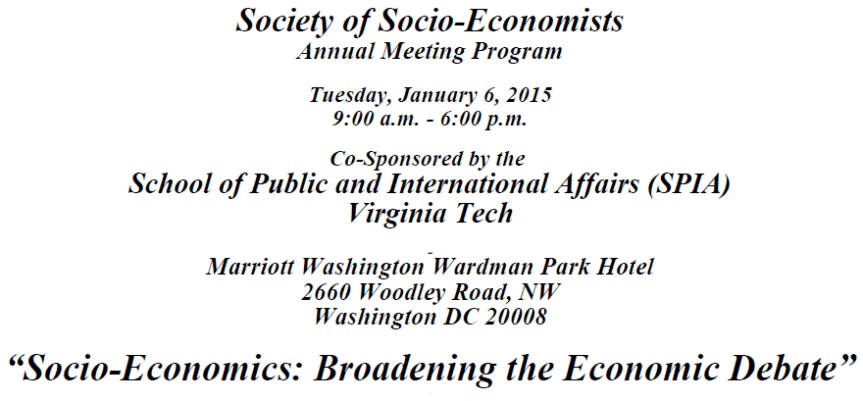
The intent of the meeting is to provide people with an opportunity to explore how their research may connect with the ‘socio-economic’ approach to economic analysis, and to build bridges between disciplines and perhaps chart new research collaborations/projects. I have reproduced the “Statement of Socio-Economic Principles” below for those who are not familiar with this text. The principles provide both a sound epistemological foundation and set of ethical rules of fair play regarding economic analysis that could aid the formulation of public policy.
The meeting will consist of a morning plenary followed by a series of concurrent sessions in the afternoon. The plenary is intended to provide a forum that affords everyone a chance to speak and exchange views. Whereas the concurrent sessions allow for more narrowly focused, but still broad, discussions.
The growing list of meeting participants includes the following individuals:
- William Anderson (Virginia Tech)
- Nicholas Ashford (MIT)
- Robert Ashford (Syracuse)
- Colleen Baker (Illinois)
- David Bieri (Virginia Tech)
- William Black (University of Missouri – Kansas City)
- Emily Brock (Virginia Tech)
- June Carbone (Minnesota)
- Harold Channer (Manhattan Neighborhood Network)
- Caesar Cororaton (Virginia Tech)
- Paul Davidson (Founding Editor, Journal of Post-Keynesian Economics)
- Dusko Doder (Author)
- Ross Eisenbrey (Vice president of EPI)
- Eddie Eitches (President, American Federation of Government Employees 476 – Housing and Urban Development)
- Sidney Greenfield (Wisconsin–Milwaukee – Emeritus)
- Ralph Hall (Virginia Tech)
- Richard Hattwick (Founding Editor – Journal of Socio-Economics)
- David Cay Johnston (Pulitzer Prize Winning Author)
- Sara Jordan (Virginia Tech)
- Anne Khademian (Virginia Tech)
- Robert Kirsch (Salisbury University)
- Nina Kohn (Syracuse)
- Sarah Lyon-Hill (Virginia Tech)
- Michael Malloy (McGeorge)
- Katherine McFate (Center for Effective Government)
- David Orden (Virginia Tech)
- Stefan Padfield (Akron)
- Ezra Rosser (American)
- Susan Sterett (Virginia Tech)
- Jennifer Taub (Vermont)
- Katie Wells (Virginia Tech)
- Jalonne White-Newsome (WE ACT)
- Johnanne Winchester (United Nations Liaison)
- Stuart Yasgur (Economist, Ashoka Foundation)
- Xiaochen Zhang (Virginia Tech)
Statement of Socio-Economic Principles
Socio-economics begins with the assumption that economics is not a self-contained system, but is embedded in society, polity, culture, and nature. Drawing upon economics, sociology, political science, psychology, anthropology, biology, and other social and natural sciences, philosophy, history, law, management, and other disciplines, socio-economics regards competitive behavior as a subset of human behavior within a societal and natural context that both enables and constrains competition and cooperation. Rather than assume that the individual pursuit of self-interest automatically or generally tends toward an optimal allocation of resources, socio-economics assumes that societal sources of order are necessary for people and markets to function efficiently. Rather than assume that people act only rationally, or that they pursue only self-interest, socio-economics seeks to advance a more encompassing interdisciplinary understanding of economic behavior open to the assumption that individual choices are shaped not only by notions of rationality but also by emotions, social bonds, beliefs, expectations, and a sense of morality.
Socio-economics is both a positive and a normative science. It is dedicated to the empirical, reality testing approach to knowledge. It respects both inductive and deductive reasoning. But it also openly recognizes the policy relevance of teaching and research and seeks to be self-aware of its normative implications rather than maintaining the mantle of an exclusively positive science. Although it sees questions of value inextricably connected with individual and group economic choices, socio-economics does not entail a commitment to any one paradigm or ideological position, but is open to a range of thinking that treats economic behavior as involving the whole person and all facets of society within a continually evolving natural context.
Unique among interdisciplinary approaches, however, socio-economics recognizes the pervasive and powerful influence of the neoclassical paradigm on twentieth century thought. Recognizing that people first adopt paradigms of thought and then perform their inductive, deductive, and empirical analyses, socio-economists seek to examine the assumptions of the neoclassical paradigm, develop a rigorous understanding of its limitations, improve upon its application, and develop alternative, perhaps complementary, approaches that are predictive, exemplary, and morally sound. With modest amendment, this description of Socio-economics was the substance of the petition signed by more than one hundred twenty law professors from over fifty member schools of the Association of American Law Schools (AALS), to establish the AALS Section on Socio-Economics. It serves as the constitution of the Section. Source.
Additional information of socio-economics can be read in this paper on Socio-Economics – An Overview by Prof. Robert Ashford.
UAP Get To Know U Event – Photos
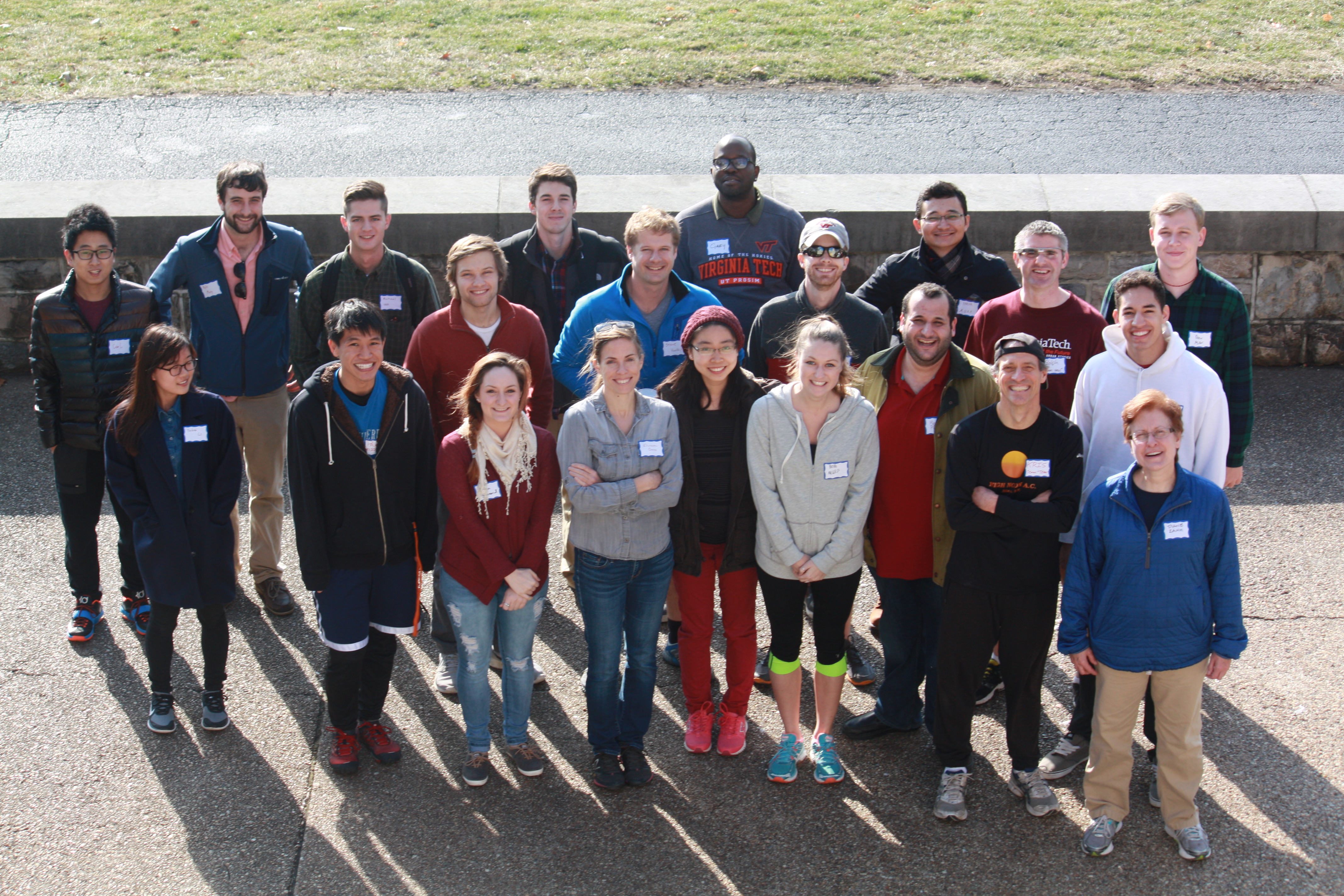 This afternoon UAP held its inaugural “Get To Know U Event.” The purpose of the event was to enable students in EPP, PUA, MURP, and PGG to get to know one another and to interact with UAP faculty in a fun environment. The images below capture several moments from this afternoon’s activities.
UAP Get To Know U Event
On Monday, December 1 from 2-4pm, UAP will be holding its inaugural “Get To Know U Event” – meeting outside War Memorial Chapel. The purpose of this event is to enable students in EPP, PUA, MURP, and PGG to get to know one another and to interact with UAP faculty in a fun environment. I look forward to having all of our undergraduate, graduate, and doctoral students together in one place – it should be quite the event!

DAC Discussion of Research and Teaching
During the third meeting of the Dean’s Advisory Committee (DAC) for the University Libraries this morning, VT faculty and staff engaged in a productive discussion of research and teaching practices at the university. The focus of the conversation was on how university libraries could support emergent trends in areas such as the measurement of research impact, the communication of scholarly material, and teaching/learning environments. The (slightly blurred) images below (taken through Glass) capture the main questions the working groups were asked to explore during the 1.5 hour session.


For me, the value of the DAC meetings is the exposure I have to the broad variety of research and teaching approaches that are used by faculty at VT. A key challenge facing the university (and especially university libraries) is how to support innovative approaches while ensuring the traditional models of research, teaching, and engagement are supported.
A lingering question I have is how to advance VT’s “hands on, minds on” vision via the platforms I use to support my classes. My use of Google Glass and Apps has enabled the fluid sharing of information among class participants (and with the public in some cases). It is also allowing me to provide personalized (and private) video feedback on assignments to students via YouTube. The deeper question is whether or how this platform can help me advance the “hands on, minds on” vision. In some courses it can be difficult to find ways to provide hands on experience – e.g., think about international development courses where it is not feasible to take students overseas – but technology can be leveraged to close the distance gap. This evening I plan to take part in a Twitter conversation with VT students and the author of the Crisis Caravan (see below). Such opportunities provide new ways for students to engage with professionals and the general public. While not “hands on” in the traditional sense, there are certainly aspects of this engagement process that require students to demonstrate their social media skills (=hands on) and mastery of the subject matter (=minds on).

SPIA Conference on Resilience
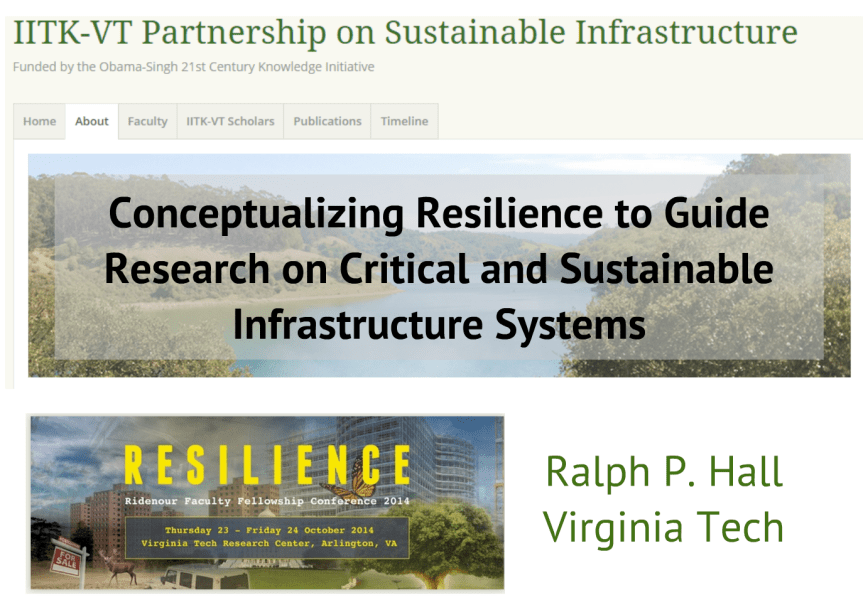
This Friday, I will be giving a presentation about the IITK-VT Partnership on Sustainable Infrastructure at Virginia Tech’s School of Public and International Affairs (SPIA) conference on resilience. The two-day conference (23-24 October) will be held at Virginia Tech’s Research Center in Arlington, Virginia. The conference can be followed on Twitter using #VTSPIA.
“Experience VT” Through Glass
This morning, Emily Van Houweling and I presented the results from the impact evaluation our team undertook of an MCC-funded rural water supply project in Nampula, Mozambique, at the “Experience Virginia Tech: Learn, Explore, Engage” event. During the event, I recorded (using Glass) a number of the presenters talking about their research and work at the university. The video below captures these comments and provides some insight into the breadth and depth of research that is underway at Virginia Tech.
 Ralph P Hall