Advanced Urban Infrastructure Planning

This fall, I will be offering a new course on Advanced Urban Infrastructure Planning (UAP 5854G) with Yehyun (Hannah) An. The course description is provided below. The course can be counted as an elective for the Graduate Certificate in Global Planning and International Development Studies.

ImageDescription: Urban infrastructure systems play a critical role in facilitating economic development and raising quality of life. However, the resource, energy, and capital-intensive characteristics of infrastructure can result in negative environmental and social impacts. Over the past two decades, the concept of sustainability and how it can be incorporated in the planning, design, and development of new infrastructure has gained significant attention. Sustainability principles have also been applied to the management of existing infrastructure.

This course will explore the emerging concepts, principles, and methodologies used to advance sustainable urban infrastructure planning. In particular, it will study national and international cases of infrastructure development, with an emphasis on projects in the US and India.

Upon completion of the course, students will be able to:

  1. describe an infrastructure system using accurate terminology;
  2. demonstrate an understanding of the main concepts and principles of infrastructure planning;
  3. identify the key features of a sustainable infrastructure system and explain how they promote sustainable development;
  4. apply analytical tools for infrastructure planning;
  5. critically evaluate infrastructure cases/projects/proposals through the lens of sustainability; and
  6. identify the gaps between theoretical principles of sustainable infrastructure and their application in practices.

Time: Tue & Thu 11:00am─12:15pm

Location: Architecture Annex 111

Credits: 3

Teaching Sustainability

Last Wednesday, I joined Joe Zietsman (Texas A&M), Damon Fordham (Cadmus), and Ann Xu (Georgia Tech) in New York for a discussion of Education and Practitioner Training to Promote Sustainability. We were invited to speak at the TRB ADC60 summer conference on Sustainable and Resilient Infrastructure.

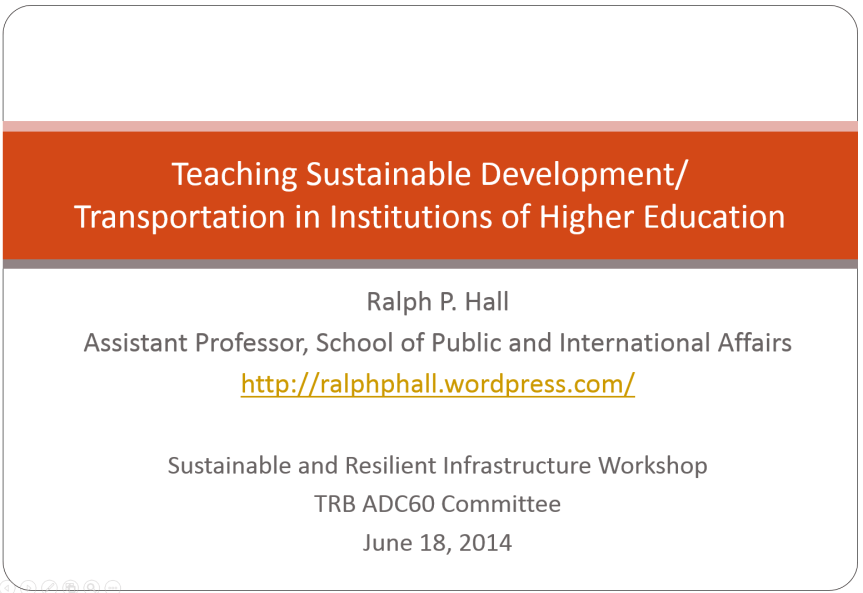
To prepare for my presentation on “Teaching Sustainable Development/Transportation in Institutions of Higher Education,” I reviewed the past decade of research captured in the International Journal of Sustainability in Higher Education. I also read papers from journals such as Sustainability Science and the Journal of Cleaner Production. For those new to this subject area, I recommend the following articles that provide useful frameworks or discuss important pedagogical approaches:

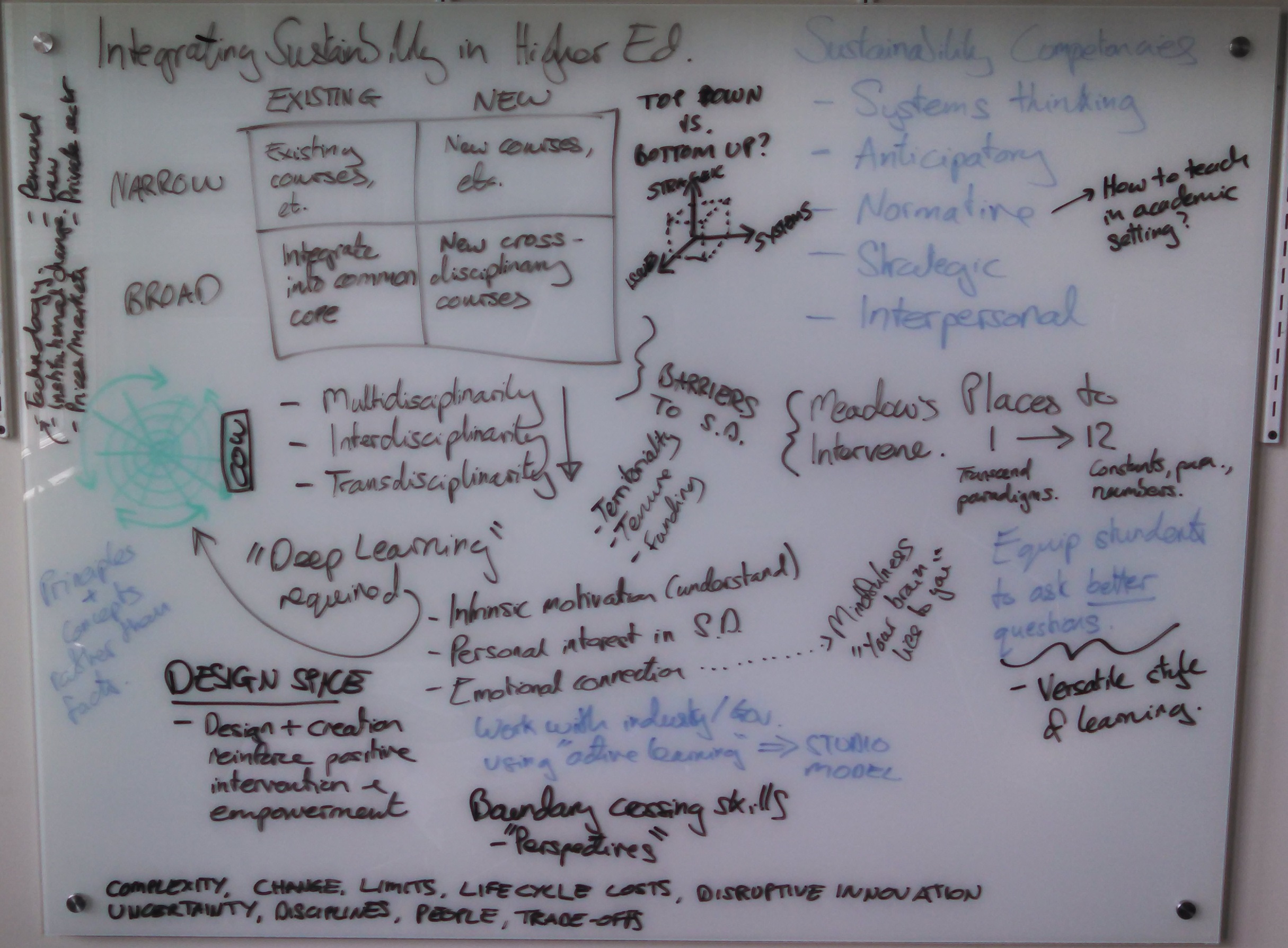
BrainstormingAfter absorbing this material, I tried to visually capture the various approaches, theories, competence areas, etc. that emerged (see photo). This visual patchwork of ideas laid the foundation for my presentation that focused on the following four questions:

  • —What knowledge and skills do students need to learn?
  • —How should we promote ‘Sustainability in Higher Education’ (SHE) – e.g., top down vs. bottom up?
  • —How do we change the hearts and minds of faculty?
  • —What should be the role of non-academic entities – e.g., government agencies, private businesses, and NGOs?

While I was only able to briefly respond to these questions in my presentation (below), the literature I cite on my slides (and listed above) should provide a useful starting point for anyone interested in learning more about theories on how to teach sustainability.

ADC60


Teaching Using Google Glass and Apps

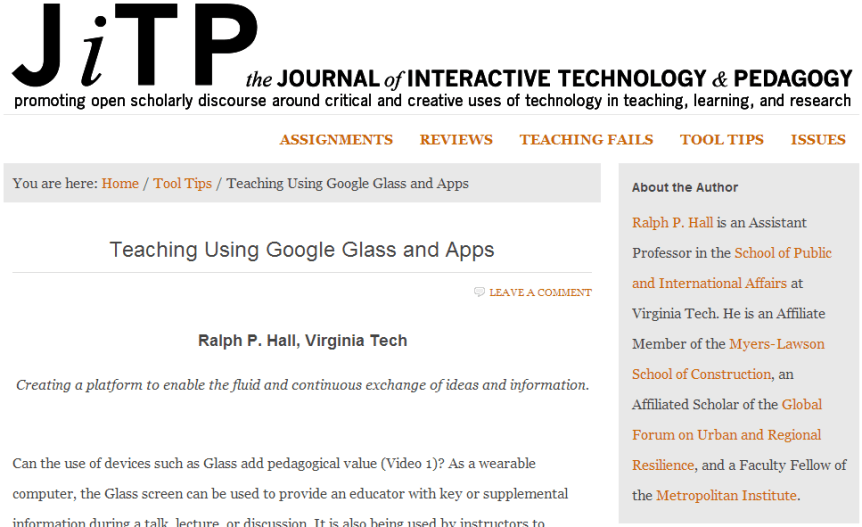
The Journal of Interactive Technology and Pedagogy has just published a Tool Tips article I wrote on how I’m using Google Glass and Apps to support my teaching at Virginia Tech. The multimedia format of the journal offers a unique opportunity to embed pictures and videos in the article that provide a rich context to the platform I’m using and what students thought of the experience.

2014-06-03_1021

IDPS Final Presentations

This afternoon, students in the International Development Planning Studio (IDPS) presented their final project proposals to a review panel of international development experts from Virginia Tech. This final session of the studio provides students with an opportunity to showcase and defend what they have been able to develop over the past 14 weeks. This year, I was very pleased to have Susan Marmagas (Public Health), Michael Bertelsen (Director, OIRED), Kurt Richter (Associate Director, OIRED), and John Browder (SPIA) serve as members of the review panel. I’d like to congratulate the students on making it through the event and for giving a series of professional and high-quality presentations.

The images below (taken #throughglass) capture a few key moments from the final studio session.

This slideshow requires JavaScript.


New Google+ WASH Community

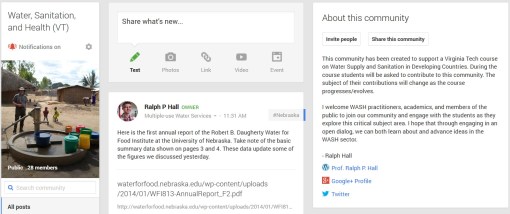
This semester I’m going to use a Google+ community to support my course on Water Supply and Sanitation in Developing Countries. Whereas the community I created last semester for my sustainability seminar was private, this WASH (water, sanitation, and health) community will be open for anyone to join.

WASH

My transition to using Google Apps is fueled by my interest in using Google Glass in education. While the VT Glass Team is still working on an App that I can use during my class (more to come on this), I have had some initial success in recording assignment-feedback videos for students. This semester I have teamed up with Mary English in VT’s Network Learning Initiatives, to formally evaluate my video feedback process. I am aware that there are many ways in which video feedback could be provided, but the Google Apps and Glass platform does make the process easy and therefore doable. I also believe that this use of Glass is one area where the device can add real value in an educational setting.

Since the assignment-feedback videos are privately shared with each student (via their Google+ account), they will not be available on the Google+ WASH community. However, I plan to post videos that discuss new WASH material that will be of interest to my students. These videos will provide a sense of how the assignment-feedback videos work in practice. I will share the results from our formal evaluation of this application of Glass as soon as they are available.

Project Ideas for UAP 5764

20131122_094126_003This morning I spoke with Prof. Akshay Sharma about the three products his students are developing in his industrial design studio. In the spring 2014 semester, students taking my International Development Planning Studio (UAP 5764) will have the opportunity to build on the work of Prof. Sharma’s students by developing a project proposal around one of the three products described in the video below. Students will also have the opportunity to develop their own ideas into an international development project proposal.

My collaboration with Prof. Sharma is part of an ongoing effort to create connections between programs and courses at Virginia Tech in the area of international development.

Spring 2014 Courses

With Spring 2014 preregistration starting today, I wanted to post an update on the two courses I will be offering next semester.

UAP 5324 / BSE 4394: Water Supply and Sanitation in Developing Countries

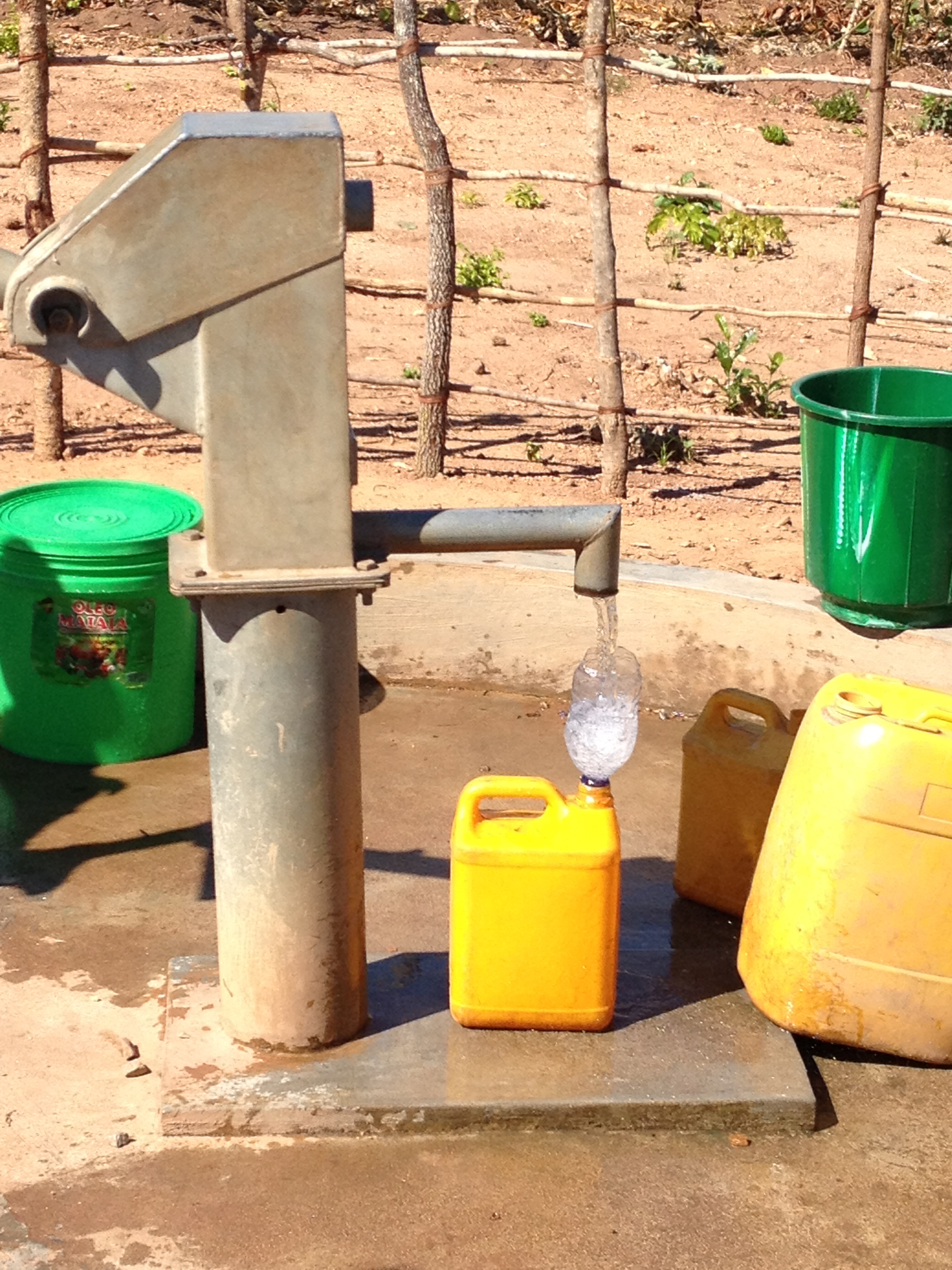
IMG_0751In this course, we will examine the planning process for the provision of water supply and sanitation (W&S) services in developing countries. The course is structured to provide both an engineering and policy perspective on the subject. Thus, the readings, class discussions, and assignments will require students to think as both an engineer and planner/analyst. The course will begin with a review of the state of water and sanitation services in different parts of the world and will raise the question of what constitutes “access” to water. Following this introduction, we will study the design of important W&S technologies. We will then examine the broader environmental and public health considerations in water W&S planning. Armed with an understanding of critical W&S issues and technologies, in the final section of the course we will examine key ideas/topics such as multiple-use water services (MUS), demand-oriented planning, service pricing, decentralization vs. centralization of W&S services, community participation in the planning process, and post-construction support.

Note: I plan to use a Google Glass and Google+ platform to support this course and transform the way in which the material is delivered.

Prerequisites: None (The CEE3104 prerequisite no longer applies. Students in BSE and Engineering, please “force add” the course on the first day of the class if you are unable to preregister.)

When: Tuesdays, 12:30pm to 3:15pm

Where: Wallace 407

UAP 5764: International Development Planning Studio

Concepts and practices in the field of international development have changed dramatically over the past few decades and even the past few years. This studio course is designed to prepare students with the most current approaches to the practice of international development as implemented by leading actors today. Students will learn the traditional project planning tools used by multi-lateral and financial institutions as well as alternative processes. They will be equipped with a variety of skills necessary for working on development projects in the real world.

Throughout the studio, elements of project development, planning, management, implementation, and monitoring and evaluation will be covered from the perspective of the prevalent development sectors. Emphasis will be placed on synthesizing and practicing skills through the preparation of a proposal for an international development project/program. During the studio, students will work on, present, and critique different elements of their project proposals. To complement the theoretical discussions, several studios will be led by experienced practitioners and academics in the field of international development.

Prerequisites: UAP 5764G International Development Policy and Planning

When: Thursdays, 12:30pm to 3:15pm

Where: Architecture Annex 200

The slideshow below shows the studio cohorts for 2012 and 2013. This studio is an intensive experience, but we do have some fun along the way.

This slideshow requires JavaScript.

Talking with Prof. Robert Siegle

At the 2013 Study Abroad Fair at Virginia Tech (VT), I was able to video Prof. Robert Siegle talking about VT’s Minor in 21st Century Studies and about the concept of post development. The latter discussion is connected with a seminar I’m teaching, where I’m using Google Glass to capture commentary on important topics by domain experts that is then introduced to students for discussion in a Google+ community dedicated to the seminar.

Video 1: Prof. Siegle talks about VT’s Minor in 21st Century Studies

Video 2: Prof. Siegle talks about Post Development

Teaching Using Google Glass and Apps

With the semester just over a week away, I wanted to describe the platform I plan to use this semester to support my seminar on technology, globalization, and sustainable development (UAP 5784).

Whereas I normally use VT Scholar to manage all course-related activities, this semester I will use Google Apps to promote a more seamless exchange of ideas among the seminar participants. The other factor driving this change is I plan to use Google Glass to share important ideas/thoughts/insights with students that I have outside of the classroom. One dimension that makes this change possible is that Virginia Tech recently made the transition to Google Apps, which means that most students will be proficient with basic Google services such as Google Drive for sharing documents.

Google+ Community

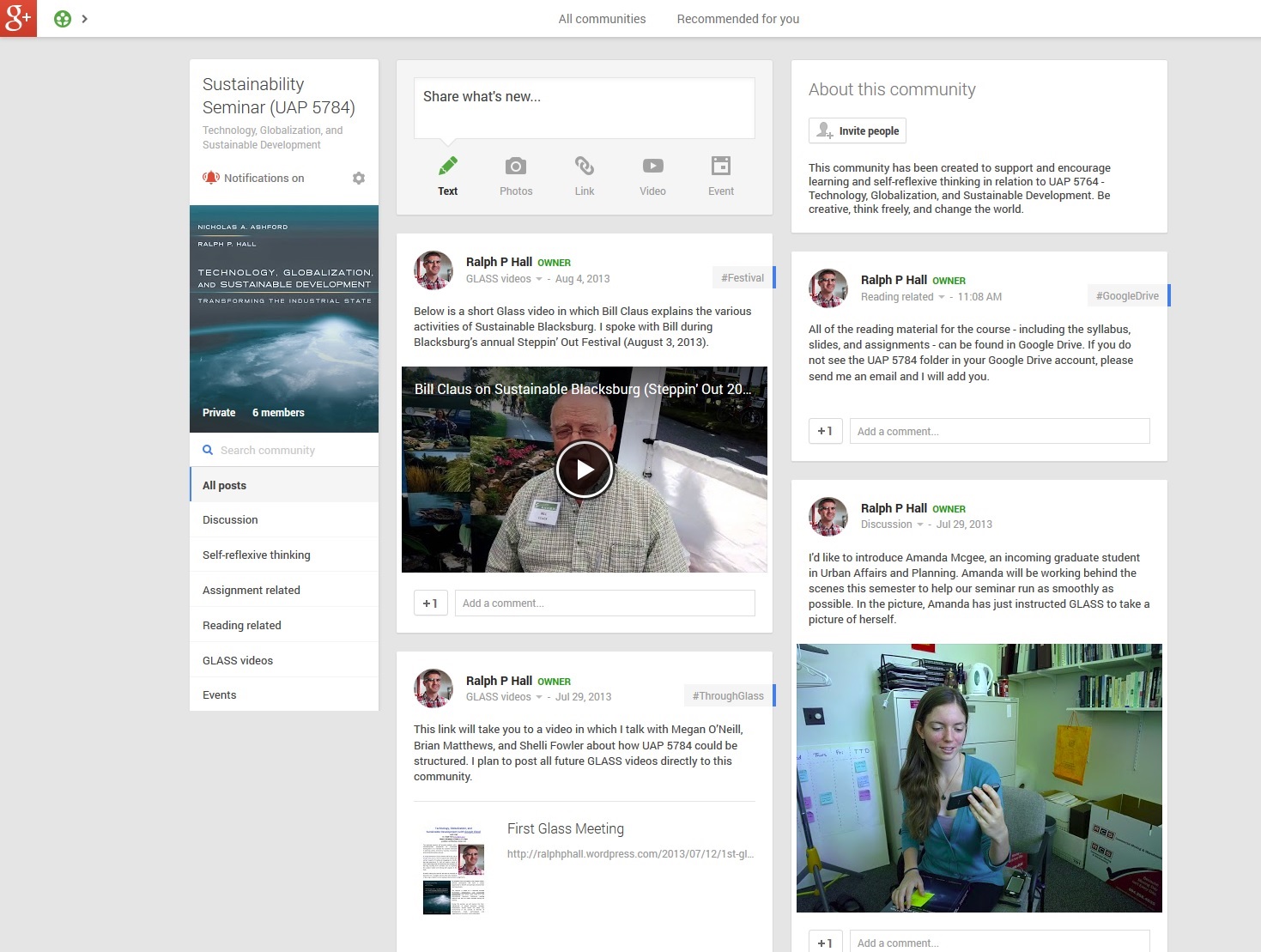
The epicenter for the seminar will be a UAP 5784 community I have created in Google+. Since I wanted to create a space in which students would feel comfortable sharing their ideas, this community is private and only accessible to those taking the seminar. I have provided a screen shot of this community below, which shows a few posts I have made to the community. At this point, no students have been invited to join the community. This action will happen during the first seminar as we begin to explore the platform. As the semester proceeds, I hope this community will become a vibrant place where students can discuss and expand on the material we are covering.
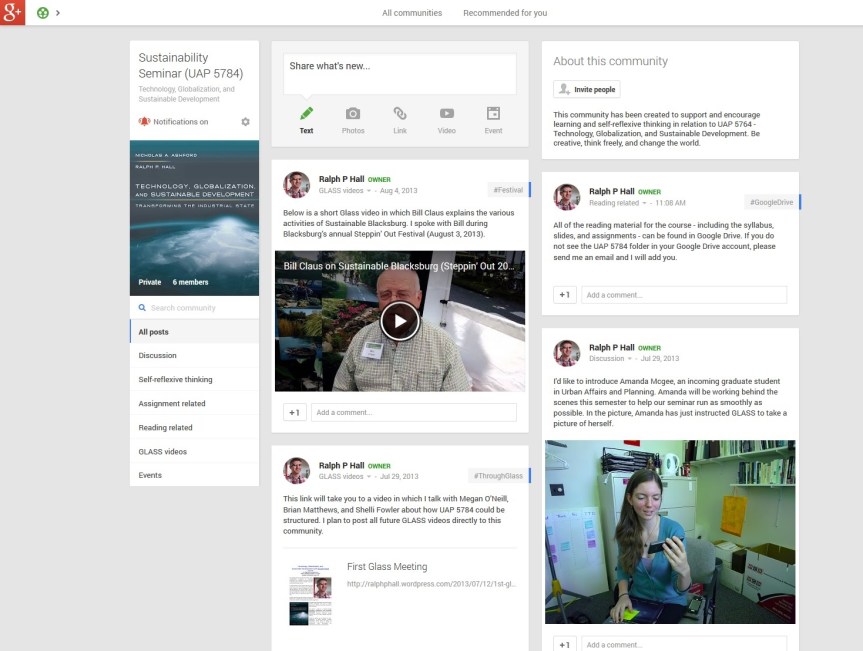
UAP5784 Community

The seminar will have two distinct parts. The first will consist of a group discussion of the assigned reading material. Students will be asked to read and “work up” the reading material with comments and questions before each seminar and be ready to engage in a discussion of the core ideas and themes that emerge from the texts. In the second part of the seminar, we will take a more reflexive look at how the students engaged with the reading material. During this discussion, I plan to develop a conversation around the material being discussed in the on-line community. Before each seminar, students will be asked to prepare a short post to the community in which they can discuss anything of relevance to the seminar. The post could consist of written, visual (e.g., photos, artwork, etc.), audio, and/or video media. Students could record a video (using a webcam) in which they describe their ideas and post it directly to the community for others to view. The process is simple so it will be interesting to see whether students prefer to write or record their posts. Each student will also be expected to comment on at least one post by a fellow seminarian. While student posts could document the questions they have about the reading material, I hope that the space will be used creatively. For example, students could discuss any additional material they consulted to better understand a specific subject. In addition, I will encourage students to try to document their key moments of learning in relation to the reading material, discussions, and/or assignments.

Google Drive
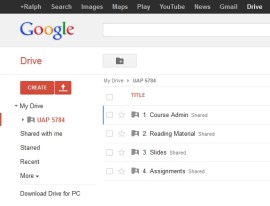
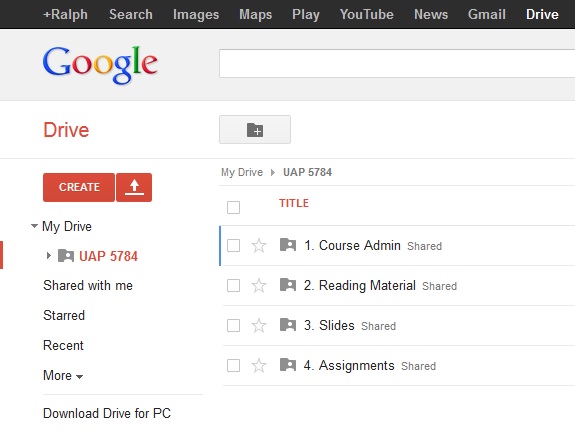
Google DriveSince it is not possible to post files to a Google+ Community, I plan to utilize Google Drive to share documents and PowerPoint/Prezi presentations directly with students. Once each student has been added to the UAP 5784 folder in my Google Drive, they will be able to view all of the files saved in the folder. I currently have four sub-folders in the main folder labeled course admin, reading material, slides, and assignments. One nice aspect of the Google Drive set up is I no longer have to upload files to VT Scholar, which always proved to be a time-consuming process.

In addition to using Google Drive to provide students with access to key documents, I plan to set up an individual folder for each student in the seminar. Students will be asked to save their assignments in these folders and provide me with rights to edit their documents. I plan to review, edit, and comment on each assignment on-line and record a video using Glass in which I will provide each student with feedback on their work while viewing it on my computer. I hope this more comprehensive feedback will demystify my written comments and provide students with a much better sense of how they could improve their work. This aspect of the seminar, which is made possible by Glass, is perhaps the most exciting part of this new platform. I’m keen to see how students react to this type of feedback and hope to see a discussion about whether it is valuable on the UAP 5784 Google+ Community.

Google Circle and Hangouts

While I will create an email listserv for the seminar, I also plan to communicate with students using a Google Circle. At this moment in time, it is not possible to share a Glass video directly with a Google+ community. As a Glass Explorer, I was able to ask a “Glass Guide” (i.e., a member of the Glass development team) whether there was any way to do this. I received the following reply: “Currently you cannot share with a Community page, I’ll add this as a feature request.” Thus, this feature may be coming soon, but it’s not yet available. As a way around this problem, I can create a Google Circle that consists of all of the students in the seminar and post my Glass videos directly to this group. I may want to do this if I have an idea I would like to share and am away from my computer. I also received the following advice from the Glass Guide on how to share my UAP 5784 circle with the students so they won’t have to recreate the circle themselves.

It is possible to share a Circle with your class, so they’ll not have to create Circles themselves. You can do this by visiting Google Plus and from the ‘Home’ tab in the top left corner clicking on ‘People’. Then click ‘Your circles’ and select the circle you’d like to share. Click ‘Actions’ > ‘Share’ this circle and click ‘Share’.

Your students would then receive a request on Google Plus to add that Circle and give them the opportunity to name it. Then you’ll be able to share to that Circle directly from Glass.”

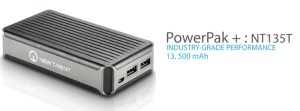
The other aspect of creating a Google Circle for the seminar is that I will be able to initiate a Google Hangout with students directly from Glass. This will enable me to bring the students into conversations I might have with experts in a certain field or have them join me while I present at a conference. I hope to do this at the 4th Conference on Community Resilience in Davos, where I will provide my students with a bird’s eye view of my panel session on Approaches to Infrastructure Resiliency in Different National PowerPak+Contexts. [As an aside, I have purchased a NewTrent PowerPak + (NT135T) to charge my Glass device while it is under heavy use – such as hosting a Google Hangout. This mobile charger can fit in my pocket and connect to Glass via the micro USB cable. I hope the charger will enable me to go for an entire day without the need to find a power outlet to recharge Glass.]
As the semester proceeds, I will provide the occasional update on how this “Google platform” is working and whether the students find this new approach to be of value.

First Glass Meeting

UAP5784 - Tech. Glob. Sus. Dev.Today I met with Megan O’Neill, Brian Matthews, and Shelli Fowler to hold an initial discussion of how I might use Glass during my seminar this semester. The video below was taken using Glass. The quality of the image is good, but the sound quality is very poor at times (i.e., you may need to use a headset to hear what is being said). In the future, I will need to sit closer to the person I’m talking with in the hope that the microphone will pickup both sides of the conversation. As you can hear, my voice comes across loud and clear.

For those of you who are interested, the 29-minute video has a size of 1.2 GB (about 10% of the space available on Glass). When I started recording the video, my battery power was at 94%. After 29 minutes of recording the battery power dropped to 19%.  I estimate that I had about 5 minutes of battery power left. Thus, a good rule of thumb is to plan to record for a maximum of 30 minutes on a full charge. Another lesson from today is that it is probably better to record shorter and more focused videos. Such action would require a certain amount of advanced planning, but limiting a video to 2 to 5 minutes would be a good skill to develop.

During our conversation, we referred to the video below that discusses an interesting way of “reviewing” (rather than grading) assignments. One idea is to use Glass to record a short video in which I would talk about the good and problematic aspects of an assignment. Such a video could be individually (privately) shared with a student. Further, if the assignment were uploaded to Google Drive, it would be possible to edit and comment on the final product. Such a process could encourage students to continue working on and refining an assignment that they could later turn into a paper or use in a professional capacity.