
William Anderson (a Visiting Professor of Practice in Virginia Tech’s School of Public and International Affairs) recently commented on the challenges posed by the budget cuts facing the USAID. With several decades of development experience (within USAID), Bill’s commentary on the make-or-break moment for U.S. foreign policy and foreign assistance is worth reading.
Author: rphall
The World Sustainability Forum 2011 (WSF-2011)
 For those of you who have an interest in sustainable development, you may want to take part in the World Sustainability Forum 2011 (WSF-2011) that will run from November 1-30, 2011. The conference is free of charge―both to attend and for authors to publish―and is sponsored by MDPI and the scientific journal Sustainability.
The conference will be held at www.sciforum.net, a new platform developed by MDPI to organize electronic conferences for scholars.
Abstract deadline: October 1, 2011. Abstracts should be submitted online at www.wsforum.org.
2012 Summer Course in Switzerland
Sustainable Europe: An International Summer Program for Students from North America
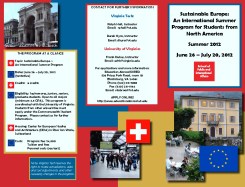 We recently decided to offer a new version of the Sustainable Europe summer course at the Villa Maderi in Riva San Vitale, Switzerland (from June 26 to July 20, 2012).
This course will be a joint offering between Virginia Tech and the University of Virginia. The course will cover the following three subject areas and is open to VT/UVA sophomores, juniors, seniors, and graduate students (with a minimum GPA of 2.5):
Part 1 (Dr. Ralph Hall, VT): “History and Theory of Contemporary Sustainable Development: How is Switzerland Translating Theory into Practice?”
Part 2 (Dr. Derek Hyra, VT): “Sustainable and Equitable Neighborhood Development: How are European Housing and Community Development Policies related to the Creation of Socially Integrated, Mixed-Income Communities?”
Part 3 (Dr. Frank Dukes, UVA): “Globalization, Immigration, and Post-Conflict Rebuilding: How are European Institutional Frameworks used for Collaborative Public Engagement and Planning?”
VT students can apply to the course through the Education Abroad Office/OIRED. UVA students should contact Dr. Frank Dukes for further information on the UVA course admissions process.
Sustainability Primer Now Available
The Emergence and Evolution of Sustainable Development (1951 to 2011)
 This primer on the emergence and evolution of sustainable development provides essential supplementary material for the textbook Technology, Globalization, and Sustainable Development: Transforming the Industrial State. The primer expands on Chapter 2 of the textbook by discussing how key events in the United States, U.S. legislation, international conferences, seminal publications, and debates from the 1950s to the present have shaped the formulation of the concept of sustainable development.
The primer serves as a basic reference for scholars, researchers, students, and policy-makers concerned with sustainable development.
MIT SDM Systems Thinking Webinar Series
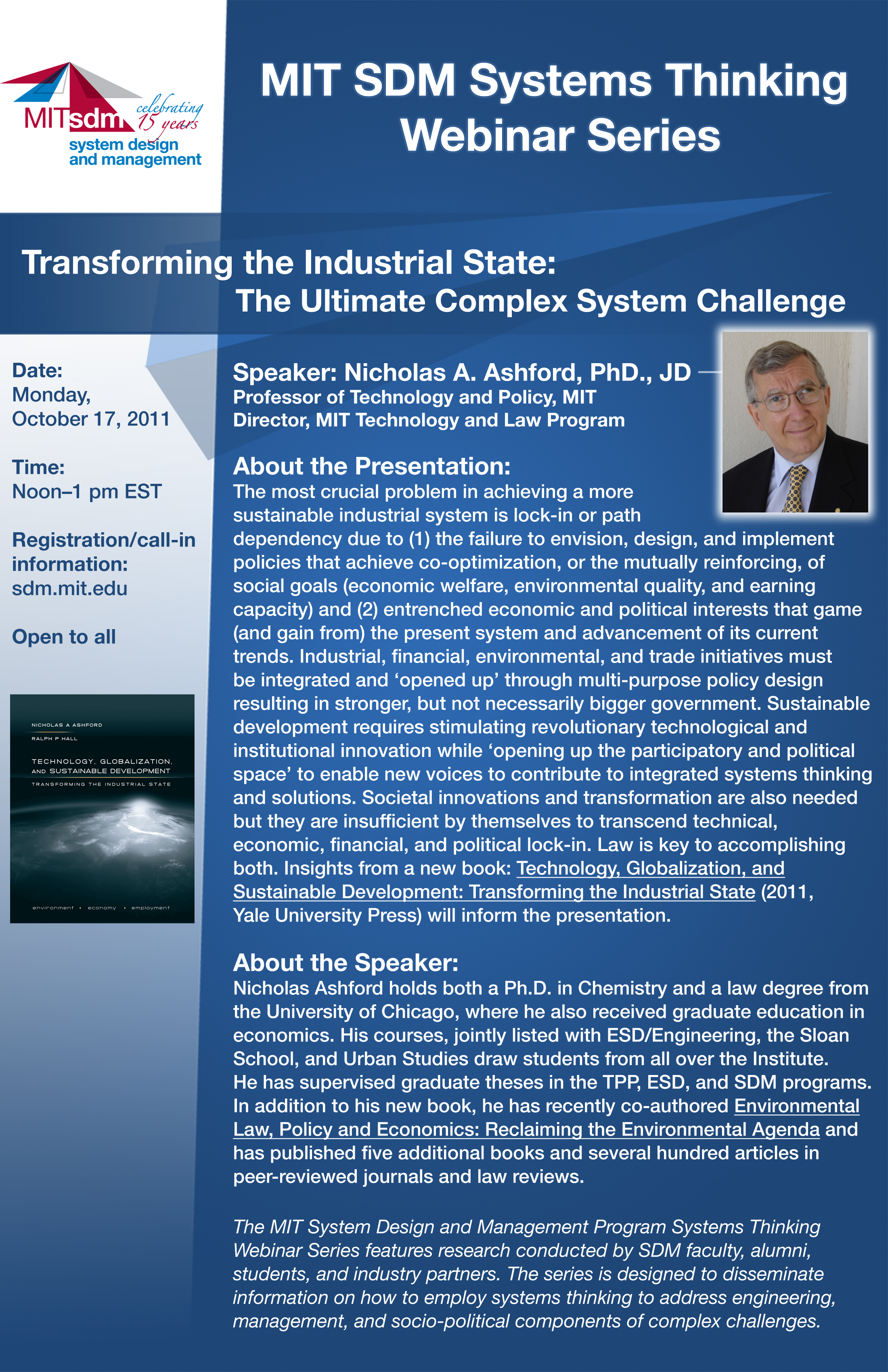
Transforming the Industrial State: The Ultimate Complex System Challenge
Speaker: Nicholas A. Ashford, Ph.D., JD
Date: Monday, October 17, 2011
Time: Noon–1 pm EST
TO SEE THE WEBINAR, go to http://sdm.mit.edu/news/news_articles/webinar_101711/webinar-ashford-systems.html
Fall 2011 (UAP 5424)
Technology, Globalization, and Sustainable Development
UAP 5424, CRN 95917
Instructor: Dr. Ralph Hall (rphall@vt.edu)
Meets: Thursdays 12:30 to 3:15pm
Location: Architecture Annex 111
This graduate seminar will provide students with a transdisciplinary perspective on sustainable development. It is intended for students interested in planning, policy, economics, business, innovation, environmental studies, and law. The seminar will explore the many dimensions of sustainability and how national, multinational, and international political and legal mechanisms can be used to further sustainable development.
More specifically, we will consider the inter-relationship of global economic changes, employment, worker health and safety, and environment in the context of theories of development, trade, technical and organizational innovation, and employment. Mechanisms for resolving the apparent conflicts between these elements will be explored.
 This seminar will use a new textbook entitled Technology, Globalization, and Sustainable Development that draws upon both U.S. and international literature. It is intended to stimulate discussion and critical thinking of the key writings in sustainable development. Students will be evaluated on the basis of their mastery of the materials through (1) written assignments and (2) class participation and attendance. There will be no final examination.
 Ralph P Hall