
Last year, I was interviewed by Wes Brandi for the Tech Talk section of the Social Scene Magazine (SSM). A copy of article is provided below courtesy of SSM. 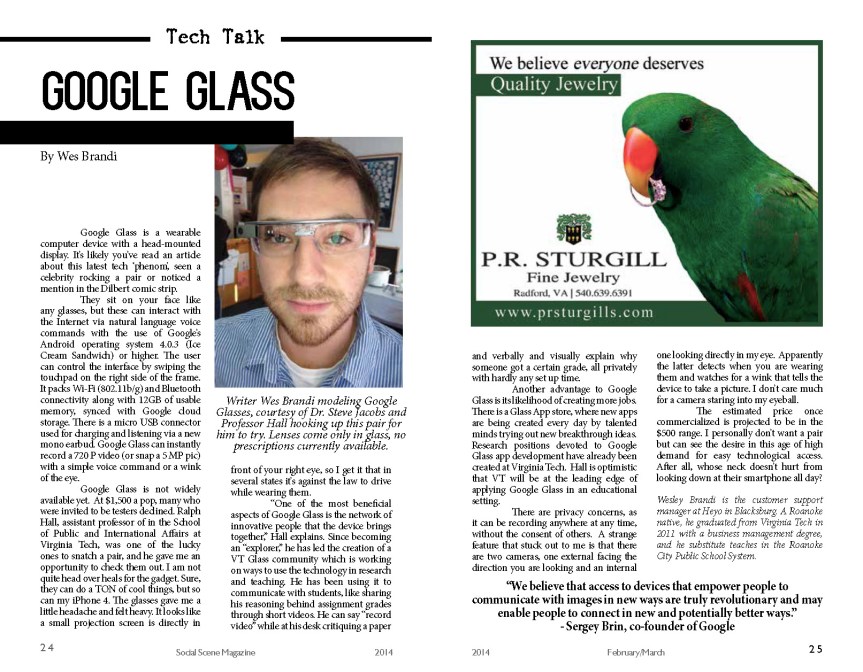
Author: Ralph Hall
New Google+ WASH Community
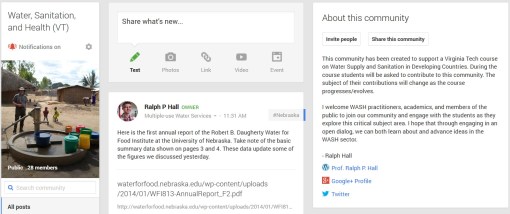
This semester I’m going to use a Google+ community to support my course on Water Supply and Sanitation in Developing Countries. Whereas the community I created last semester for my sustainability seminar was private, this WASH (water, sanitation, and health) community will be open for anyone to join.
My transition to using Google Apps is fueled by my interest in using Google Glass in education. While the VT Glass Team is still working on an App that I can use during my class (more to come on this), I have had some initial success in recording assignment-feedback videos for students. This semester I have teamed up with Mary English in VT’s Network Learning Initiatives, to formally evaluate my video feedback process. I am aware that there are many ways in which video feedback could be provided, but the Google Apps and Glass platform does make the process easy and therefore doable. I also believe that this use of Glass is one area where the device can add real value in an educational setting.
Since the assignment-feedback videos are privately shared with each student (via their Google+ account), they will not be available on the Google+ WASH community. However, I plan to post videos that discuss new WASH material that will be of interest to my students. These videos will provide a sense of how the assignment-feedback videos work in practice. I will share the results from our formal evaluation of this application of Glass as soon as they are available.
TRB 2014 Through Glass
ADD40 and Collaborative Research
I’m looking forward to reconnecting with members and friends of the Sustainable Transportation Committee (ADD40) at the TRB 93rd Annual Meeting in January. During the conference we will hold the inaugural Sustainability Research Subcommittee, ADD40(2), meeting on Tuesday, 14 January, 1:30pm – 3:15pm (Hilton, Kalorama).
As you may know, in ADD40’s Triennial Strategic Plan we made the decision to promote and support research that integrates the three dimensions of sustainability. One important step in achieving this goal will be the extent to which we can develop collaborative research relationships with other TRB standing committees that have an interest in sustainability. Our objective is to try and broaden the scope of TRB research to ensure a more balanced treatment of environmental, social, and economic concerns.
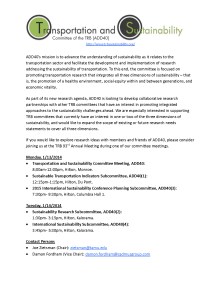 The TRB Annual Meeting presents a unique opportunity for members and friends of ADD40 to reach out to other relevant standing committees and begin the process of reviewing sustainability-related research needs statements and/or developing new statements. To assist with this task, we have developed the adjacent flyer that can be used to inform other committees about our mission and interest in developing collaborative research projects.
During the main ADD40 committee meeting from 8am-12pm on Monday, 13 January (Hilton, Monroe), everyone in attendance will have the opportunity to brief the committee on which TRB standing committees they plan to reach out to during the annual meeting. This will enable the committee to identify the coverage we have at the annual meeting and will provide those in attendance with an opportunity to identify others who may have a shared interest in working with a specific committee.
During the research subcommittee meeting ADD40(2), I look forward to learning about the collaborations that are already underway or are planned and beginning the process of developing several new research thrusts that ADD40 will lead. If you have any ideas for transportation research projects that integrate all three dimensions of sustainability, please either send me an email (rphall@vt.edu) prior to the annual meeting or join us on Tuesday, 14 January.
New Paper on The Human Right to Water
 The Human Right to Water: The Importance of Domestic and Productive Water Rights
Ralph P. Hall, Barbara Van Koppen, Emily Van Houweling
Science and Engineering Ethics
Abstract
The United Nations (UN) Universal Declaration of Human Rights engenders important state commitments to respect, fulfill, and protect a broad range of socio-economic rights. In 2010, a milestone was reached when the UN General Assembly recognized the human right to safe and clean drinking water and sanitation. However, water plays an important role in realizing other human rights such as the right to food and livelihoods, and in realizing the Convention on the Elimination of All Forms of Discrimination against Women. These broader water-related rights have been recognized but have not yet been operationalized. This paper unravels these broader water-related rights in a more holistic interpretation of existing international human rights law. By focusing on an emerging approach to water services provision—known as ‘domestic-plus’ services—the paper argues how this approach operationalizes a comprehensive range of socio-economic rights in rural and peri-urban areas. Domestic-plus services provide water for domestic and productive uses around homesteads, which challenges the widespread practice in the public sector of planning and designing water infrastructure for a single-use. Evidence is presented to show that people in rural communities are already using their water supplies planned for domestic uses to support a wide range of productive activities. Domestic-plus services recognize and plan for these multiple-uses, while respecting the priority for clean and safe drinking water. The paper concludes that domestic-plus services operationalize the obligation to progressively fulfill a comprehensive range of indivisible socio-economic rights in rural and peri-urban areas.
Glass Upgrade
I’m looking forward to receiving Glass 2.0. After some research, it looks like my prescription lenses will fit the updated version. The frame is essentially the same. 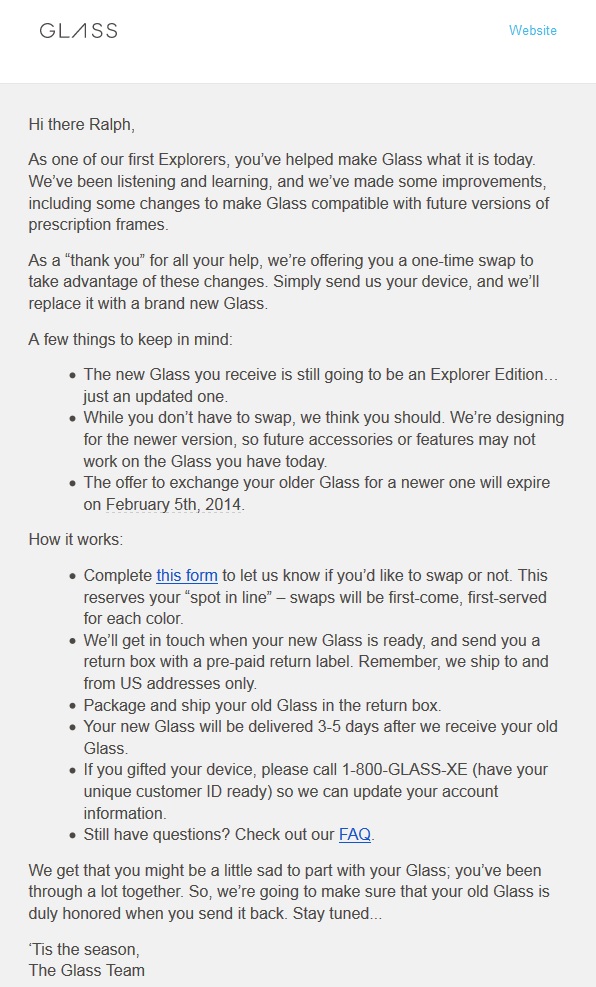 I decided to stay with #TeamShale.
VT Wireless Network App for Glass
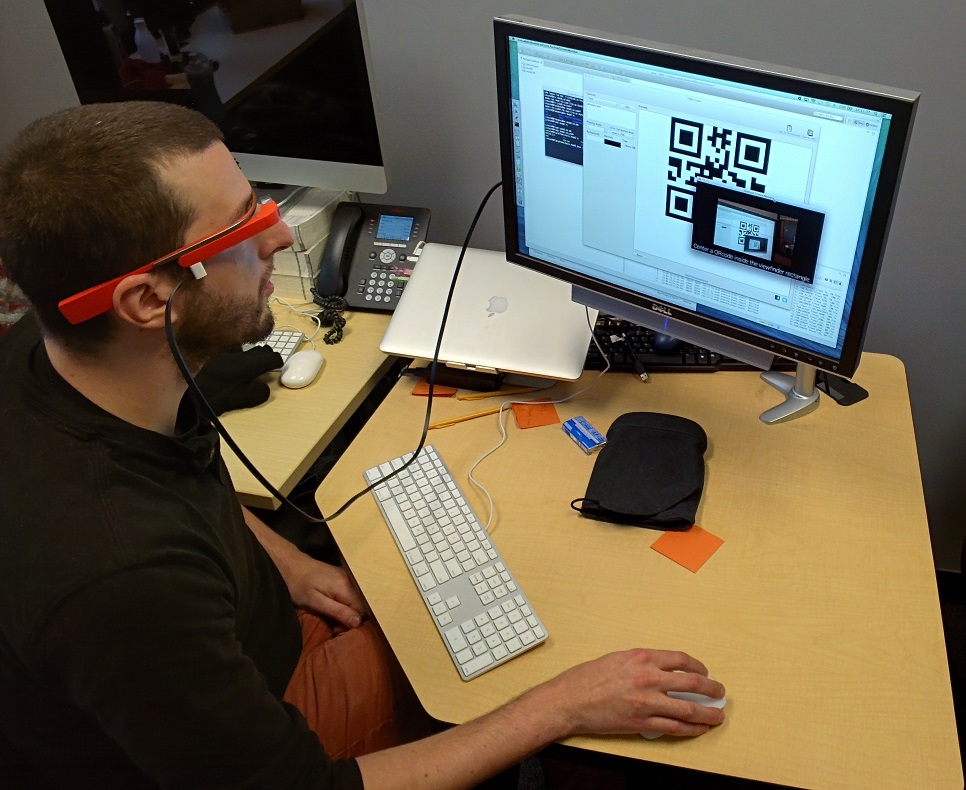 In the video below, Andrew Lincoln talks about the new App he is developing that will enable members of the VT Glass Team to connect their device to the VT wireless network.
VT Glass Team is Growing
I had a fun and creative meeting today with one half of the VT Glass team. We are now starting to map out the Glass Apps that we plan to develop and test during the Spring semester. The fusion of fields/disciplines provides a constant stream of ideas. Watch this space for more news!
Project Ideas for UAP 5764
 This morning I spoke with Prof. Akshay Sharma about the three products his students are developing in his industrial design studio. In the spring 2014 semester, students taking my International Development Planning Studio (UAP 5764) will have the opportunity to build on the work of Prof. Sharma’s students by developing a project proposal around one of the three products described in the video below. Students will also have the opportunity to develop their own ideas into an international development project proposal.
My collaboration with Prof. Sharma is part of an ongoing effort to create connections between programs and courses at Virginia Tech in the area of international development.
Assistant Professor – Urban Affairs and Planning
We currently have an open position for a tenure-track Assistant Professor in Urban Affairs and Planning (UAP) at Virginia Tech. The position will be located at our main campus in Blacksburg, VA.
Position Summary:
Appointment to the rank of Assistant Professor carries with it professional responsibilities in teaching/learning, research/discovery, and outreach/engagement/service. Interdisciplinary interests should demonstrate strong research, teaching, and outreach expertise in the areas of sustainability; energy; water resources; pollution control; climate change; and/or environmental engineering, technology, or science. Pedagogy should include international dimensions of the environment and/or work addressing issues of race, gender, and class. Teaching responsibilities are in the Urban Affairs and Planning (UAP) undergraduate and graduate programs in Blacksburg, and the Ph.D. in Planning, Governance, and Globalization.
Additional responsibilities include outreach and/or service work, including community service-learning projects, service to the profession, service to students through interactive programming and advising work, and service to the School, College, or University through participation on various committees, including curriculum development.
UAP constitutes one of three academic programs in the School of Public and International Affairs (SPIA) in Virginia Tech’s College of Architecture and Urban Studies. The other programs are Public Administration and Policy and Government and International Affairs. All three programs operate at the main campus in Blacksburg and at the National Capital Region campus in Alexandria, VA.
Required Qualifications:
A Ph.D. in planning, social and behavioral sciences, or engineering. Experience teaching and demonstrated excellence in research.
How to Apply for this Job:
Interested candidates are encouraged to apply online at www.jobs.vt.edu, and search for posting number TR0130127. Please include a cover letter, resume/curriculum vita, list of references, research and teaching statements. Review of applications will begin on December 9, 2013.
APPLY HERE: https://listings.jobs.vt.edu/postings/43466
 Ralph P Hall