IDPS Final Presentations

This afternoon, students in the International Development Planning Studio (IDPS) presented their final project proposals to a review panel of international development experts from Virginia Tech. This final session of the studio provides students with an opportunity to showcase and defend what they have been able to develop over the past 14 weeks. This year, I was very pleased to have Susan Marmagas (Public Health), Michael Bertelsen (Director, OIRED), Kurt Richter (Associate Director, OIRED), and John Browder (SPIA) serve as members of the review panel. I’d like to congratulate the students on making it through the event and for giving a series of professional and high-quality presentations.

The images below (taken #throughglass) capture a few key moments from the final studio session.

This slideshow requires JavaScript.


First Meeting of the DAC – University Libraries

This morning, the Dean’s Advisory Committee (DAC) for the University Libraries had its inaugural meeting in the new multipurpose room in Newman Library. Over the next year the 22 DAC members from across the university will work to identify opportunities to put Virginia Tech at the leading edge of library services. The images below were taken #throughGlass.

This slideshow requires JavaScript.

Using Glass at VT

In the video below, Brian Mathews and I provide some insight into how faculty and students are using Google Glass at Virginia Tech.

[Acknowledgments: I’d like to thank Carlos Waters for his help in editing the above video. I’d also like to thank Virginia Tech’s Networked Learning Initiatives and InnovationSpace for the resources they have made available for members of the VT Glass team.]

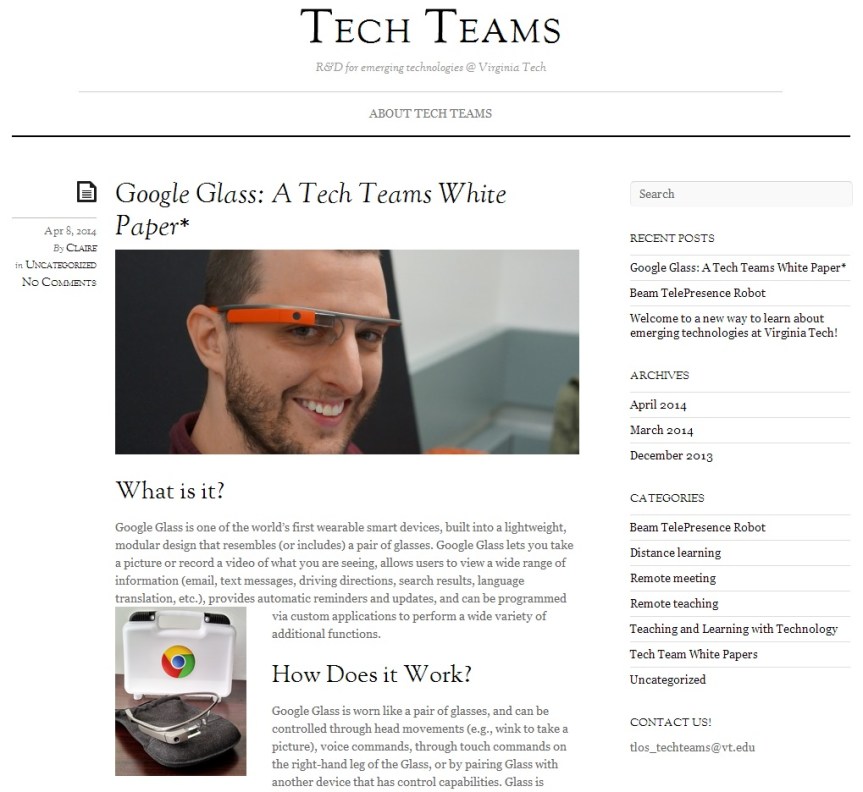
For additional information on how faculty and students are using Glass at Virginia Tech, see the recently published Tech Teams White Paper.

Untitled

Debating Development

On Friday, April 11, I joined faculty and students at Virginia Tech in a mini-conference to debate “Development and Humanitarianism.” The event was hosted by Prof. Brett Shadle and Prof. Patricia Nickel to bring together researchers who engage in critical examinations of development and humanitarianism, and researchers who engage in development and humanitarian work. I fall into the latter group, which is why it was a pleasure to meet Prof. Ilan Kapoor (the keynote speaker) and learn more about his postcolonial view on development. 

This slideshow requires JavaScript.


Congratulations Mark Seiss!

On Friday, March 28, Mark Seiss – the first “on-the-ground” statistician at Virginia Tech – successfully defended his doctoral dissertation in statistics.
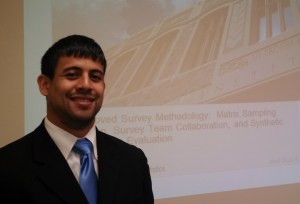
Mark1Mark’s research covers several aspects of survey methodology, from questionnaire design to final estimation. His first paper develops an approach to matrix sampling designs, where a subset of questions are administered to a respondent in such a way that the administered questions are predictive of the omitted questions. The proposed methodology compares favorably to previous matrix sampling methods when applied to data collected from a household survey conducted in Nampula, Mozambique. His second paper documents how statisticians can help improve the quality of data collected from surveys by carefully analyzing the data soon after it is collected. In addition to correcting data entry errors, the approach provides surveyors with continuous support throughout the fieldwork, enhancing their training and reducing the number of errors being made as the fieldwork progresses. His final paper proposes a model-based approach to the estimation of the mean squared error associated with synthetic (indirect) estimates. Mark applied the proposed mean squared error estimation methodology to simulated data and estimates from the 2010 Census Coverage Measurement (CCM). He found that the proposed mean squared error estimation methodology compared favorably to the previous methods in the literature, while allowing for area-specific estimates.

I served on Mark’s doctoral committee with Eric Vance (committee chair), Leanna House, and Inyoung Kim.

The pictures below were taken in 2011, when Mark acted as the “on-the-ground” statistician during a household survey in rural Nampula, Mozambique.

This slideshow requires JavaScript.

MCC Webinar: Impact Evaluation of the RWSA in Mozambique

On Thursday, March 27, Dr. Eric Vance and I will be giving an MCC webinar to explain some of the main findings from our impact evaluation of the MCC-funded Rural Water Supply Activity (RWSA) in Nampula, Mozambique. The slides for this webinar can be accessed below.

MCC Webinar

20140327_104939_513b
Photo taken through Google Glass just before the start of the MCC webinar


Talk: An Introduction to Binary Economics

On Wednesday, April 2, Prof. Robert Ashford will be giving an introductory talk on binary economics. His talk will focus on how the approach can address inequality, create demand for employment, and finance sustainable development. More information on the talk is provided below. 

When: Wednesday, April 2, 5:30 to 7:30pm

Description: In general, earning capacity can be enhanced by some combination of two contributions: (1) increased wages earned through employment; and (2) money earned through the ownership of productive capital (e.g., land, technology, patents, etc.). Usually, only people who already own capital are able to acquire capital with the earnings of capital; and they do so substantially in proportion to their existing wealth, which helps to explain how wealth tends to concentrate in a capital intensive economy like the USA. Binary economics reveals practical ways of extending effective market opportunities to poor and middle-class people so that they can also acquire capital with the earnings of capital. In this way, as production becomes ever more capital intensive, poor and middle class people can earn not only by working but increasingly as owners of productive capital. In this talk, Prof. Ashford will introduce the binary economic approach and explain how it can enhance not only an individual’s capital earning capacity (addressing inequality), but also the demand for employment and the prospects for achieving sustainability.

Ashford_April2_2014

Developing Glass Videos

This past week, I enjoyed working with Carlos Waters (VT InnovationSpace), Shelli Fowler (Director, Networked Learning Initiatives – NLI), and Jacques Walker (NLI) on developing the outline for several videos that will document how I’m using Glass to advance learning in my courses. I will post these videos as soon as they are ready for distribution. 


#IfihadglassVT Competition

IMG_20130805_115543_693The VT Glass Explorer Team recently received a number of invitations to invite new people to join the Google Glass Explorer program. We have at least nine invitations available and will offer them to the best response we read to the hashtag #IfihadglassVT 

This competition is open to all VT students, faculty, and staff. To be considered for one of the invitations, you need to post your #IfihadglassVT response to Twitter or Google+ by 12pm on Friday, March 7. If selected, you will be responsible for covering the cost of the Glass device ($1,500 + tax and shipping).

If you are a VT student, I encourage you to “pitch” your Glass-related research ideas to your advisor with the objective of securing research funds to cover the cost of the device  😉

We look forward to growing the VT Glass Team and seeing how you would Invent the Future!

RWSA Impact Evaluation Presentation

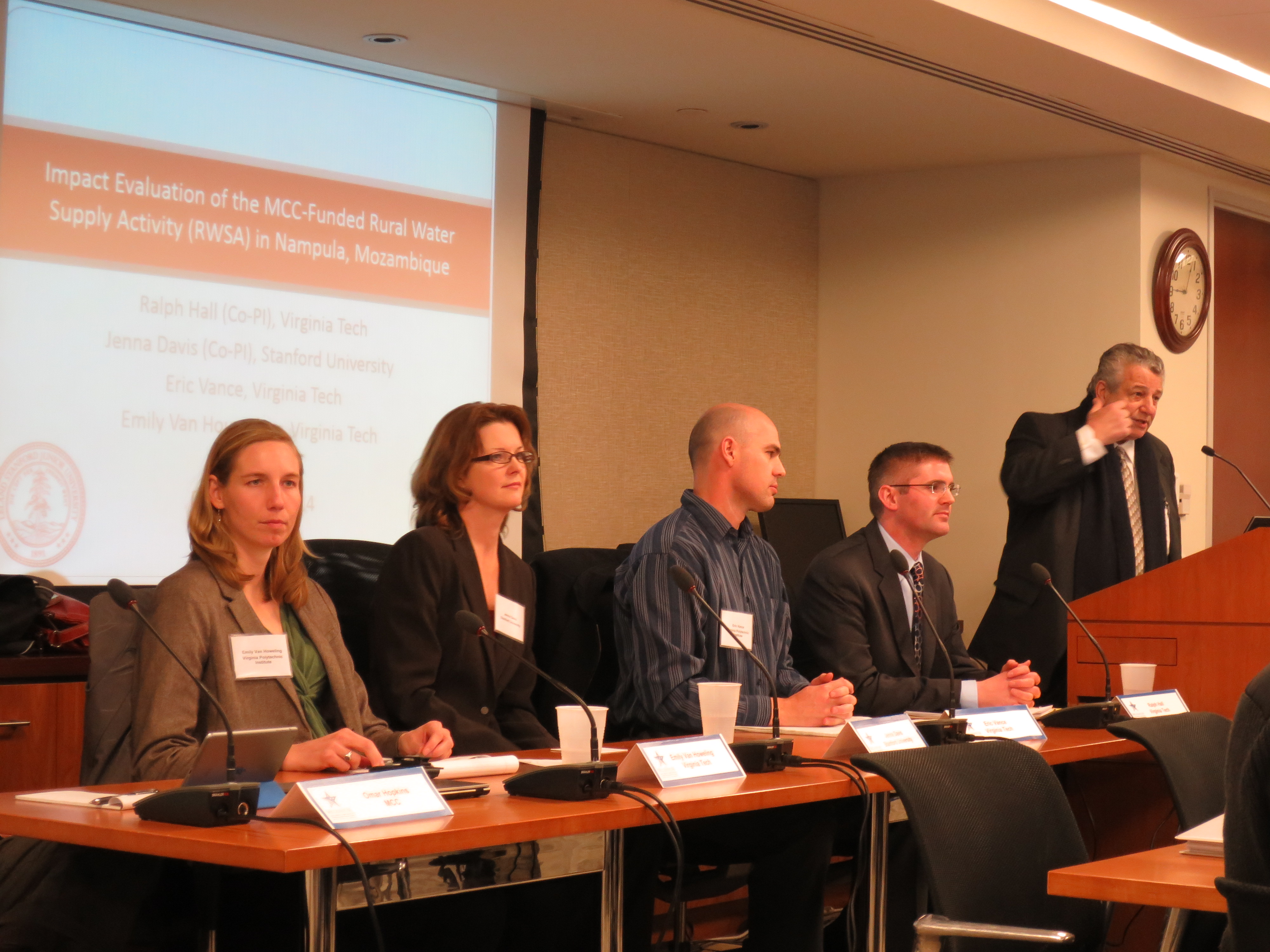
IMG_1257On February 7, I was joined by colleagues from Virginia Tech and Stanford University to present the results from our impact evaluation of the Millennium Challenge Corporation-funded Rural Water Supply Activity (RWSA) in Mozambique at the MCC’s 2014 Monitoring and Evaluation (M&E) and Economic Analysis (EA) College. The M&E/AE College was attended by monitoring and evaluation and economic analysis experts from many of the countries with which the MCC has an active Compact.

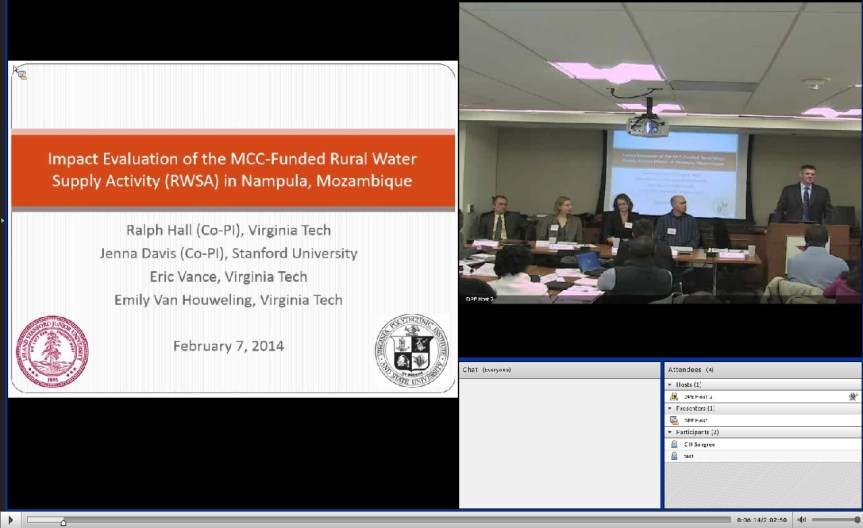
The presentation was recorded using Adobe Connect and can be accessed by clicking on the image below. The final impact evaluation report will be available in the coming weeks via the MCC’s Independent Evaluations Catalog.

MCC