Innovation in Teaching Using Google Apps

This afternoon, I had the pleasure of talking with the PGG doctoral students about life as a faculty member and how I approach the design of my courses. In this post, I thought I’d capture some of the ideas we discussed about my overall approach to teaching.

My teaching philosophy is largely a product of my own learning and research experience. I believe students should be encouraged to think—and approach problems—in an integrative and transdisciplinary manner. I believe that teaching innovation occurs through a process of creative destruction, where new ideas and ways of learning continually challenge, replace, or enhance the old. The challenge, though, is knowing when something is working and why. Thus, evaluating how I can improve my teaching and mentoring of students is a central part of my philosophy.

In 2013, I was invited to become a Google Glass Explorer, which had a profound impact on how I approach my teaching and interact with students. Prior to Glass, my engagement with students was structured, perhaps ‘constrained,’ by the VT Scholar [course management] system and by my scheduled class time with students. I believe the ability to ‘recycle’ my courses in Scholar had the effect of dampening my enthusiasm to radically revise each course. I became aware of this after making the transition to delivering all of my courses using various combinations of VT Google Apps. The ease at which an entire course can be created in Google Drive and changed while in progress is liberating. Students can also take control of the course platform and share information either via a public or private Google+ Community or in a shared Google Drive folder. This process enables students to take ownership of their learning and become teachers in the process. This enables me to focus less on identifying and mastering content, and more on helping students interpret and locate new information, ideas, and theories in their own learning frameworks or value systems.

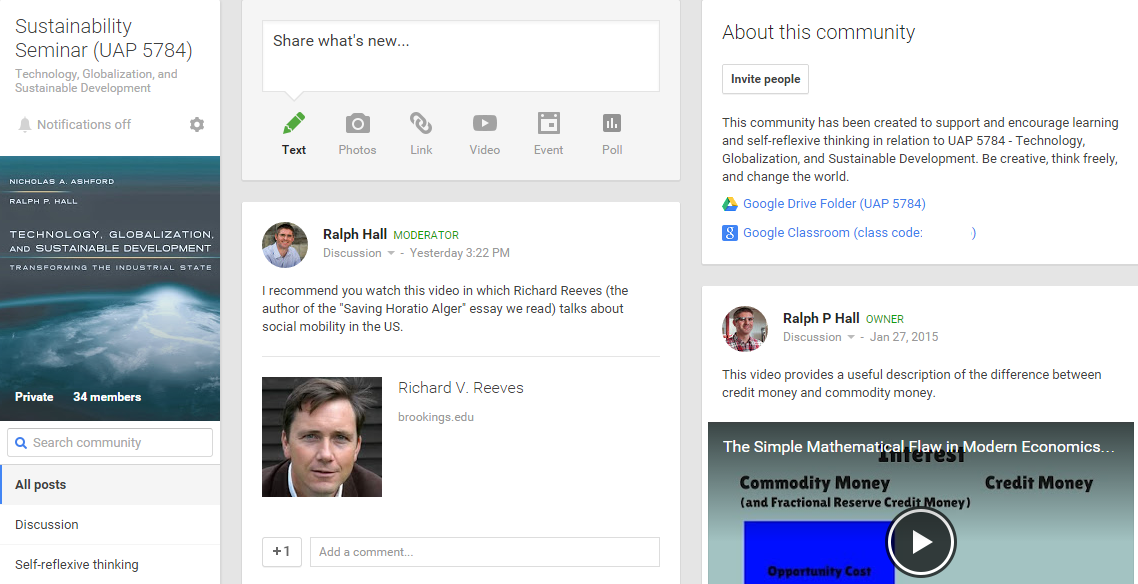
I now build each of my courses around a shared Google Drive folder and a public or private Google+ Community. I’d recommend using a private community so that links to course-related Apps can be embedded in the community (see the top right corner of the image below). All assignments are managed via Google Classroom. Course communication happens primarily in a Google+ Community or via messages I send from my Google+ account to a Google Circle created for each course. [Note to Google – it would be useful if I could also send these message directly from my VT gmail account.] The Google Circles are important since they enable me to quickly identify specific students when in YouTube so I can send them private assignment-feedback videos. Whereas I used to record these videos using Google Glass, I recently made the transition to Snagit, which enables me to capture my computer screen while providing audio feedback on a student’s assignment. After recording a video (1 to 5 minutes in length), I directly upload it to YouTube from Snagit, making sure the video has a clear label and is set to ‘private.’ From YouTube, I privately share the feedback video with each student. After viewing the video, students are able to send me private comments on my feedback (in Google+/YouTube), which creates a two way dialogue rather than a one way conveyance of information. Since January 2014, I have recorded well over 100 assignment-feedback videos that have been sent to students in six different courses. I am currently working with Mary English to evaluate the impact of this feedback and we plan to publish the results of this research later this year.
Google-Community

A benefit of the Google Apps platform is that it enables the sharing of information from any device at any time of day. I believe learning can occur at any moment, such as when riding the bus or a bike, taking a walk, or even sitting in one of my colleague’s classes! Having a platform that enables students to engage from wherever they are is important. The Google+ community is the medium where students can link the theories/ideas we discuss in the classroom to real-world events. This process deepens their understanding of the material and may result in better long-term retention due to the networked nature of the conversation and information.

As should be evident from the above description, the suite of Google Apps I’m using has ‘freed’ my approach to teaching that is now more fluid and flexible. However, now that I have complete control over my courses, I also need to manage the enrolment/disenrollment of students from each course. While this process can be a little challenging, once the Apps have been mastered the process is relatively straightforward. The autonomy of the platform has enabled me to explore the idea of letting students be a lifelong member of a course, which I am trying in my sustainability class. My hope is that as students progress through their professional careers, they will re-engage with the course when they have something to contribute or if they want to refresh or update their knowledge. This approach to delivering a course could advance a learning model that is truly lifelong.

In summary, my experience with using Google Apps has led to one significant realization. The systems we use to support our teaching can either enable or inhibit innovation in teaching. Those systems that can be easily integrated and adapted are likely to survive, whereas those that constrain creatively are likely to stifle innovation in teaching. While Google Apps are not perfect, their flexibility and ease of use means that it is more difficult to become locked-in to a system or way of delivering a course. I have full autonomy over how I administer, structure, and approach my courses, which I believe is the key to teaching innovation.
VT Assessment Showcase (Feb 9-13)

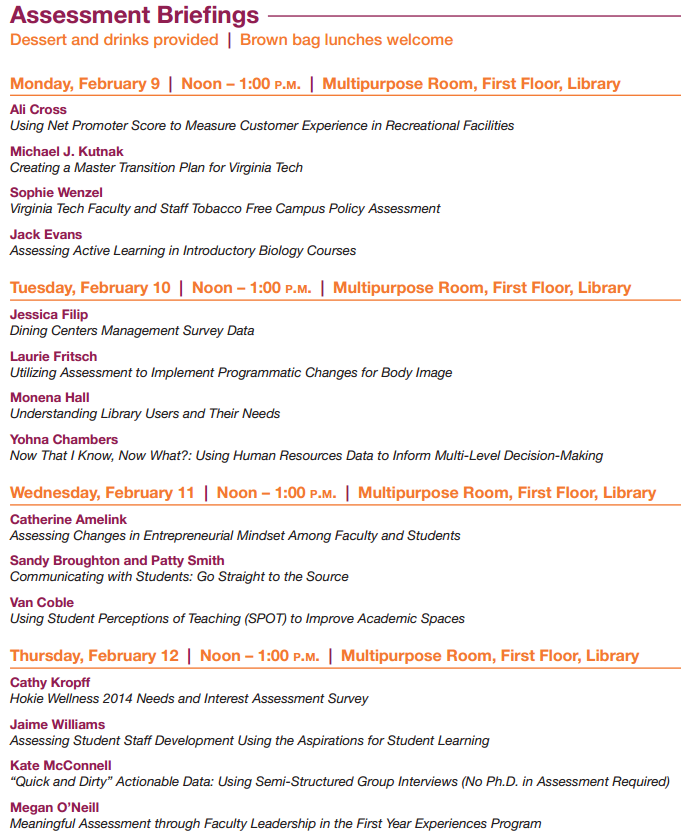
This afternoon I attended the first of five “Live Assessment Briefings” that will be held this week as part of the Virginia Tech Assessment Showcase. This inaugural event features successful assessment and evaluation initiatives from across the university. Today’s assessment briefing included the following talks (the image below provides a summary of the remaining four sessions):

  • Catherine Amelink20 – Assessing Changes in Entrepreneurial Mindset Among Faculty and Students.
  • Michael J. Kutnak – Creating a Master Transition Plan for Virginia Tech.
  • Sophie Wenzel – Virginia Tech Faculty and Staff Tobacco Free Campus Policy Assessment.
  • Jack Evans – Assessing Active Learning in Introductory Biology Courses.

Given my interest in using Google Apps to support teaching, I found the talk by Jack Evans on the ‘flipped classroom’ model being advanced for their freshman Biology Course of particular interest. I believe there is an opportunity to leverage different Google Apps to support their new model of student engagement/learning and reduce the burden of administering the class via the VT Scholar system. In particular, I believe Google Drive, a (private) Google+ Community, Google+ Circles, Google Docs (for co-creating work), and Google Classroom (to administer assignments) could be set-up as an integrated platform for the ‘flipped classroom.’ I also believe Apps like ParticiPoll could be used effectively for in-class polling (or quizzes), which would replace the current use of clickers. Other Apps like Splashtop could also be an effective way to enable instructors to control their laptops remotely from an iPAD, tablet, or smartphone. I plan to follow-up with Jack’s team in the near future to discuss these ideas and to learn more about their teaching model. I also plan to develop a wishlist of Google Apps functions that could enhance the use of this platform in a teaching environment. I’ll post the list here when its ready.

Posters from the Assessment Showcase speakers will be on display all week in Newman Library with a live “popcorn and posters” session on February 13 from noon – 2:00 p.m. I encourage anyone on campus to drop by the event to learn more about the various assessment activities that are underway at the university.

The photos below were taken during the event using Google Glass.

This slideshow requires JavaScript.

MURP Alumni Receives TRB Certificate of Appreciation

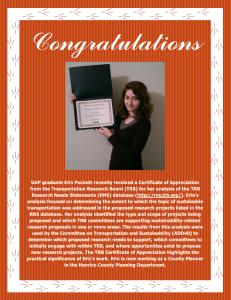
UAP graduate Erin Puckett recently received a Certificate of Appreciation from the Transportation Research Board (TRB) for her analysis of the TRB Research Needs Statements (RNS) database. Erin’s analysis focused on determining the extent to which the topic of sustainable Erintransportation was addressed in the proposed research projects listed in the RNS database. Her analysis identified the type and scope of projects being proposed and which TRB committees are supporting sustainability-related research proposals in one or more areas. The results from this analysis were used by the Committee on Transportation and Sustainability (ADD40) to determine which proposed research needs to support, which committees to initially engage with within TRB, and where opportunities exist to propose new research projects. The TRB Certificate of Appreciation highlights the practical significance of Erin’s work. Erin is now working as a County Planner in the Henrico County Planning Department.

UAP Wins Exemplary Program Award

This evening, the Urban Affairs and Planning (UAP) program received Virginia Tech’s Exemplary Program Award. The three other award recipients were the Department of Chemistry in the College of Science, the Department of Psychology also in the College of Science, and  VT Engage in the Division of Student Affairs.

The 2014 award focused on recognizing groups that are developing and sustaining innovative and effective departmental approaches to fostering Ut Prosim (That I May Serve) at the undergraduate or graduate level.

I have posted a few pictures from the event below, along with a video I took through Glass of Diane Zahm receiving the award on behalf of UAP.

This slideshow requires JavaScript.

Studio Reading Exercise

For my studio today, I challenged the students to prepare a review of 11 international development-related reports and papers (listed below). The combination of these documents led to some interesting discussions about the purpose of development assistance (from public, non-governmental, and private entities) and the emerging trends that are occurring within the sector. In the list below, I have included some of the questions the students raised after reviewing each reading. Please feel free to respond to any of these questions if you have an interest in this subject matter.

Studio Reading Exercise

1. World Bank (2015) World Development Report: Mind, Society, and Behavior.

  • What areas of international development do think stand to benefit from a greater consideration of psychological and social behavioral drivers?
  • Do you think development efforts focusing on human behavior and decision making will be more effective at a global, national, community, or person-to-person scale?

2. World Bank (2014) World Development Report: Risk and Opportunity.

  • Would the creation of a transnational risk board be more effective at the international or regional level?

3. Oxfam (2011) The Politics of Partnership: How donors manage risk while letting recipients lead their own development.

  • How feasible are partnerships involving the management of risk? Could they end up doing more harm than good?

4. Brinkerhoff, D. W. (2010) Developing Capacity in Fragile States.

  • With limited resources, is it possible to balance short term stability with long term development in a fragile state?
  • In fragile states with pressure to provide a quick response, how can interventions reach people without undermining the government?

5. Global Health Strategies initiatives (GHSi) (2012) How the BRICS are reshaping global health and development.

  • Although this paper focused on health related issues, the proposal to create a “multilateral bank that would be exclusively funded by developing nations and finance projects in those countries” was mentioned. This proposal has been explored further since this paper was published, and it has been said that the BRICS bank could rival the World Bank. What types of impacts could a BRICS bank have?

6. Kharas, H. and Rogerson, A. (2012) Horizon 2025. Creative destruction in the aid industry.

  • If you were directing an aid agency, what strategies would you use to remain nimble/adaptable? How would you monitor your relevance or vulnerability as global needs and the aid landscape changes over time? What are the benchmarks or red flags that might convey your relevance or stagnancy as an institution?
  • This paper is based on finance driving and shaping international development. To what extent do you agree that this is true?

7. European Commission (2011) Aid Effectiveness 2011. Progress in Implementing the Paris Declaration.

  • What are the key challenges to delivering effective aid? How might these challenges be met to improve aid effectiveness?
  • How would the design of national development strategies for aid effectiveness affect other development objectives and goals?

8. OECD (2014) Making Development Co-operation More Effective – 2014 Progress Report

  • Different countries have different cultures and values. Thus, different priorities can be set concerning development co-operation principles. How can we approach these differences constructively in the monitoring process?
  • The Busan Partnership Agreement is a voluntary commitment. Would a more compulsory agreement be a more effective way to meet the specified targets?

9. Zimmermann, F. and Smith, K. (2011) More Actors, More Money, More Ideas for International Development Co‐operation.

  • How can we prevent aid fragmentation between DAC and non-DAC aid recipients?

10. USAID (2013) USAID’S Legacy in Agricultural Development: 50 Years of Progress.

  • In addition to measuring income and higher productivity, how else could we assess the long-term effectiveness of agriculture development? 

11. USAID (2014) 50 Years of Global Health: Saving Lives and Building Futures.

  • What are some of the failures in international development? Do you think the changes are as positive as those documents in the report?

Advice to MURP and PGG Applicants

The Urban Affairs and Planning (UAP) program is looking to fill two doctoral level research assistantships in the Planning, Governance, and Globalization (PGG) Ph.D. program and one master’s level graduate research assistantship in the Master of Urban and Regional Planning (MURP) program beginning Fall 2015. We are especially interested in receiving applications from minority and first generation college students.

If you would like to apply for either of these opportunities, I encourage you to carefully review the UAP Research Needs Statement to identify the subject area and faculty with whom you would like to work. Please include this information in the personal statement submitted with your application.

2015-01-26_0920

Update on Google Glass and Apps

Following the announcement that Google will no longer be selling Glass, I thought I’d provide an update on my plans for using Google Glass and Apps this coming semester. Essentially, not much will change. I will continue to use the platform to support my courses and plan to test new ways of interacting with students in the classroom, such as using ParticiPoll to ask questions during a presentation.

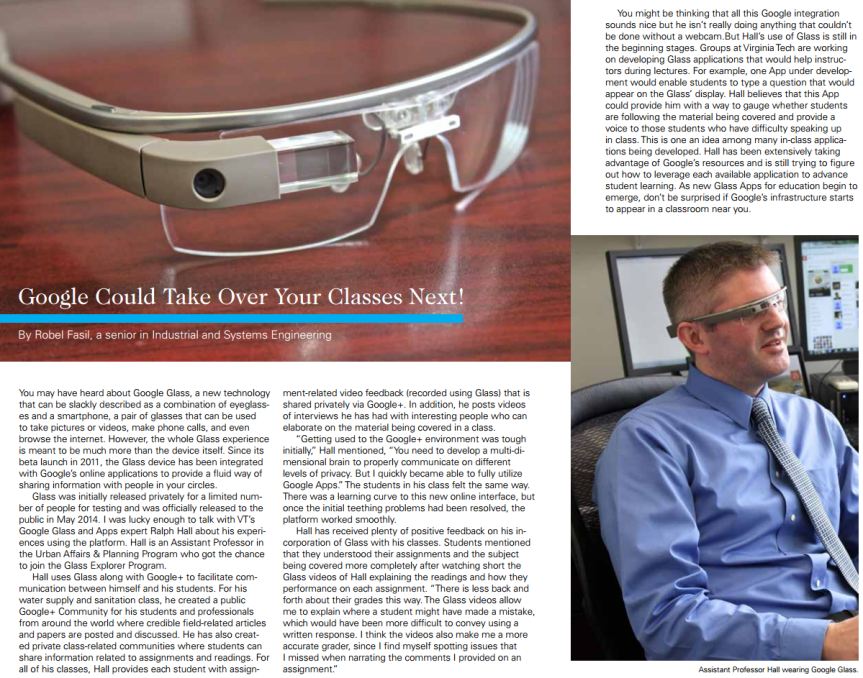
My experience with learning and using Glass and Google Apps has transformed the way I approach my teaching. I no longer use VT’s Scholar system and run all of my courses using VT-supported Google Apps. I’m more willing to try new things and can easily walk away from ideas that simply didn’t work. I’m sure the spirit of the Explorer program had something to do with this. Below is the welcome message from Google that came with Glass device.

2015-01-19_2049

During the Fall 2014 semester, I tested Google Classroom in one of my courses and will now rollout this App in all of my courses. I would describe the App as a useful assignment management tool that eliminates the need to download/upload assignments and streamlines this aspect of administering a course. While it took a while to understand exactly how files were being shared – this process is managed in the Classroom App – I’d recommend the App to anyone who is comfortable using Google Drive.

Towards the end of this semester, I plan to conclude an assignment-feedback study I have been undertaking with Mary English that should reveal the value of providing video feedback in addition to written comments. With Glass being phased out for now, I plan to start testing alternative video recording devices and software to capture my feedback. The suite of Google Apps I use to support my courses will not change.

I have included a short article below that was published in the Engineers’ Forum magazine (pp. 14-15) that talks about my use of Google Glass and Apps. The title of the article reflects my jump into the Google Inc. universe. A jump that I have yet to regret.

2015-01-19_2022

TRB 2015 Annual Meeting

Having just returned from a intellectually stimulating SOS meeting in Washington, D.C., I’m looking forward to traveling back to DC next week for the 2015 TRB Annual Meeting. During this meeting I will be supporting the work of the ADD40 Committee on Transportation and Sustainability.

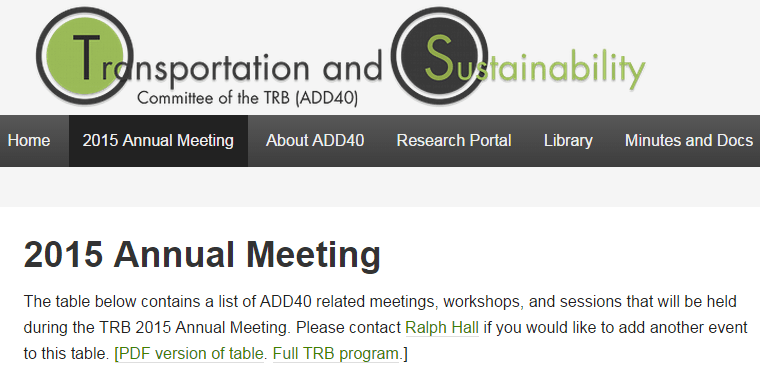
2015-01-08_1050While ADD40 is supporting a number of workshops, sessions, and meetings at the annual meeting, the following list outlines the committee-led events:

 Monday

Tuesday

Wednesday

SOS Meeting – Agenda

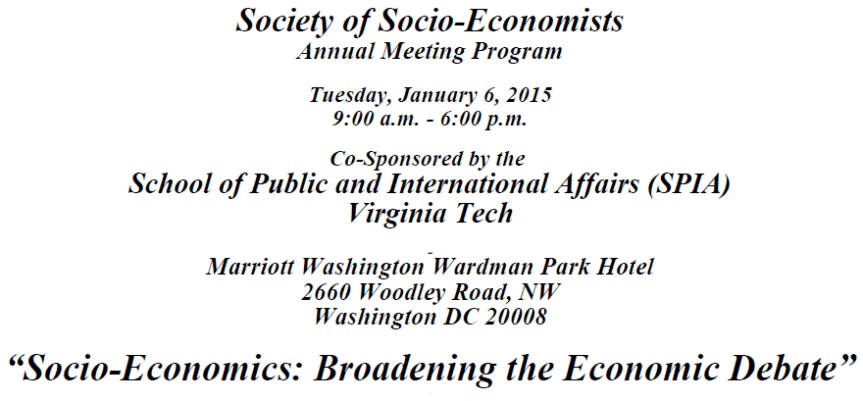
The information below outlines the agenda for the annual meeting of the Society of Socio-Economists (SOS) on Tuesday, January 6in Washington, D.C. A series of concurrent sessions will follow a morning plenary that is intended to provide a forum to discuss how the ‘socio-economic’ approach to economic analysis can help connect disciplines and perhaps chart new research collaborations/projects.

2014-12-11_0849A list of meeting participants can be found here.

The meeting is open to professionals, academics, and students. The registration fee is $75 for professionals and academics and $10 for students. This fee can be reduced or waived if needed.

9:00 a.m. – 11:45 a.m. Plenary Session

Topics to be discussed include…

  1. Socio-Economic Theory
  2. Sustainable Economic Growth
  3. Wealth and Income Distribution
  4. Poverty, Race, Gender, and Class
  5. Corporate Fiduciary Duties, Governance, and Social Responsibility
  6. Social Entrepreneurship
  7. Economic, Financial, and Environmental Regulation
  8. Economics of War and Peace
  9. Tax Policy
  10. Ethical Dimensions of Economic Analysis

12:15 – 1:15 p.m. Luncheon Panel

1:30 p.m. – 3:00 p.m. Concurrent Sessions

  • 1-A Connecting and Integrating Strategies for an Economic Transformation

Nicholas Ashford (M.I.T.) (Organizer/Moderator)
Ralph Hall (Virginia Tech)
Katherine McFate (Center for Effective Government)

  • 1-B Reinventing the State in an Era of Inequality

June Carbone (Minnesota) (Organizer/Moderator)
Sara Jordan (Virginia Tech)
Nina Kohn (Syracuse)
Katie Wells (Virginia Tech)

  • 1-C Socio-Economic Theory

Robert Ashford (Syracuse) (Organizer/Moderator)
Stephan Padfield (Akron)

3:15 p.m. – 4:45 p.m. Concurrent Sessions

  • 2-A Governing Environmental Justice in the Context of Climate Change

Susan M. Sterett (Virginia Tech) (Organizer/Moderator)
Jalonne White-Newsome (WE ACT)

  • 2-B Financial Services Regulation in Times of Financial Crisis

Michael Malloy (McGeorge) (Organizer/Moderator)
Colleen Baker (Illinois)

  • 2-C Socio-economics Perspectives on Economic Theory

Stefan Padfield (Akron) (Moderator)
David Bieri (Virginia Tech)
Robert Kirsch (Salisbury University)

6:00 p.m. Concluding Plenary

SOS Meeting in Washington D.C. (Jan 6)

On Tuesday, January 6the Society of Socio-Economists (SOS) will be holding its annual meeting in Washington, D.C. This years meeting on “Socio-Economics: Broadening the Economic Debate” is being co-sponsored by SPIA and promises to be a valuable and thought provoking event with notable speakers (see below).2014-12-09_1345

The intent of the meeting is to provide people with an opportunity to explore how their research may connect with the ‘socio-economic’ approach to economic analysis, and to build bridges between disciplines and perhaps chart new research collaborations/projects. I have reproduced the “Statement of Socio-Economic Principles” below for those who are not familiar with this text. The principles provide both a sound epistemological foundation and set of ethical rules of fair play regarding economic analysis that could aid the formulation of public policy.

2014-12-11_0849The meeting will consist of a morning plenary followed by a series of concurrent sessions in the afternoon. The plenary is intended to provide a forum that affords everyone a chance to speak and exchange views. Whereas the concurrent sessions allow for more narrowly focused, but still broad, discussions.

The growing list of meeting participants includes the following individuals:

Statement of Socio-Economic Principles

Socio-economics begins with the assumption that economics is not a self-contained system, but is embedded in society, polity, culture, and nature. Drawing upon economics, sociology, political science, psychology, anthropology, biology, and other social and natural sciences, philosophy, history, law, management, and other disciplines, socio-economics regards competitive behavior as a subset of human behavior within a societal and natural context that both enables and constrains competition and cooperation. Rather than assume that the individual pursuit of self-interest automatically or generally tends toward an optimal allocation of resources, socio-economics assumes that societal sources of order are necessary for people and markets to function efficiently. Rather than assume that people act only rationally, or that they pursue only self-interest, socio-economics seeks to advance a more encompassing interdisciplinary understanding of economic behavior open to the assumption that individual choices are shaped not only by notions of rationality but also by emotions, social bonds, beliefs, expectations, and a sense of morality.

Socio-economics is both a positive and a normative science. It is dedicated to the empirical, reality testing approach to knowledge. It respects both inductive and deductive reasoning. But it also openly recognizes the policy relevance of teaching and research and seeks to be self-aware of its normative implications rather than maintaining the mantle of an exclusively positive science. Although it sees questions of value inextricably connected with individual and group economic choices, socio-economics does not entail a commitment to any one paradigm or ideological position, but is open to a range of thinking that treats economic behavior as involving the whole person and all facets of society within a continually evolving natural context.

Unique among interdisciplinary approaches, however, socio-economics recognizes the pervasive and powerful influence of the neoclassical paradigm on twentieth century thought. Recognizing that people first adopt paradigms of thought and then perform their inductive, deductive, and empirical analyses, socio-economists seek to examine the assumptions of the neoclassical paradigm, develop a rigorous understanding of its limitations, improve upon its application, and develop alternative, perhaps complementary, approaches that are predictive, exemplary, and morally sound. With modest amendment, this description of Socio-economics was the substance of the petition signed by more than one hundred twenty law professors from over fifty member schools of the Association of American Law Schools (AALS), to establish the AALS Section on Socio-Economics. It serves as the constitution of the Section. Source.

Additional information of socio-economics can be read in this paper on Socio-Economics – An Overview by Prof. Robert Ashford.