
I’m pleased to share our new report on agrivoltaics that was commissioned by the Virginia Department of Energy. The report examines agrivoltaics practices, policies, and programs across the United States through 2024, highlighting emerging trends, benefits, and lessons learned. Together, these insights offer a foundation for aligning clean energy development with agricultural productivity and land stewardship in Virginia.
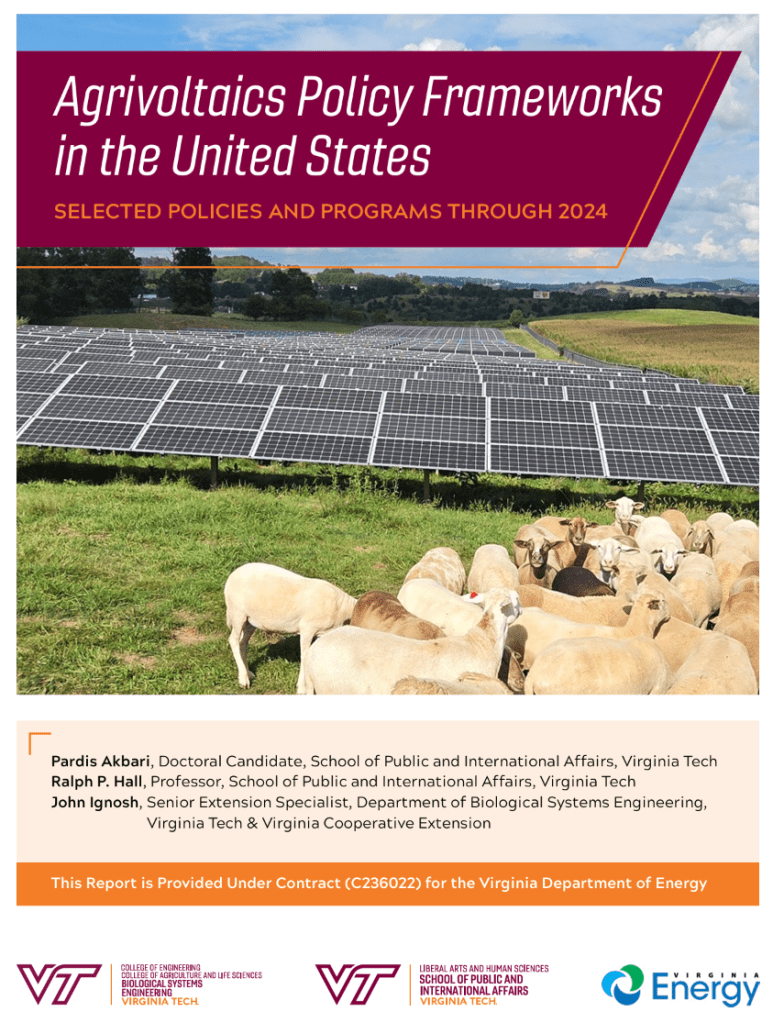
Akbari, P., Hall, R. P., & Ignosh, J. (2026). Agrivolatics Policy Frameworks in the United States: Selected Policies and Programs through 2024. Virginia Tech, Blacksburg. https://hdl.handle.net/10919/141096
Executive Summary
Agrivoltaics, also known as dual-use solar or agrisolar, is an integrated land-use approach that combines agricultural production and photovoltaic electricity generation on the same site, allowing crops to be cultivated, livestock to be grazed, or pollinator habitats to be maintained while producing renewable energy from solar panels (Department of Energy, 2022; Macknick et al., 2022).
Agrivoltaics presents a potential sustainable solution to land-use competition between food and energy production (Jain, 2024). By integrating solar power generation with agriculture, agrivoltaics systems optimize land use and can increase overall land productivity by 35–73% compared to traditional single-use approaches (Dupraz et al., 2011). The systems can also improve water-use efficiency beneath photovoltaic (PV) panels, reducing evaporation and conserving soil moisture (Adeh et al., 2018). Additionally, agrivoltaics can lower solar panel temperatures by 1-2°C, improving energy efficiency and extending a system’s lifespan (Patel et al., 2019). The partial shading from panels can benefit crops sensitive to heat and sunlight stresses, potentially creating a more favorable microclimate for growth in some production systems and locations (Kussul, 2020; Marucci et al., 2018). Beyond environmental benefits, agrivoltaics may enhance the economic resilience of farms by providing an additional revenue stream from energy generation (Dinesh & Pearce, 2016).
The Virginia Department of Energy commissioned this review to better understand evolving agrivoltaics practices, policies, and programs across the United States at both the federal and state levels. Its purpose is to identify emerging trends and provide an overview of current and recent efforts supporting the integration of agriculture and solar energy development. This review focuses primarily on agrivoltaics initiatives through 2024.
The United States federal government has introduced several policies and programs that indirectly support the growth of agrivoltaics as part of the country’s broader clean energy transition. Key legislative actions, including the Bipartisan Infrastructure Law of 2021 and the Inflation Reduction Act of 2022, have provided significant funding to the Department of Energy (DOE) to expand clean energy infrastructure and strengthen domestic energy resilience. Although these laws do not specifically focus on agrivoltaics, they helped to create a more favorable environment for its development. Federal incentives such as the Investment Tax Credit (ITC) and the U.S. Department of Agriculture’s (USDA’s) Rural Energy for America Program (REAP) have also encouraged the use of renewable energy within agricultural settings. In addition, research and development efforts by the Department of Energy (DOE) through its Solar Energy Technologies Office, including the FARMS and InSPIRE programs, and by the USDA’s National Institute of Food and Agriculture (NIFA), have helped improve the understanding of how agrivoltaics systems perform and how they can support both energy generation and agricultural production.
Across the states, there is growing momentum to promote agrivoltaics through new policies and incentives. Massachusetts continues to lead the way with its SMART program and Agricultural Solar Tariff Generation Unit (ASTGU) incentive, which provide payments and clear design guidelines to ensure that farmland remains in active agricultural use while supporting solar energy production. Other states have developed similar initiatives. For example, New Jersey’s Dual-Use Pilot Program offers incentives for projects that combine solar power with ongoing farming operations, while Colorado supports agrivoltaics through property tax exemptions, research funding, and pilot grant programs. In Virginia, the Department of Environmental Quality’s (DEQ’s) Permit-by-Rule framework now includes reduced project mitigation requirements when practices such as managed grazing and crop cultivation are incorporated when solar projects impact prime farmland. Collectively, these efforts show a growing commitment to balance farmland protection with renewable energy expansion.
A closer look at these initiatives reveals several common elements are emerging that shape the direction of agrivoltaics policy in the United States. Most initiatives rely on financial incentives to make agrivoltaics projects economically viable, recognizing that dual-use systems often require higher upfront costs for design and construction. In addition, many programs include pilot and demonstration projects as a central strategy, providing opportunities to test system designs, crop performance, and management practices under real-world agricultural conditions before broader implementation.
To support the effective expansion of agrivoltaics in Virginia, a harmonized policy framework and a consistent definition of the practice are necessary. Coordination among incentives, performance standards, and data-sharing mechanisms can enhance agricultural productivity and renewable energy generation goals. When properly integrated, agrivoltaics can be an effective approach toward energy production, food security, and land stewardship goals. This alignment could turn land-use conflicts into opportunities for sustainable development and resilient clean energy growth. This report summarizes various agrivoltaics initiatives across the United States. Because energy and land-use planning policies are frequently updated, the details of these initiatives are often in flux. However, this summary aims to capture the full range of efforts, even if some programs are inactive. By doing so, the compilation helps inform future work in Virginia by sharing national experiences and providing resources for further review of each approach.
References:
Adeh, E. H., Selker, J. S., & Higgins, C. W. (2018). Remarkable agrivoltaic influence on soil moisture, micrometeorology and water-use efficiency. PLoS ONE, 13(11), e0203256. https://doi.org/10.1371/journal.pone.0203256
Dinesh, H., & Pearce, J. M. (2016). The potential of agrivoltaic systems. Renewable and Sustainable Energy Reviews, 54, 299–308. https://doi.org/10.1016/j.rser.2015.10.024
Dupraz, C., Marrou, H., Talbot, G., Dufour, L., Nogier, A., & Ferard, Y. (2011). Combining solar photovoltaic panels and food crops for optimising land use: Towards new agrivoltaic schemes. Renewable Energy, 36(10), 2725–2732. https://doi.org/10.1016/j.renene.2011.03.005
Jain, S. (2024). Agrivoltaics: The synergy between solar panels and agricultural production. Darpan International Research Analysis, 12(3), 137–148. https://doi.org/10.36676/dira.v12.i3.61
Kussul, E., Baydyk, T., Garcia, N., Velasco Herrera, G., & Curtidor López, A. V. (2020). Combinations of solar concentrators with agricultural plants. Journal of Environmental Science and Engineering B, 9(5), 168–181. https://doi.org/10.17265/2162-5263/2020.05.002
Macknick, J., Hartmann, H., Barron-Gafford, G., Beatty, B., Burton, R., Choi, C. S., Davis, M., Davis, R., Figueroa, J., Garrett, A., Hain, L., Herbert, S., Janski, J., Kinzer, A., Knapp, A., Lehan, M., Losey, J., Marley, J., MacDonald, J., McCall, J., Nebert, L., Ravi, S., Schmidt, J., Staie, B., & Walston, L. (2022). The 5 Cs of agrivoltaic success factors in the United States: Lessons from the InSPIRE research study (NREL/ TP-6A20-83566). National Renewable Energy Laboratory. https://docs.nrel.gov/docs/fy22osti/83566.pdf (Archived at https://perma.cc/A7HS-SC8R)
Marucci, A., Zambon, I., Colantoni, A., & Monarca, D. (2018). A combination of agricultural and energy purposes: Evaluation of a prototype of photovoltaic greenhouse tunnel. Renewable and Sustainable Energy Reviews, 82, 1178–1186. https://doi.org/10.1016/j.rser.2017.09.029
Patel, B., Gami, B., Baria, V., Patel, A., & Patel, P. (2019). Cogeneration of solar electricity and agriculture produce by photovoltaic and photosynthesis—Dual model by Abellon, India. Journal of Solar Energy Engineering, 141(3), 031014. https://doi.org/10.1115/1.4041899
U.S. Department of Energy. (2022, December 8). Foundational Agrivoltaic Research for Megawatt Scale (FARMS) funding program. https://www.energy.gov/eere/solar/foundational-agrivoltaic-research-megawattscale-farms-funding-program (Archived at https://perma.cc/8SFL-4NVM)
 Ralph P Hall