New Paper in Sustainability

A new paper by Shyam Ranganathan, Raj GC, and I was recently published in Sustainability. The paper presents a way to advance an interconnected set of SDGs and targets through a multiple-use water services (MUS) approach to rural water delivery.
2017-02-21_13-38-20

Abstract: The 2030 agenda presents an integrated set of Sustainable Development Goals (SDGs) and targets that will shape development activities for the coming decade. The challenge now facing development organizations and governments is how to operationalize this interconnected set of goals and targets through effective projects and programs. This paper presents a micro-level modeling approach that can quantitatively assess the impacts associated with rural water interventions that are tailored to specific communities. The analysis focuses on how a multiple-use water services (MUS) approach to SDG 6 could reinforce a wide range of other SDGs and targets. The multilevel modeling framework provides a generalizable template that can be used in multiple sectors. In this paper, we apply the methodology to a dataset on rural water services from Mozambique to show that community-specific equivalents of macro-level variables used in the literature such as Cost of Illness (COI) avoided can provide a better indication of the impacts of a specific intervention. The proposed modeling framework presents a new frontier for designing projects in any sector that address the specific needs of communities, while also leveraging the knowledge gained from previous projects in any country. The approach also presents a way for agencies and organizations to design projects or programs that bridge sectors/disciplines (water, irrigation, health, energy, economic development, etc.) to advance an interconnected set of SDGs and targets.

Citation: Hall, R.P.; Ranganathan, S.; G. C., R.K. A General Micro-Level Modeling Approach to Analyzing Interconnected SDGs: Achieving SDG 6 and More through Multiple-Use Water Services (MUS). Sustainability 2017, 9(2), 314.

2017 Undergraduate Research Conference

Today I had the fortune of moderating a session at the 2017 Dennis Dean Undergraduate Research & Creative Scholarship Conference. This conference showcases the creative and scholarly accomplishments of Virginia Tech’s undergraduate students.

During my session, the following students (from five different programs) each provided excellent presentations of their research:

Congratulations Behshad Ghadimi!

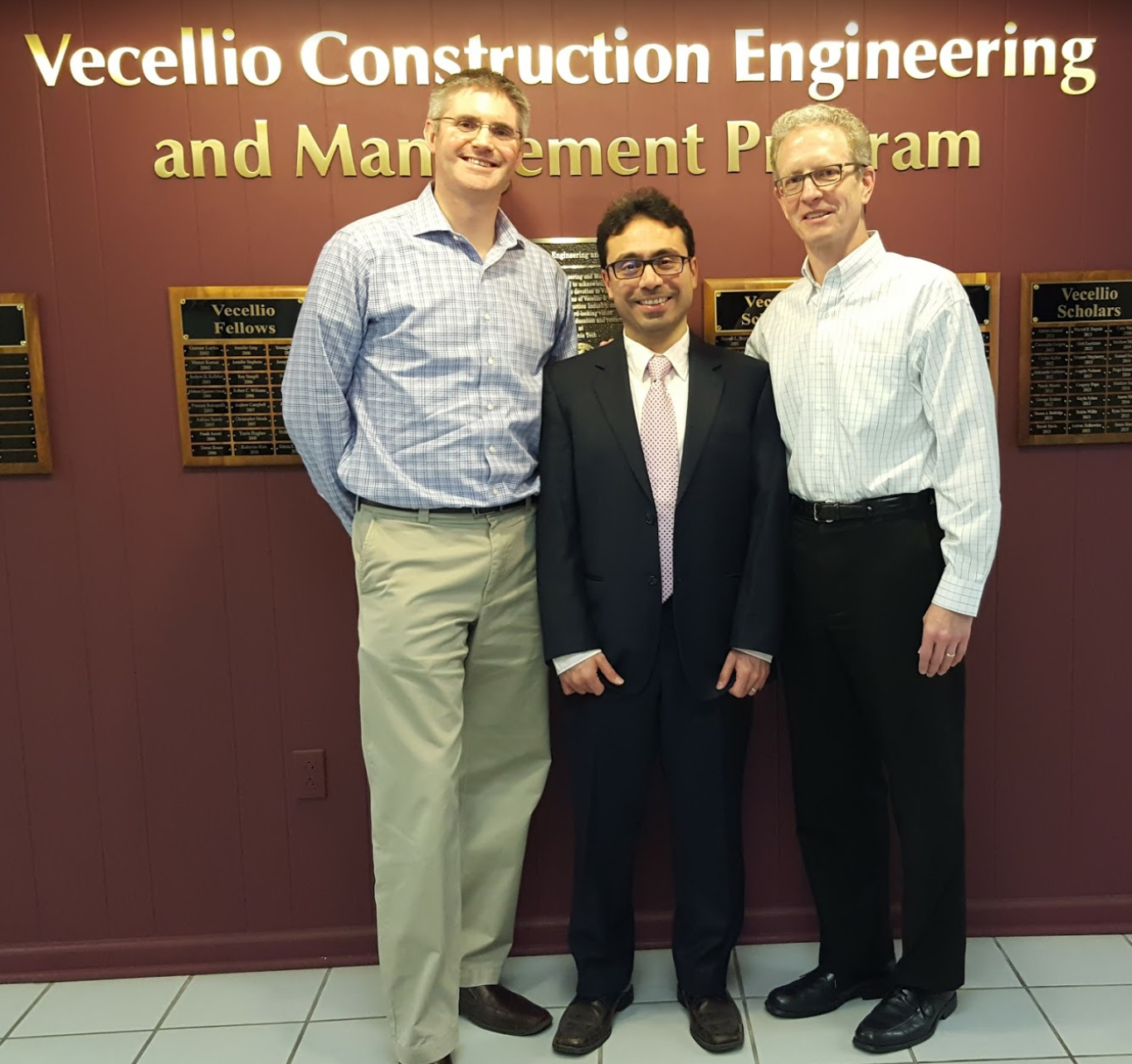
Congratulations to Behshad Ghadimi who successfully defended his PhD in Civil Engineering today. Behshad’s researched focused on the impact of project delivery methods on stakeholder issues and involvement practices in megaprojects. I served on Behshad’s PhD committee with Michael Garvin (Committee Chair, shown on the left below), Sunil Sinha, and John Taylor. The abstract to Behshad’s dissertation is provided below.

2017-02-15_1632

Abstract

As the scale and scope of infrastructure projects have increased, so too has the array of stakeholders either involved or impacted. Such projects often take years to come together and evolve with time through the actions of project sponsors and the engagement of various stakeholders. Stakeholders through engagement and input can help legitimize and improve large-scale project initiatives. Stakeholders can also marshal opposition that can delay or block these projects. Consequently, the significance of stakeholder involvement is critical in megaprojects.

Governments have increasingly utilized public-private partnerships (PPPs) for megaproject delivery. This method introduces characteristics that distinguish PPP megaprojects from others such as: private control, profiteering, foreign profits, and long-term concessions. This study investigates whether differences exist between PPP and non-PPP megaprojects with respect to stakeholder involvement strategies and stakeholder issues raised in such projects.

The research employs a longitudinal multiple case study approach that examines four tolled fixed crossing megaprojects; two of them are delivered as PPPs and two are delivered as design-build (i.e., non-PPP). The approach follows the design of prior studies in this area by De Schepper, Dooms, and Haezendonck (2014) and Winn (2001). Pre and post milestone event analysis captures trends and shifts in involvement strategies and stakeholder issues. Subsequently, stakeholder issue tables (organized by issue themes) and stakeholder mechanism tables (organized by mechanism type and information flow) are utilized for across case synthesis and comparison to identify similarities and differences among the cases.

Analysis of stakeholder involvements across cases shows that NEPA establishes a baseline for involvement, but its requirements are not sufficient for megaprojects; a more comprehensive strategy is necessary. Further, although participatory involvements may enhance input and legitimize projects, these mechanisms must be carefully managed in terms of process and criteria for evaluating stakeholder input. Examination of stakeholder issues indicates that issues that are common to non-PPP and PPP projects are more prevalent than PPP specific issues. In particular, issues related to tolling are dominant; moreover, toll affordability is extremely sensitive, and its severity is predictable based on affected area demographics and past toll escalation practices.

The study provides insights about how megaprojects are shaped through actions of project sponsors as well as impacted and interested stakeholders. It also demonstrates how these projects become artifacts of aspiration for politically powerful figures. Lastly, it identifies the main stakeholder issues and suggests a set of guidelines to assist future practitioners in developing better stakeholder involvement strategies, which should both enhance and legitimize megaprojects.

New Paper – Pit Latrine Fecal Sludge Resistance

In 2016, I was pleased to welcome Charles Chirwa to Virginia Tech for a period several weeks. During his time at the university, we began to analyze the data he collected on the consistency of sludge in 300 pit latrines in Mzuzu, Malawi. We were joined in this task by my colleagues Leigh-Anne KrometisEric Vance, Adam Edwards, and Ting Guan.

At the end of his stay, I posted a tweet in which I stated that “we plan to publish a WASH paper on his research.” After returning to Mzuzu, Charles continued to work on the paper with his primary advisor, Rochelle Holm, and his extended research team in the US. This week his paper was published in the International Journal of Environmental Research and Public Health.

I wanted to congratulate Charles on this accomplishment, which involved hundreds of hours of diligent and carefully executed fieldwork and months of data cleaning and processing to find the best way to present his data. His research provides important data and insights into strategies that could advance pit latrine emptying in resource poor communities in Africa.

2017-02-03_2110