Professor, Urban and Environmental Policy and Planning (UEPP), Virginia Tech; Joann Boughman Innovation Fellow at USG; Acting Director, Center for Future of Work Places and Practices (CFWPP); Head of Outreach and Engagement, Center for European and Transatlantic Studies (CEUTS)
Congratulations to Dr. Sadhana Manthapuri who I had the privilege of hooding this afternoon at the Virginia Tech Graduate School Commencement Ceremony.
It has been a true pleasure to work with Sadhana over the past four years. She has a passion for her research and an incredible work ethic that enabled her to explore almost every facet of the concept of urban DNA. I have copied the abstract from her dissertation below to provide a sense of the scope of her research.
Sadhana’s contributions at Virginia Tech extended beyond her dissertation. She taught two courses—Land Use and Environment and Renewable Energy Systems—sharing her knowledge and enthusiasm with our undergraduate students. She also served as a graduate research assistant with the Center for Economic and Community Engagement, enriching her academic experience with applied research. Internationally, she has presented her research at urban conferences in Spain and London, and was interviewed by Prof. Greg Clark (CBE) as part of his DNA of Cities podcast.
Outside of Virginia Tech, Sadhana was selected for the prestigious 2024 Mayoral Fellowship Program in the City of Detroit. In this program, she worked closely with the crime and violence intervention team, explored a range of policy issues, and regularly engaged with Mayor Mike Duggan. Before that, Sadhana spent her 2023–24 winter break developing an economic revitalization plan for Philadelphia’s 7th Ward, earning second place in the Edmund N. Bacon Urban Design Competition.
I highlight these experiences not just to list her accomplishments, but to illustrate the breadth of her engagement during her time at Virginia Tech. Sadhana seized every opportunity to grow, lead, and contribute—both in the classroom and in communities across the country.
Congratulations again, Dr. Manthapuri!
Abstract
This dissertation examined the concept of Urban DNA from both theoretical and practical perspectives. While urban scholars frequently use the term “urban DNA” in their discussions, many theoretical aspects and applications remain unresolved. In the post pandemic world, as an increasing number of cities are keen to explore their unique urban DNA and leverage this for effective branding, there is a need to understand what urban DNA is. However, there is a lack of comprehensive step-by-step guidance available to urban planners and policymakers on how urban DNA can facilitate the urban development process.
To bridge this gap, a bibliometric review of existing literature was conducted to gain insights into how scholars have framed the concept of urban DNA. This review highlights the strengths and weaknesses of various narratives of urban DNA, thereby providing a more comprehensive understanding of the topic. To establish the urban DNA theoretical framework, 17 different urban development and evolutionary theories were studied to understand what factors could define the genetic essence of cities and how a development transition could occur. Regulation and urban niche theory emerged as the two most effective frameworks due to their ability to explain urban uniqueness, as well as the temporal and spatial variations, growth, and stability that occur across different cycles of urban development.
To validate the regulation and urban niche DNA model, interviews were conducted with the directors of the economic and planning departments across seven tech hubs, aiming to understand how the unique characteristics of these cities evolved over the past two decades. The analysis revealed that, despite notable differences in their economic identities and growth trajectories, the interviewees consistently identified similar regulatory and niche factors as the foundational elements of the cities’ genetic essence. Additional urban DNA mechanisms linked with sectoral, temporal, and spatial interplay were also captured. Drawing from the findings of the qualitative approach, a preliminary vector autoregression framework was developed to quantitatively visualize the DNA of a city and understand the impacts of the phenomenon of addition, substitution, and deletion of genetic elements on the evolution of cities using San Francisco to present the ideas.
I’m pleased to share below a recording of Dr. Arlene Blum’s seminar entitled “Climbing your own Everest: Mountains & Molecules.” In this talk, Arlene explores her amazing career as a pioneering mountaineer and impactful chemist.
At the end of the seminar, I reminisce on how Arlene kindly supported the first class I taught while a postdoc at Stanford. It is truly remarkable to see what she has accomplished with the Green Science Policy Institute that was only an idea being developed back in 2007.
As a result of the Zoom outage on April 16th, we have rescheduled the 5th annual Jean Monnet Lecture, with Ms. Ruth Bajada, Deputy Chief of Mission of the European Delegation to the United States, to April 30th at 3:30pm.
Ms. Bajada has over 23 years of experience in EU affairs and 20 years in foreign policy. Between 2020-2024, she was the Deputy Director/Head of Division United States and Canada in the European External Action Service (EEAS). She has also served as the Political Advisor to the EEAS Secretary General (2019-2020) and was posted in Chile (2015-2019) and Lebanon (2012-2015).
Ms. Bajada joined the European institutions in 2002 and worked at the European Parliament and the Secretariat General of the Council of Ministers.
She holds a bachelor’s degree in Political Science from the University of Malta, a master’s degree in European studies from the College of Europe (Bruges-Belgium), and a master’s degree in International Relations from ULB/Paris II.
Rev. Dr. Virgil Alexander Wood, a trusted mentor, church leader, educator, and towering figure in the civil rights movement, passed away on December 28, 2024, at the age of 93.
I had the privilege of knowing Dr. Wood during what he warmly referred to as his “twilight years.” We first connected in 2016, after he called me about a video I created for a MacArthur 100&Change proposal. I’ll say more about this video and why it led to a close partnership and friendship below.
Dr. Wood’s life was a testament to faith, resilience, and a deep commitment to social justice. Ordained as a Baptist minister in his late teens, he served churches for over five decades in Rhode Island, Massachusetts, and Virginia. While pastoring in Lynchburg, Virginia, he became deeply involved in the civil rights movement, establishing the Lynchburg Improvement Association as a local arm of the Southern Christian Leadership Conference (SCLC).
Dr. Virgil Wood (left) and Dr. Martin Luther King Jr. (right). Photo courtesy of Getty Images.
From 1963 to 1970, he led the Blue Hill Christian Center in Boston’s Roxbury neighborhood and chaired the Massachusetts Unit of the SCLC. As a close confidant of Dr. King, Jr., he served on the SCLC’s National Executive Board during the final ten years of Dr. King, Jr’s. life, coordinating the State of Virginia’s involvement in the historic March on Washington in 1963.
Dr. Martin Luther King Jr. (left) and Dr. Virgil Wood (right). Photo courtesy of Getty Images.
Dr. Wood’s academic achievements reflected his thirst for knowledge and passion for empowering others. After earning a BA in history from Virginia Union University in 1952, he obtained a Master of Divinity from Andover Newton Theological School in 1956 and a Doctorate in Education from Harvard University in 1973. His career in education was as impactful as his ministry, with roles as Dean and Director of the African American Institute at Northeastern University and as a professor at Virginia Seminary and College. He also served as a lecturer and researcher at Harvard University and led the Beloved Community Initiative as a Distinguished Ridenour Faculty Fellow in the School of Public and International Affairs at Virginia Tech.
Dr. Wood with Louise and Minnis Ridenour.
Dr. Wood’s dedication to economic justice led him to work as an administrator for the Opportunities Industrialization Centers (OICs) of America, founded by his friend and mentor Dr. Leon Sullivan to provide job training for underserved communities. Dr. Wood established 13 OICs in eight southern states and in Boston, Massachusetts. He also lent his wisdom to three White House Conferences under the Johnson, Nixon, and Carter administrations.
Throughout his life, Dr. Wood maintained friendships with civil rights icons such as Rosa Parks, Dr. Martin Luther King, Jr. and Sr., Dr. Leon Sullivan, Dr. Ralph Abernathy, Dr. Samuel Dewitt Proctor, Dr. C.T. Vivian, Dr. Wyatt Tee Walker, and many others. Some of these connections can be seen in Dr. Wood’s 2020 book entilted In Love We Still Trust: Lessons we learned from Martin Luther King Jr. and Sr.
Dr. Wood and Rosa Parks while she was receiving an Honorary Doctorate. Source: Wood, V. A. (2006) In Love We Trust.
When we first met in person, I remember we joked that if I lived my life twice over, I’d still be younger than him. It was a lighthearted moment that underscored the incredible tenure of his life’s work, his wealth of wisdom, and his generous spirit.
Our work together built on my long-term collaboration with Prof. Robert Ashford, who has been advancing Louis Kelso’s theory of binary economics throughout his academic career. The 90-second 100&Change video mentioned above outlined a proposal to provide citizens of a country with a capital ownership stake in their nation’s economic future. Using the principles of binary economics, people could acquire capital (i.e., an ownership stake in new and inherently sustainable goods and services) with credit repayable with pre-tax future earnings of capital (future savings).
Dr. Wood’s interest in Louis Kelso’s theory of binary economics is reflected through his work creating the OICs and efforts to advance economic and social justice. The former revealed the value of enabling people to earn an income through meaningful work and the latter of the transformative potential of capital ownership/income. Dr. Wood understood the economic potential of real capital ownership and that relying on wage income alone would be insufficient to address the roots of poverty in America. The video below shows Dr. Wood speaking about this idea (1:28) while we visited the Booker T. Washington High School in Houston in 2018.
During our early conversations, Dr. Wood explained how, in February of 1968, he made the case to Dr. King, Jr. that a Poor Peoples’ Campaign built on the “Why” of his Beloved Community concept, without the “How” embodied in Louis Kelso’s theory of binary economics, would mean that the promise of the campaign would remain unfulfilled. Dr. Wood’s underlying argument was that the Poor Peoples’ Campaign should be taken to Wall Street, rather than to Washington, to which Dr. King, Jr. apparently replied, “you are right, but we can’t do that now.” Dr. King’s assassination on April 4, 1968 effectively halted the integration of these ideas. This historic moment anchored our partnership and provided a clarity of purpose around reigniting Dr. Wood’s 1968 vision.
Today, the need for a reformulated Poor Peoples’ Campaign that helps build a new and regenerative economy cannot be more pressing. Few people earn enough to take care of themselves or their families. Labor, the main source of economic productiveness prior to the industrial revolution, has declined in relative productiveness as labor-displacing technology (think GenAI) advances and becomes hyper-productive in comparison to labor. These trends are driving the growth in inequality and the erosion in labor earning capacity, with the ownership of productive wealth being highly concentrated, and with most people owning little or nothing.
Dr. Wood envisioned a modern day Poor Peoples’ Campaign (what he called the Beloved Economy) built around the ideas of Dr. King, Jr. and Kelso. In the Beloved Economy, the ownership of capital―a critical and growing form of income―becomes more inclusive by using future capital earnings (future savings) to finance broadening capital acquisition to provide growing numbers of people with capital income. Dr. Wood knew that as production becomes ever more capital intensive, providing the poor with a capital ownership stake will be critical to broadly increasing purchasing power, reducing inequality, and advancing Dr. King, Jr’s notion of the Beloved Community.
During his time with Virginia Tech, Dr. Wood led the creation of the Beloved Community Initiative (BCI) that established an essay contest (see the essay contest video and several photos from the award ceremony below) and hosted the MLK Jubilee Summit in 2018.
In an effort to capture some of Dr. Wood’s life experience, my colleague Prof. Sylvester Johnston interviewed Dr. Wood and his long-term friend Prof. Owen Cardwell (University of Lynchburg) in 2018 about their upbringing and work. The first 25 minutes of the video below, produced by Prof. Rachel Weaver, covers Dr. Wood’s early childhood, his time with Dr. Martin Luther King, Jr., the economy of abundance, and more. In addition to this video, we decided to record an informal “In Conversation” series where Dr. Wood held discussions with his colleagues, including Prof. Cox, Prof. Cardwell , Dr. Hulbert, and Dr. Tasby and Dr. Smith. The complete set of recordings can be found on the Beloved Community Initiative YouTube channel.
During his visits to Virginia Tech, Dr. Wood always asked for opportunities to speak and engage with students, faculty, staff, and the local community. He had a unique ability to make people feel heard and left spaces filled with energy and opportunity.
Dr. Wood leaves behind a legacy that will continue to inspire future generations. In his own words, “the song has ended, but the melody lingers on.” It is now left to everyone who knew Dr. Wood to pick up and work with what he left behind to build the future we believe is possible. He was not just a leader but a beacon of hope, compassion, and purpose. His life reminds us that the pursuit of justice and equity is a journey worth dedicating everything to—and that even in our twilight years, we can still shine brightly.
The next installment of the Center for Future Work Places and Practices’s (CFWPP’s) Women in the Future of Work speaker series will be happening on Friday, November 15, from 3-4pm in Pamplin, Room 1045.
Please join us to hear Dr. Sreyoshi Bhaduri present on “Women in High Tech: Upskilling in the Era of Gen AI.”
Dr. Bhaduri is a Senior Research Scientist at Amazon with over 10 years of experience in mixed-methods research. She is a Founding Fellow of the Aula Fellowship for Artificial Intelligence and champion of democratizing emerging tech in the ever changing and interconnected workforce and broader society. Dr. Bhaduri’s recent recognitions include the Society of Women Engineers’ (SWE’s) Distinguished New Engineer award (2024) and the Amazon Tech Innovator award (2024). In 2022, Dr. Bhaduri was named on the SWE’s list of Women Engineers You Should Know.
The Center for European and Transatlantic Studies (CEUTS) will be holding the next installment of its Ambassador Series on November 12, 2024, at 4pm (EST). Please join us to hear his Excellency, Dr. Godfrey C. Xuereb, Ambassador of the Republic of Malta to the United States, deliver a talk about Malta-US and Transatlantic Relations.
Opening remarks will be provided by Prof. Besnik Pula, Associate Jean Monnet Chair, Department of Political Science, Virginia Tech. After the talk, participants will have an opportunity to engage with Ambassador Xuereb via a moderated Q&A.
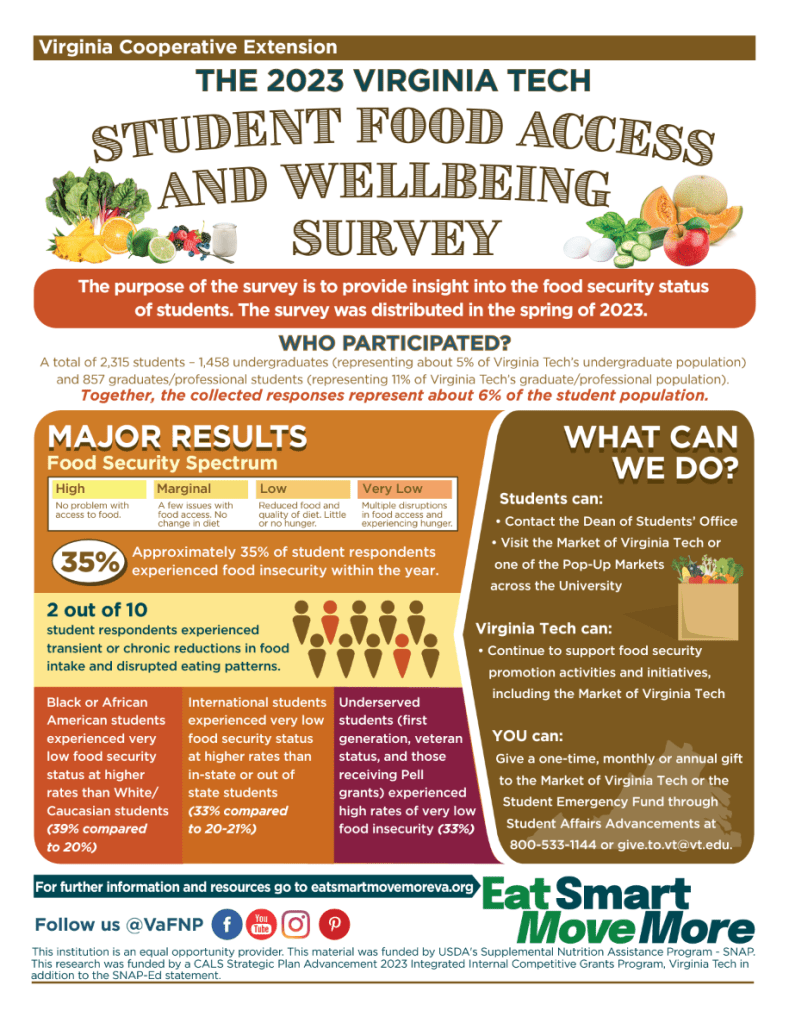
We are pleased to release an infographic and report of the main findings from the 2023 Virginia Tech Student Food Access and Wellbeing Survey. This research was made possible by the 2023 CALS Strategic Plan Advancement Integrated Internal Competitive Grants Program.
Main Findings
A little over a third (34.51%) of student respondents can be classified as being food insecure (having a low or very low food security status).
Around 2 out of 10 respondents (22.63%) were found to be experiencing transient or chronic reductions in food intake and disrupted eating patterns.
Both undergraduate and graduate students had comparable levels of food insecurity (33.81% vs. 35.71%, respectively).
Those students most at risk of having a low or very low food security status include international students and Black or African American and Hispanic or Latino students.
If you are a Virginia Tech student and are in need of food assistance, please consider the following two options.
Option 1: If you find it difficult, for whatever reason, to obtain a sufficient quantity of healthy food each week, please complete this food assistance form in theDean of Students’ office.
Option 2: If you find yourself in a moment of need, please consider visiting The Market of Virginia Tech during the following open hours to access a variety of non-perishable items. No prior intake or registration is required.
Tuesdays: 9:30–11:30 a.m.
Thursdays: 4:30–7 p.m.
Fridays: 9–11:30 a.m.
This past spring semester, Dr. Chanit’a Holmes, Dr. Sarah Misyak, and I ran the first ever Virginia Tech Employee Food Access and Wellbeing Survey. We are currently analyzing the survey responses and plan to release our preliminary findings later this semester.
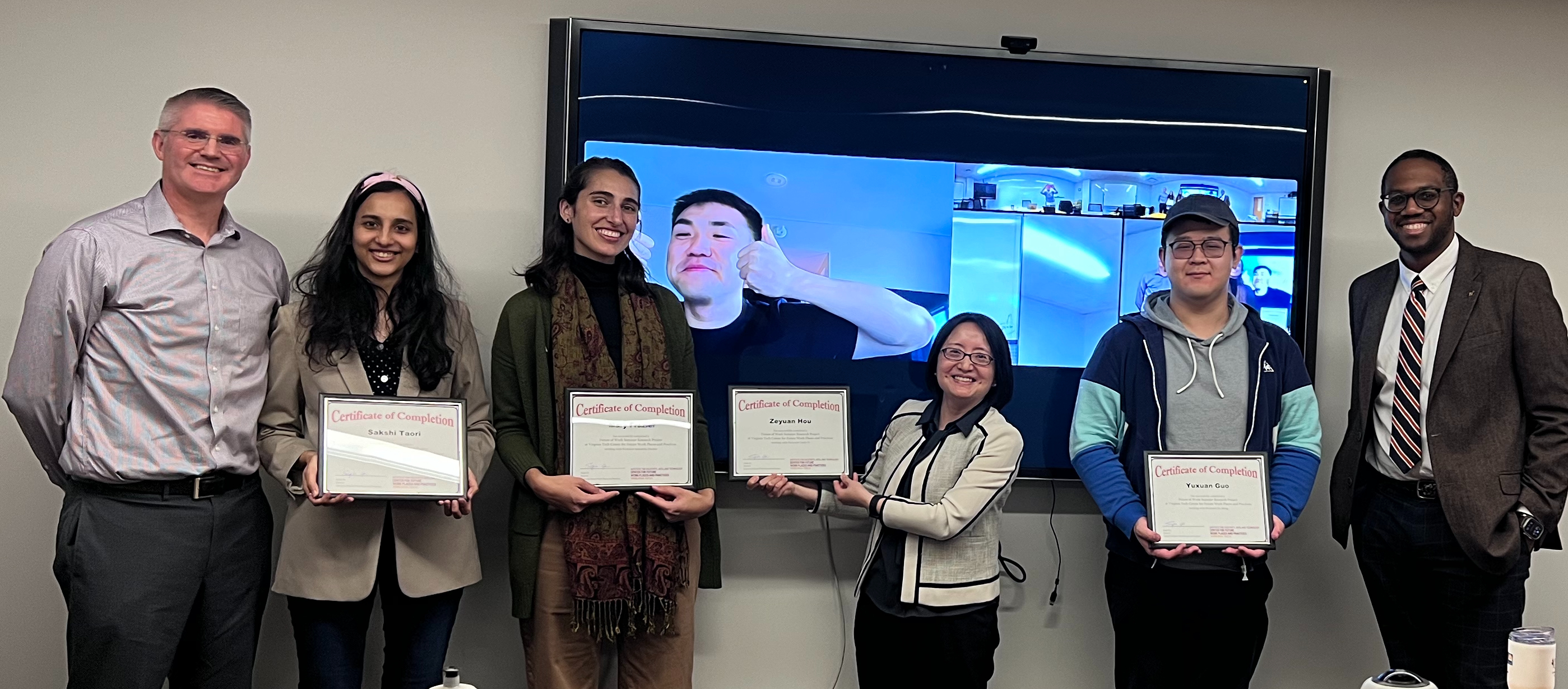
On May 9, from 2-4pm, the Center for Future Work Places and Practices (CFWPP) will hold its annual friends and affiliates networking meeting at the Virginia Tech Inn. The meeting will provide attendees with an opportunity to meet and interact with other affiliates and friends of the center. During the event, we will have a brief presentation about the center activities over the last year, followed by several short presentations about ongoing research related to the future of work. There will also be plenty of time for coffee/free discussion. Please register here.




 Ralph P Hall