
Congratulations to Ibrahim Altasan for successfully defending his PhD dissertation entitled “The Governance of Mobilized Urban Policies: The Case of Riyadh’s Transit-Oriented Development Program.” The general audience abstract for his dissertation is provided below.
Ibrahim has been a valued member of our Planning, Governance, and Globalization (PGG) doctoral community, where he has become known (by our undergraduates in the Smart and Sustainable Cities major) as our resident expert on Urban Footprint.
I co-chaired Ibrahim’s dissertation committee with Dr. Todd Schenk. We were joined on the committee by Dr. Robert Oliver and Dr. Hamad Alsaiari.
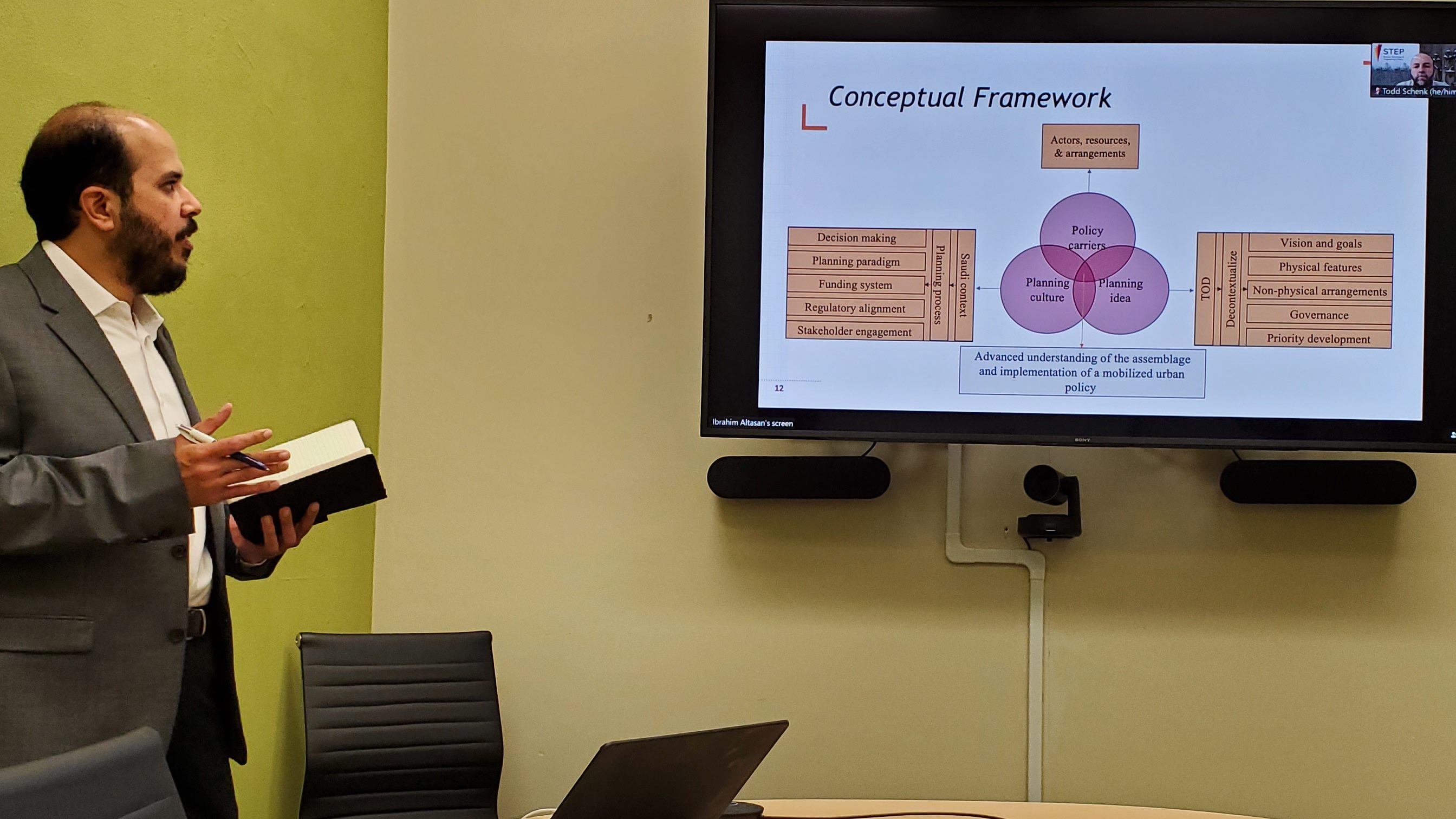

General Audience Abstract
Nowadays, city officials are looking outside their borders for urban policies that promote sustainability and improve quality of life. However, city officials rarely consider how differences between local urban areas could affect the adoption of urban policy. To address this challenge, the field of Urban Policy Mobility (UPM) emerged to shed light on how the unique local factors that shape each city environment affect what elements of an urban policy are or are not adopted. This study examines the changes that occurred when a Transit-Oriented Development (TOD) urban policy was introduced in Riyadh, Saudi Arabia. In order to learn about the changes and challenges of Riyadh’s TOD policy, interviews were conducted with employees responsible for the policy. Additionally, TOD policy documents and other publications that contained information about Riyadh’s TOD were reviewed to obtain additional data to help build a deeper understanding of why certain policy elements were implemented and others were not. The study found that: 1) the TOD policy was not completely translated into Riyadh where the focus is more on increasing building density, diversifying land uses, and enhancing design aesthetics, which resulted in overlooking other important policy elements that enhance economic and social sustainability; and 2) the implementation of the TOD policy led to governance challenges due to the differences in how urban planning is undertaken in Riyadh when compared with TOD policy environments in western countries. This in-depth study of Riyadh’s experience can inform other cities that are looking to implement urban policies borrowed from overseas.
 Ralph P Hall