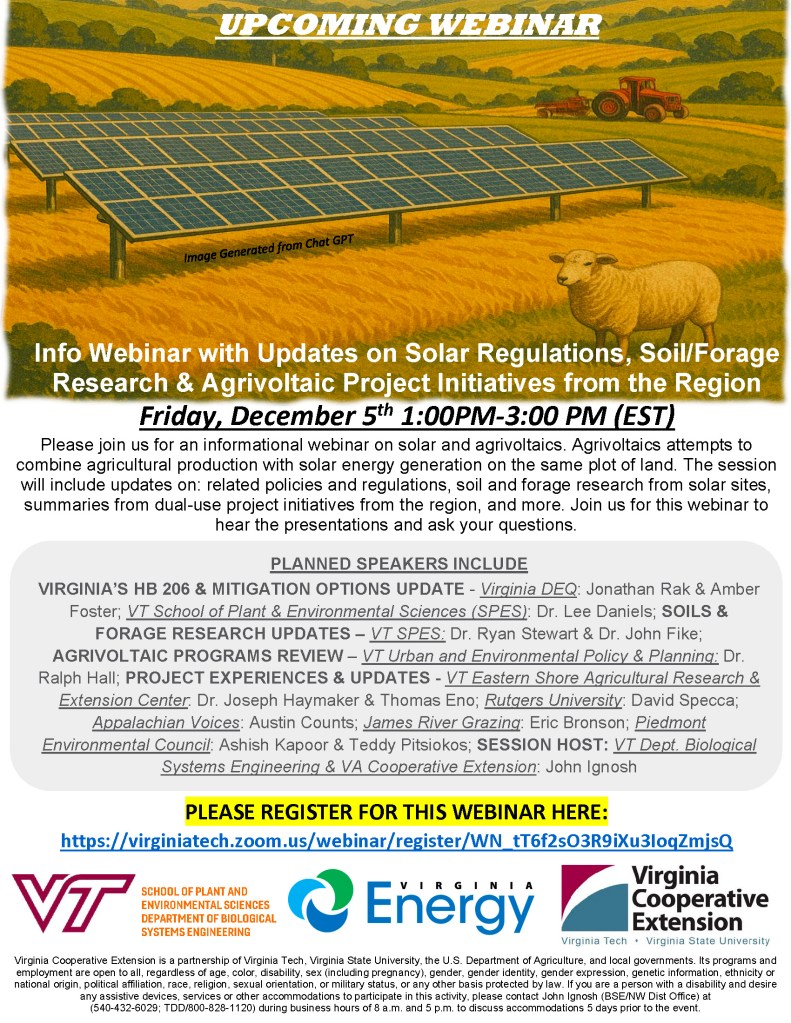
Informational Webinar on Solar Regulations, Soil/Forage Research, and Agrivoltaics Initiatives

Please join us on Friday, December 5, 1:00–3:00 PM (EST) for an informational webinar exploring the intersection of agriculture and solar energy. Learn about:

  • Lessons from dual-use agrivoltaic projects
  • Solar policies & regulations affecting farmland
  • Soil & forage research on solar sites

Planned Speakers & Topics:

  • Virginia’s HB 206 & Mitigation Options Update: Jonathan Rak & Amber Foster (Virginia DEQ), Dr. Lee Daniels (VT SPES)
  • Soils & Forage Research Updates: Dr. Ryan Stewart & Dr. John Fike (VT SPES)
  • Agrivoltaic Programs Review: Dr. Ralph Hall (VT Urban and Environmental Policy & Planning)
  • Project Experiences & Updates: Dr. Joseph Haymaker & Thomas Eno (VT Eastern Shore Agricultural Research & Extension Center), David Specca (Rutgers University), Austin Counts (Appalachian Voices), Eric Bronson (James River Grazing), Ashish Kapoor & Teddy Pitsiokos (Piedmont Environmental Council)

The session will be recorded, and a link to the recording will be shared with all registrants.

This is a great opportunity for farmers, researchers, policymakers, and anyone interested in sustainable energy and agriculture to learn, connect, and explore new approaches in the rapidly evolving field of agrivoltaics.

Please share this announcement with colleagues or friends who may be interested in the topic.

Register here.
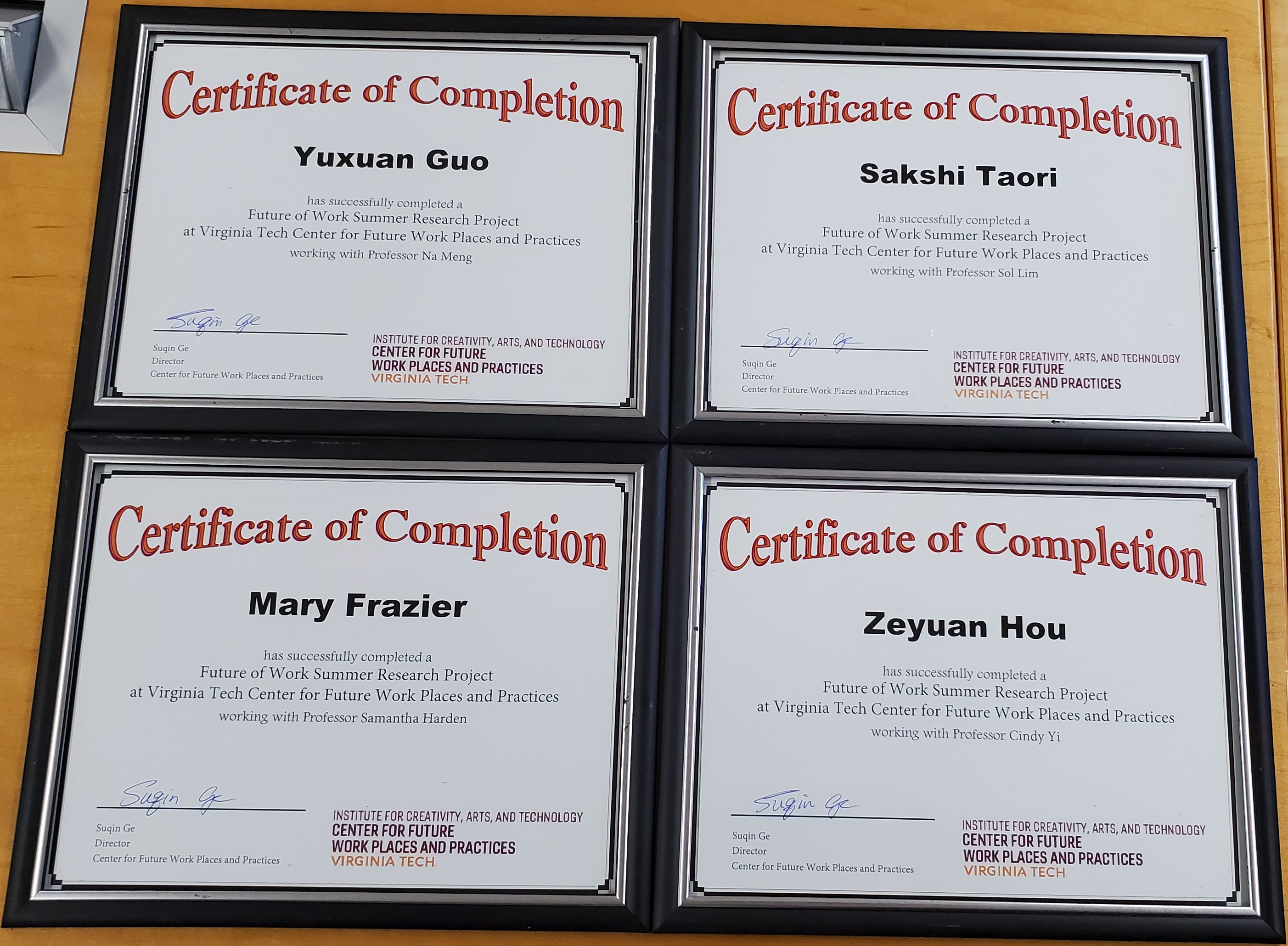
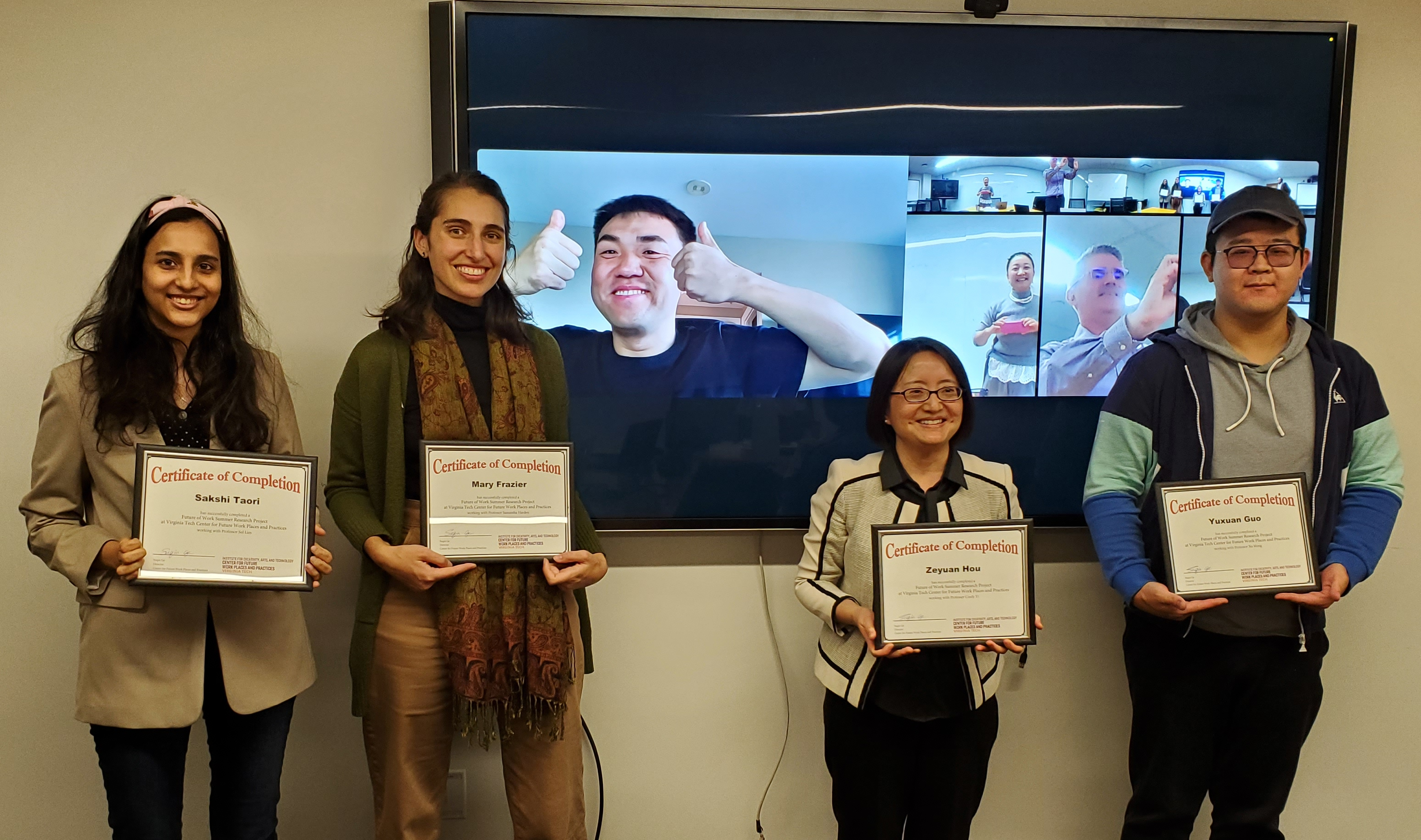
2024 CFWPP Summer Research Award Recipients

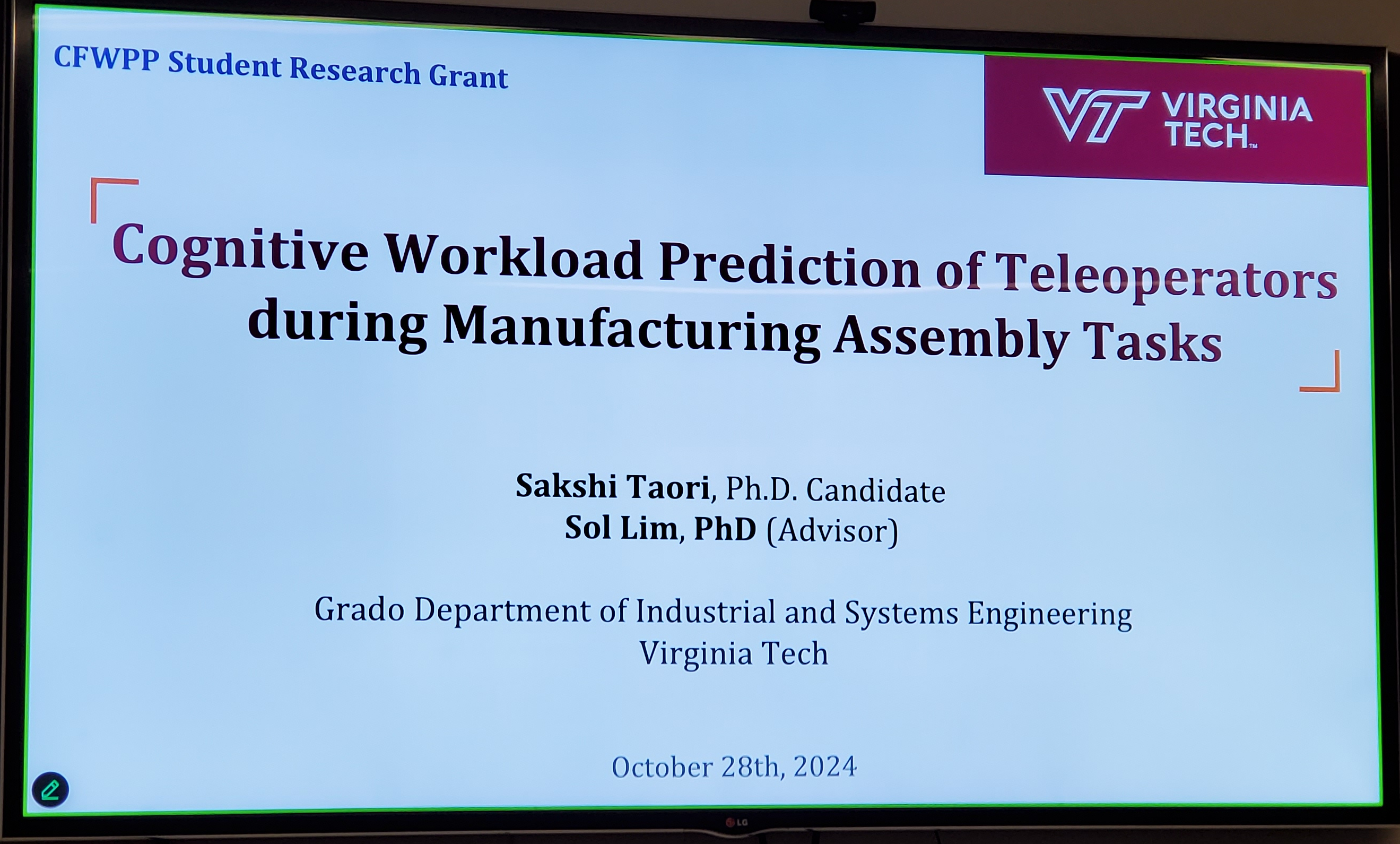
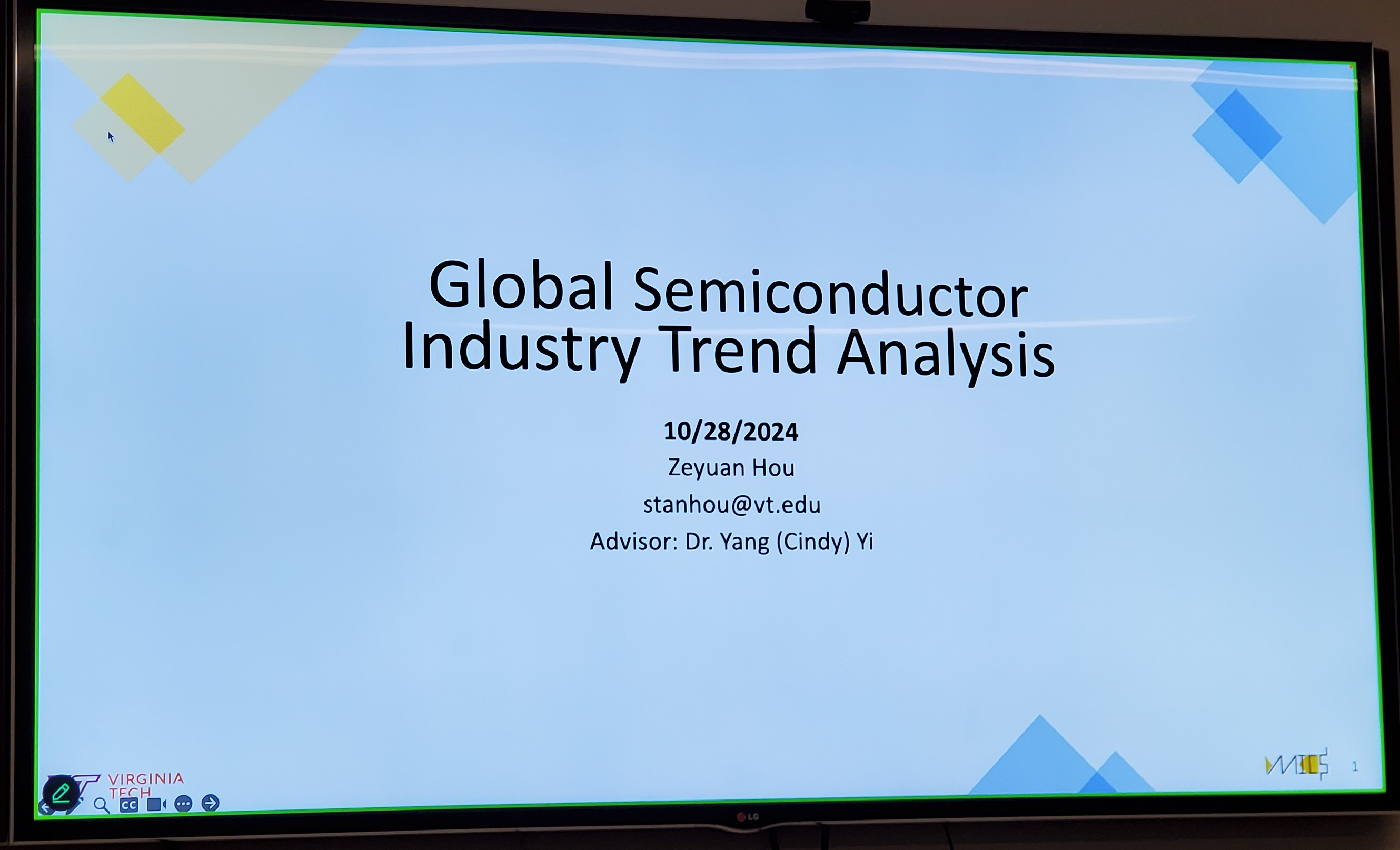
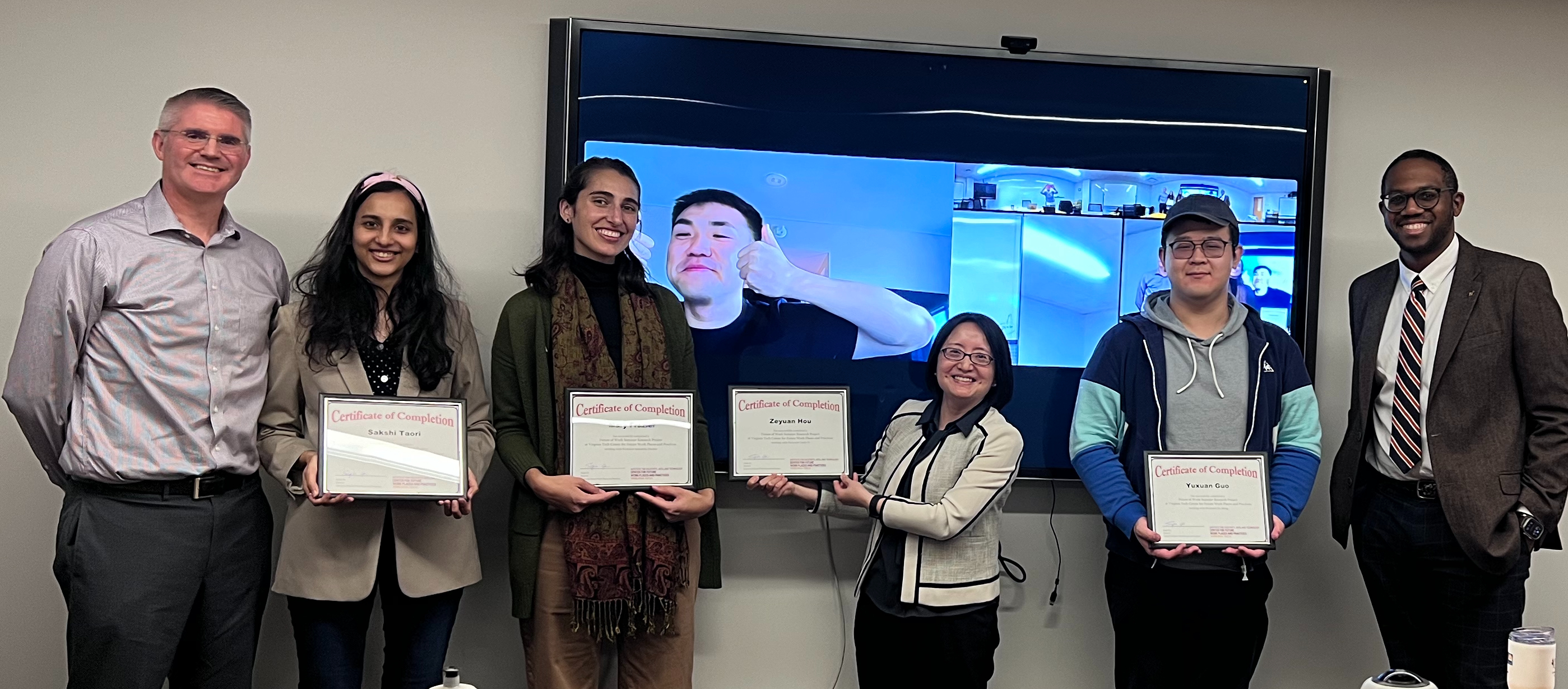
Meet the Center for Future Work Places and Practices (CFWPP) 2024 Summer Research Award Recipients – Sakshi Taori, Mary Frazier, Yuxuan Guo, and Zeyuan Hou – who shared the findings from their summer research with the center earlier this week.

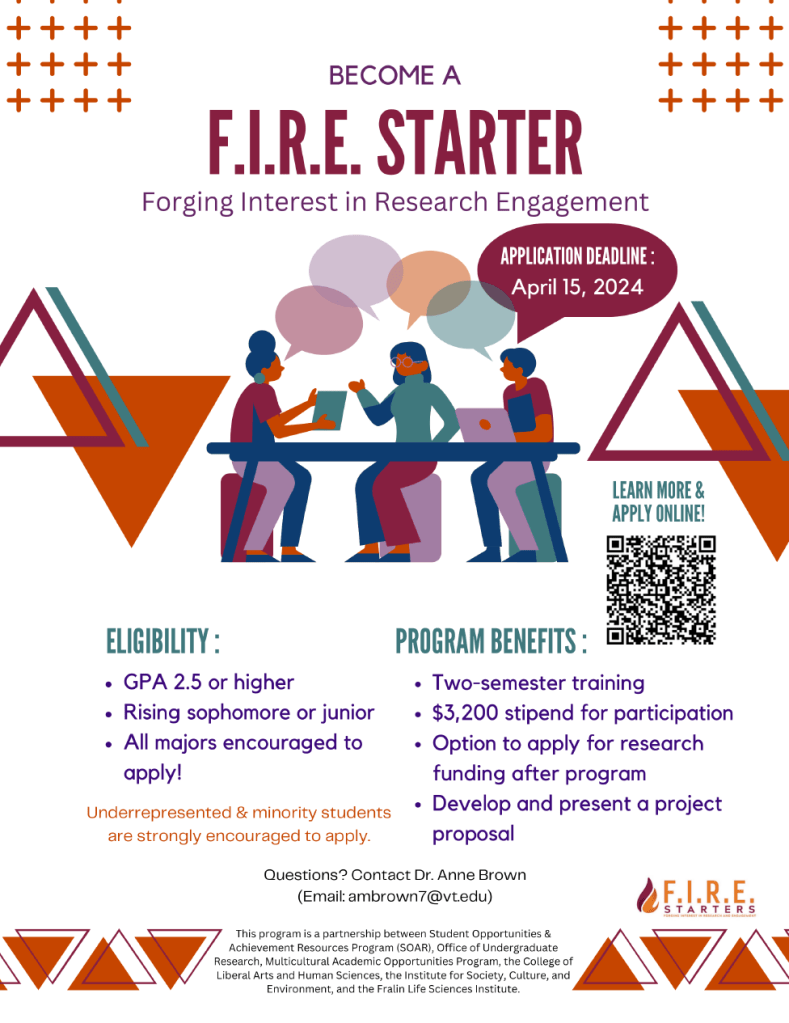
Application Open for 2024-25 F.I.R.E. Starters

The application for the 2024-2025 F.I.R.E. (Forging Interest in Research and Engagement) Starters program is now open to Virginia Tech undergraduates (specifically, rising sophomores and/or students with junior standing, or students with at least 2 years remaining at Virginia Tech).  

As a global land-grant institution, Virginia Tech is committed to serving individuals and society and improving the quality of life for all. The realization of this vision rests on our ability to advance transdisciplinary research that is informed by a diverse array of lived experiences. The purpose of the F.I.R.E. Starters program is to:

  1. increase diversity in undergraduate research at Virginia Tech,
  2. increase access to foundational research training,
  3. connect students with faculty research mentors, and
  4. prepare students for independent and collaborative research, competitive summer research opportunities, and other undergraduate research experiences.

Students in all disciplines – especially in the humanities and social sciences – are encouraged to apply.

The deadline for applications is April 15, 2024

Advice to MURP and PGG Applicants

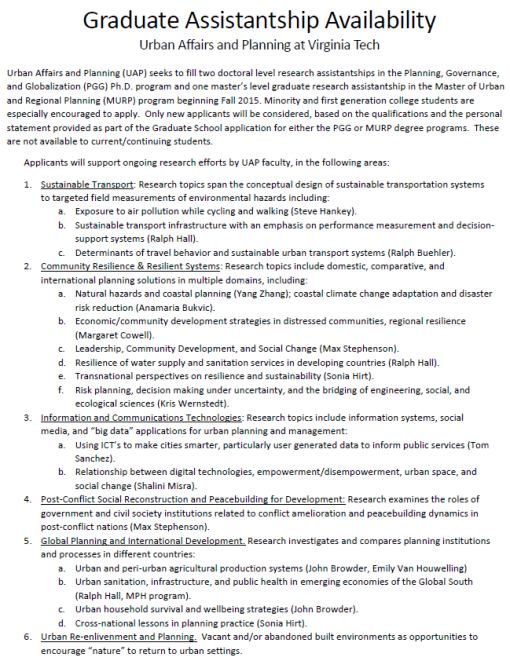
The Urban Affairs and Planning (UAP) program is looking to fill two doctoral level research assistantships in the Planning, Governance, and Globalization (PGG) Ph.D. program and one master’s level graduate research assistantship in the Master of Urban and Regional Planning (MURP) program beginning Fall 2015. We are especially interested in receiving applications from minority and first generation college students.

If you would like to apply for either of these opportunities, I encourage you to carefully review the UAP Research Needs Statement to identify the subject area and faculty with whom you would like to work. Please include this information in the personal statement submitted with your application.

2015-01-26_0920

ADD40 and Collaborative Research

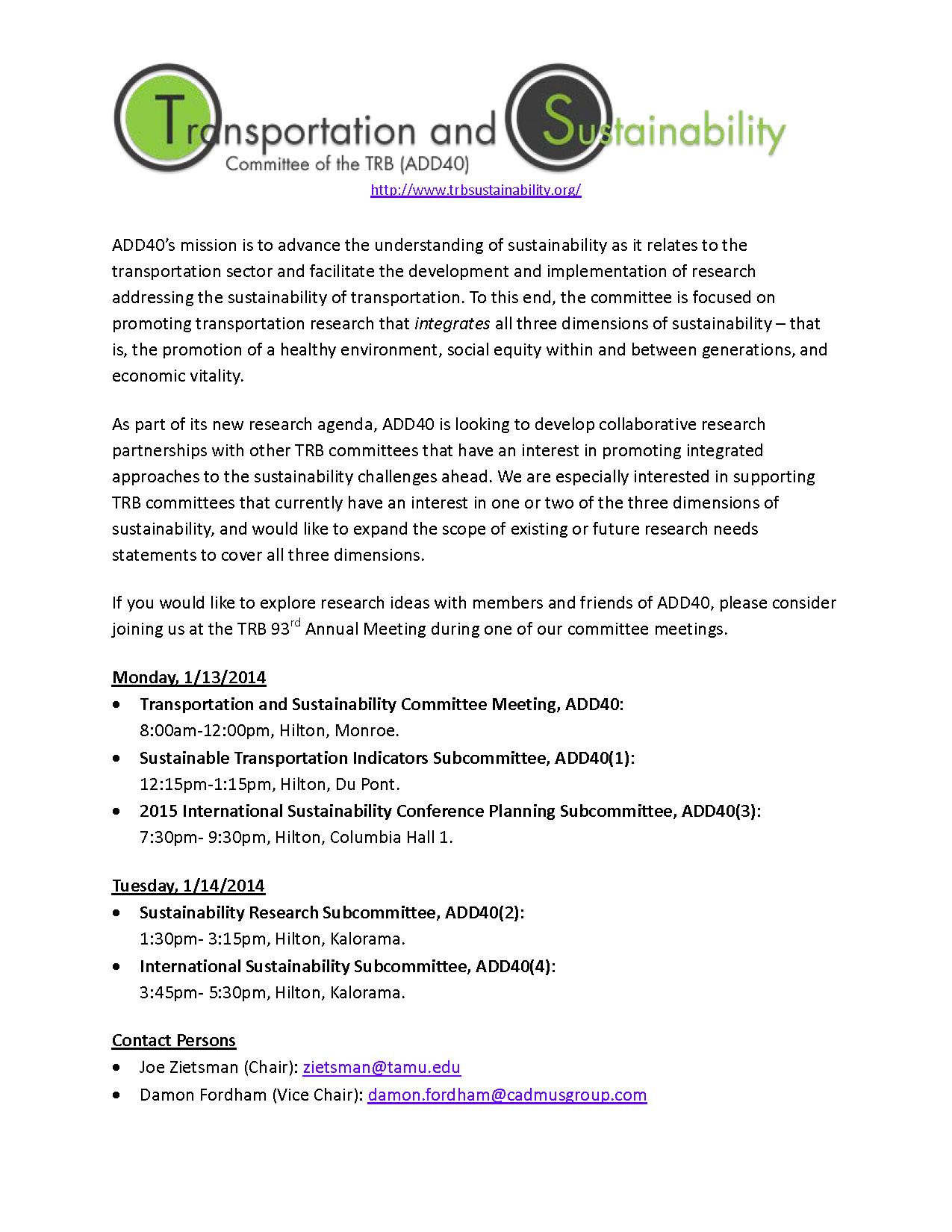
I’m looking forward to reconnecting with members and friends of the Sustainable Transportation Committee (ADD40) at the TRB 93rd Annual Meeting in January. During the conference we will hold the inaugural Sustainability Research Subcommittee, ADD40(2), meeting on Tuesday, 14 January, 1:30pm – 3:15pm (Hilton, Kalorama).

As you may know, in ADD40’s Triennial Strategic Plan we made the decision to promote and support research that integrates the three dimensions of sustainability. One important step in achieving this goal will be the extent to which we can develop collaborative research relationships with other TRB standing committees that have an interest in sustainability. Our objective is to try and broaden the scope of TRB research to ensure a more balanced treatment of environmental, social, and economic concerns.

ADD40 FlyerThe TRB Annual Meeting presents a unique opportunity for members and friends of ADD40 to reach out to other relevant standing committees and begin the process of reviewing sustainability-related research needs statements and/or developing new statements. To assist with this task, we have developed the adjacent flyer that can be used to inform other committees about our mission and interest in developing collaborative research projects.

During the main ADD40 committee meeting from 8am-12pm on Monday, 13 January (Hilton, Monroe), everyone in attendance will have the opportunity to brief the committee on which TRB standing committees they plan to reach out to during the annual meeting. This will enable the committee to identify the coverage we have at the annual meeting and will provide those in attendance with an opportunity to identify others who may have a shared interest in working with a specific committee.

During the research subcommittee meeting ADD40(2), I look forward to learning about the collaborations that are already underway or are planned and beginning the process of developing several new research thrusts that ADD40 will lead. If you have any ideas for transportation research projects that integrate all three dimensions of sustainability, please either send me an email (rphall@vt.edu) prior to the annual meeting or join us on Tuesday, 14 January.

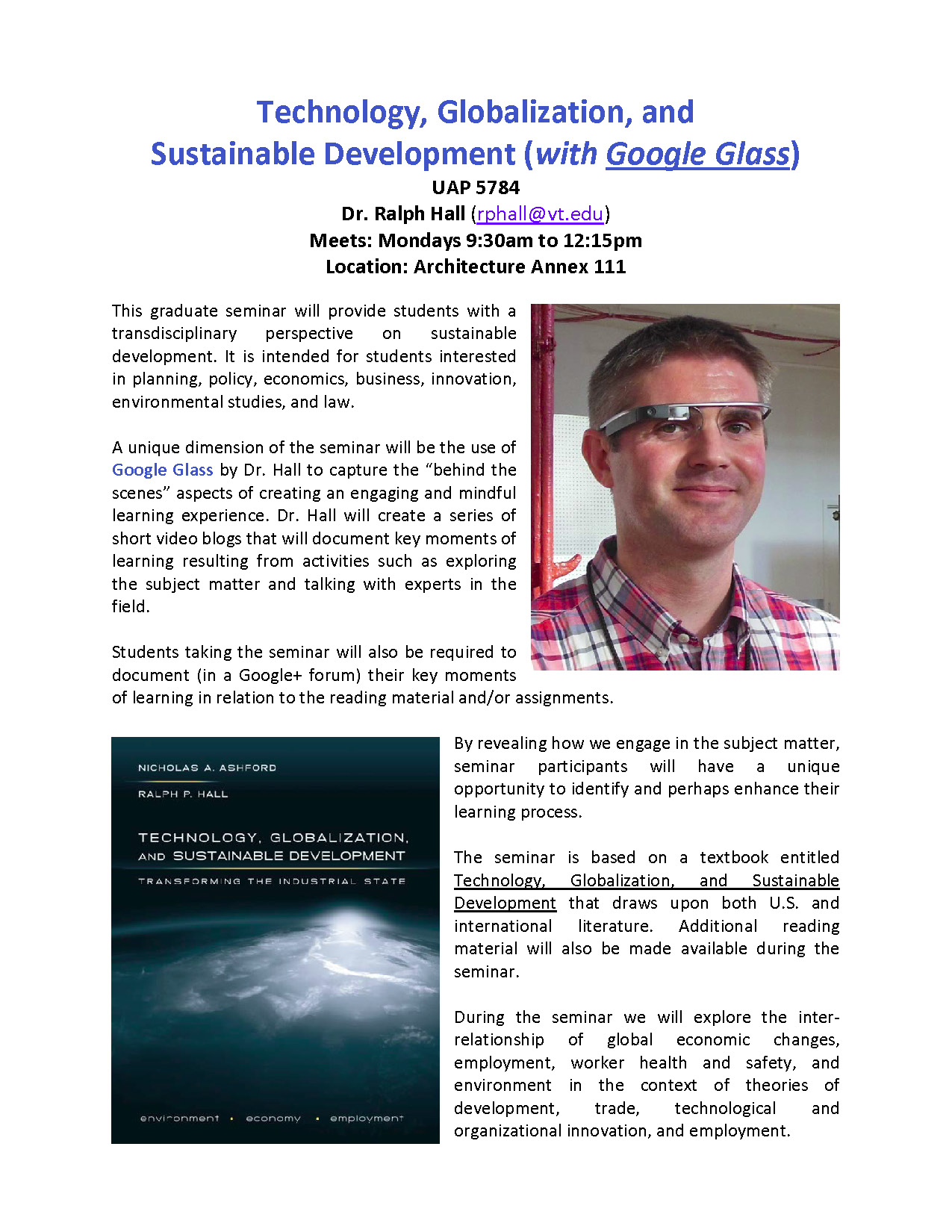
First Glass Meeting

UAP5784 - Tech. Glob. Sus. Dev.Today I met with Megan O’Neill, Brian Matthews, and Shelli Fowler to hold an initial discussion of how I might use Glass during my seminar this semester. The video below was taken using Glass. The quality of the image is good, but the sound quality is very poor at times (i.e., you may need to use a headset to hear what is being said). In the future, I will need to sit closer to the person I’m talking with in the hope that the microphone will pickup both sides of the conversation. As you can hear, my voice comes across loud and clear.

For those of you who are interested, the 29-minute video has a size of 1.2 GB (about 10% of the space available on Glass). When I started recording the video, my battery power was at 94%. After 29 minutes of recording the battery power dropped to 19%.  I estimate that I had about 5 minutes of battery power left. Thus, a good rule of thumb is to plan to record for a maximum of 30 minutes on a full charge. Another lesson from today is that it is probably better to record shorter and more focused videos. Such action would require a certain amount of advanced planning, but limiting a video to 2 to 5 minutes would be a good skill to develop.

During our conversation, we referred to the video below that discusses an interesting way of “reviewing” (rather than grading) assignments. One idea is to use Glass to record a short video in which I would talk about the good and problematic aspects of an assignment. Such a video could be individually (privately) shared with a student. Further, if the assignment were uploaded to Google Drive, it would be possible to edit and comment on the final product. Such a process could encourage students to continue working on and refining an assignment that they could later turn into a paper or use in a professional capacity.