VT Student Food Access & Wellbeing Infographic & Report

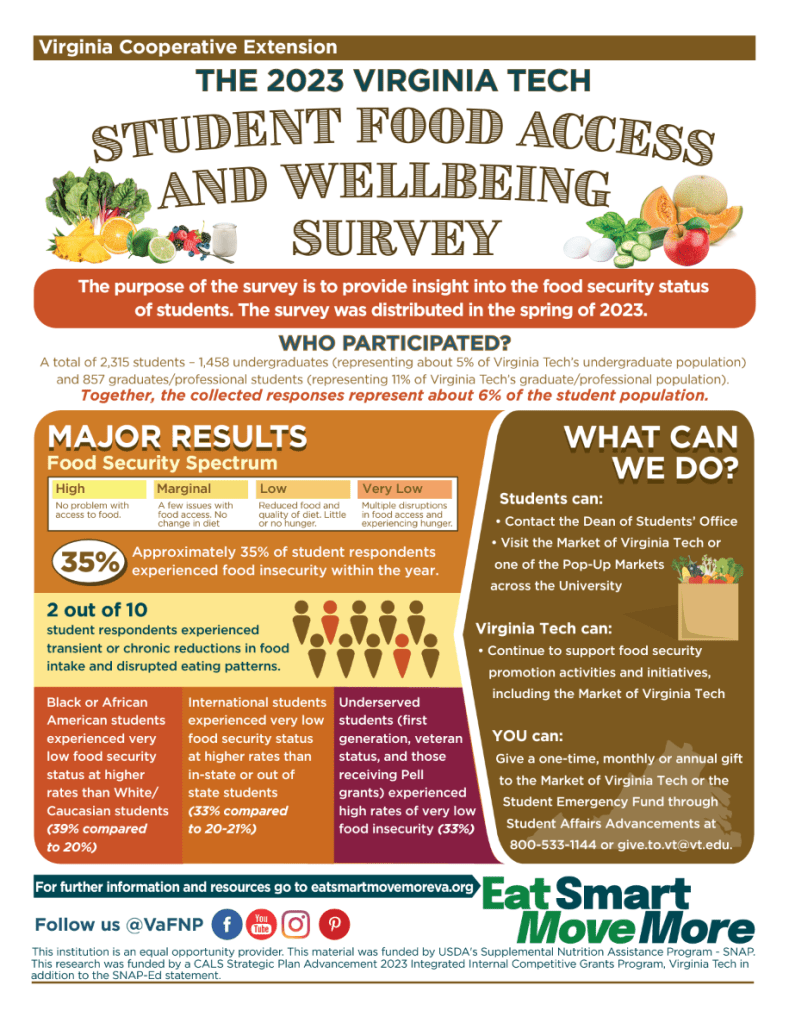
We are pleased to release an infographic and report of the main findings from the 2023 Virginia Tech Student Food Access and Wellbeing Survey. This research was made possible by the 2023 CALS Strategic Plan Advancement Integrated Internal Competitive Grants Program.

Main Findings

  • A little over a third (34.51%) of student respondents can be classified as being food insecure (having a low or very low food security status).
  • Around 2 out of 10 respondents (22.63%) were found to be experiencing transient or chronic reductions in food intake and disrupted eating patterns.
  • Both undergraduate and graduate students had comparable levels of food insecurity (33.81% vs. 35.71%, respectively).
  • Those students most at risk of having a low or very low food security status include international students and Black or African American and Hispanic or Latino students.
If you are a Virginia Tech student and are in need of food assistance, please consider the following two options.

Option 1: If you find it difficult, for whatever reason, to obtain a sufficient quantity of healthy food each week, please complete this food assistance form in the Dean of Students’ office

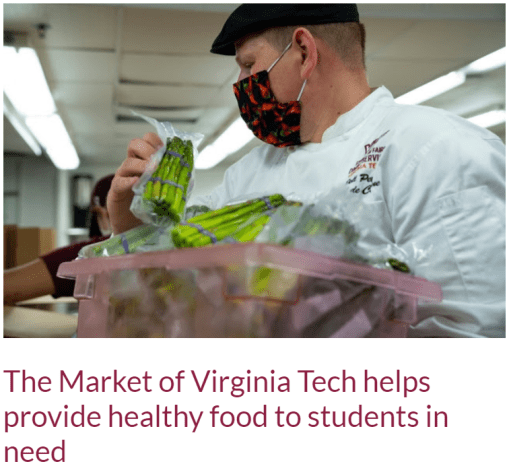
Option 2: If you find yourself in a moment of need, please consider visiting The Market of Virginia Tech during the following open hours to access a variety of non-perishable items. No prior intake or registration is required.

  • Tuesdays: 9:30–11:30 a.m.
  • Thursdays: 4:30–7 p.m.
  • Fridays: 9–11:30 a.m.

This past spring semester, Dr. Chanit’a Holmes, Dr. Sarah Misyak, and I ran the first ever Virginia Tech Employee Food Access and Wellbeing Survey. We are currently analyzing the survey responses and plan to release our preliminary findings later this semester.

New Paper on Food Access and Security

Our new paper entitled “Systematic investigation of inadequate food access at a large southeastern land grant university,” is now available at PLOS ONE.

Abtract: Over the past decade, the impact of low food security on student well-being and academic performance has become a growing concern at institutions of higher education across the U.S. This mixed methods study adds to the growing body of evidence on the association between student socio-demographic and economic characteristics and food security. An online survey covering food access, student well-being, and housing security was sent to 35,337 undergraduate and graduate students at a large southeastern land grant university. A total of 2,116 complete responses were received; a 6% response rate. The survey responses also included 176 written statements by students. The survey found that 16% of both undergraduate and graduate students had low or very low food security, as defined by a modified USDA food security measure. The socio-demographic and economic characteristics that were linked to a higher likelihood of low food security included: having a GPA of less than 3.0, having a disability, being an international student, being a first-generation student, being a transfer student, going into debt to pay for food, being a Black or African American student, having poor mental health, having uncertain living arrangements, and having no medical insurance. Recommendations for enhancing student access to food, housing, and mental health services are discussed.

Recording of VT Food, Housing, and Well-being Presentation

The recording of our presentation on Addressing Food, Housing, and Well-being at Virginia Tech: Results from the 2019 & 2021 Survey to the VT Center for Food Systems and Community Transformation, can now be accessed here.

Food, Housing, and Well-bing at Virginia Tech

On Wednesday, April 26, at 3:30pm, please join Dr. Jessica Agnew and I to learn about the results from our 2019 and 2021 food access and well-being studies at Virginia Tech. The report from our 2019 study can be accessed here. We will provide a brief summary of the 2019 results and then share the findings from the 2021 study. We will also discuss the events that led to the creation of The Market of Virginia Tech and will outline the future research that is underway.

The Market of Virginia Tech

Over the past several months, Dr. Jessica Agnew (Assistant Director, Research, Operations, and Program Management at Center for International Research, Education, and Development, Virginia Tech), Jesse Harden (a PhD student in Computer Science at Virginia Tech), and I have been running an impact evaluation of Phase 1 and 2 of Virginia Tech’s new food access program. The Market of Virginia Tech was officially announced today. In the coming weeks, we plan to release a platform that will share the results from our 2019 study of Food Access and Security at Virginia Tech and the insights we obtained from our impact evaluation of The Market of Virginia Tech. In the future, this new platform will also present the research we are currently undertaking on how blockchain technology can be used to improve food security through African indigenous vegetables in Kenya.