Binary Economics Seminar (Nov 7, 1-3pm)

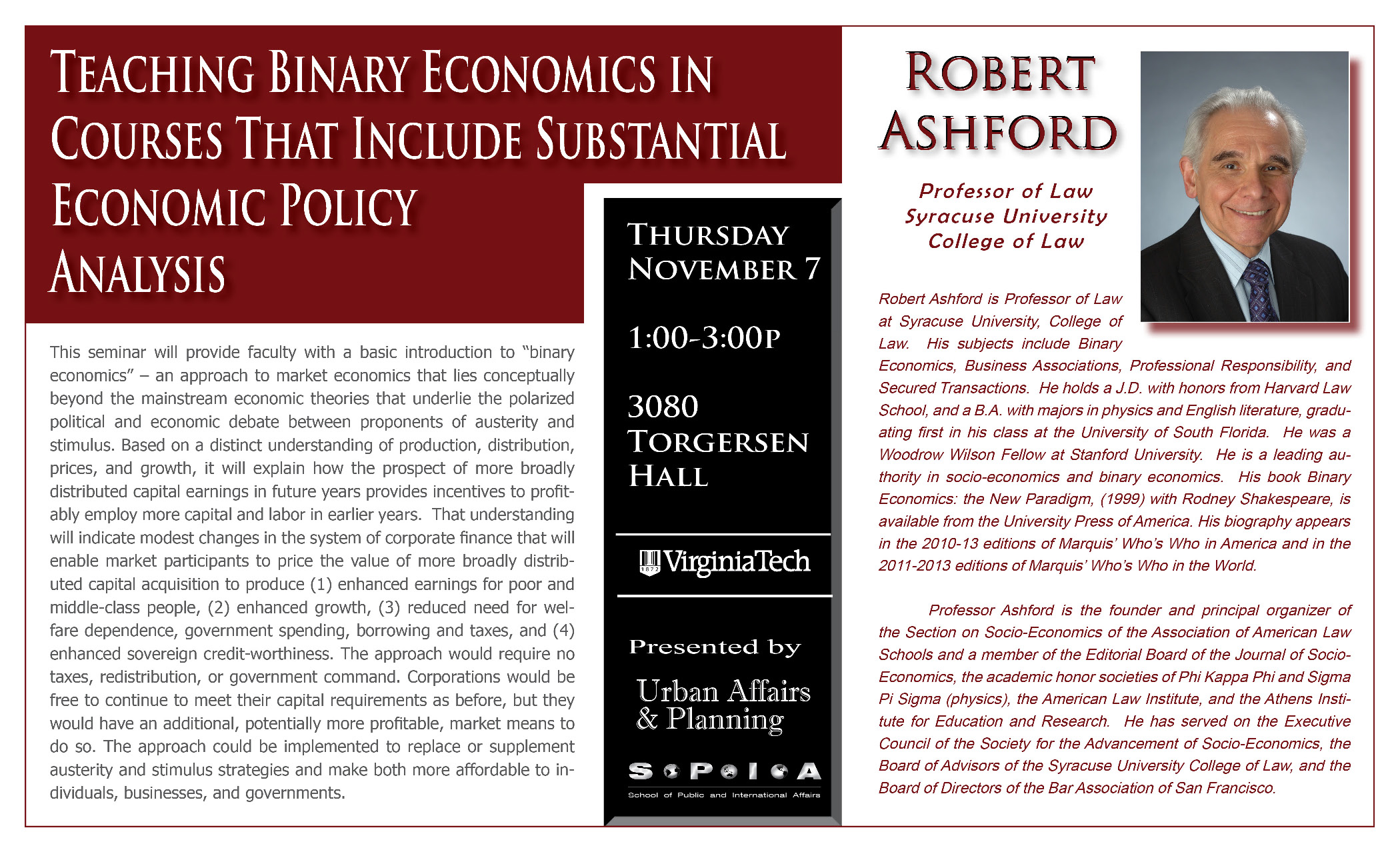
When: November 7, 1-3pm

Where: 3080 Torgersen

Register: https://app.fdi.vt.edu/public/modules/selfenroll/_viewevent.php?eventPk1=21198

Prof. Robert Ashford will be teaching a seminar for faculty and doctoral students at Virgina Tech on “Teaching Binary Economics in Courses That Include Substantial Economic Policy Analysis.” The seminar will be offered through Virginia Tech’s Network Learning Initiatives (NLI).

The seminar will provide faculty and doctoral students with a basic introduction to “binary economics” – an approach to market economics that lies conceptually beyond the mainstream economic theories that underlie the polarized political and economic debate between proponents of austerity and stimulus. Based on a distinct understanding of production, distribution, prices, and growth, Prof. Ashford will use a binary economics lens to explain how the prospect of more broadly distributed capital earnings in future years provides incentives to profitably employ more capital and labor in earlier years. The seminar will be a great opportunity to learn from one of the leading binary economist in the world.

Ashford_NLI

Robert Ashford to Visit VT

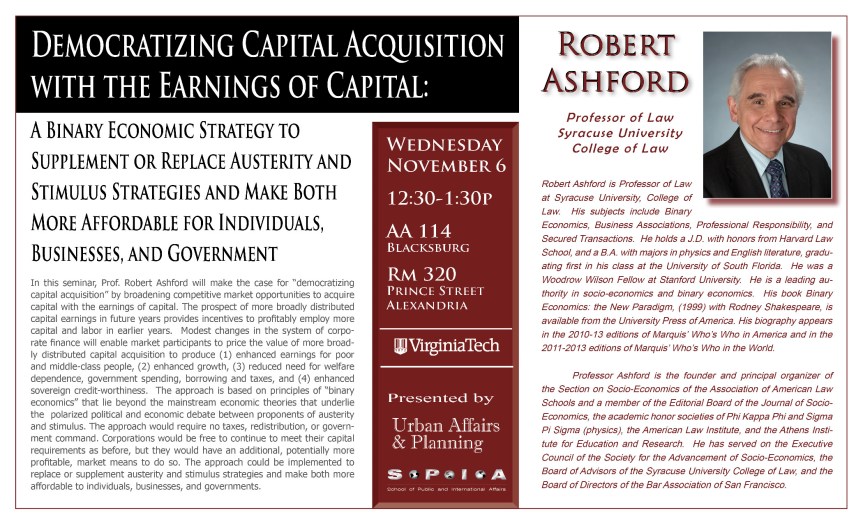
Ashford-Robert Photo 2013I’m pleased to announce that Prof. Robert Ashford will be visiting Virginia Tech in November, during which he will take part in a series of events related to the concept of Binary Economics. The first of these events will be a SPIA seminar on November 6, during which Robert will make the case for “democratizing capital acquisition” by broadening competitive market opportunities to acquire capital with the earnings of capital – see the flyer below for more information about this talk.

Over the past several years, I have had the opportunity to work with Robert, leading to the two papers below published in the European Financial Review.

Ashford_poster-Nov6I first became aware of binary economics when searching for alternative, transformational models of development. The importance of identifying new development pathways has only intensified following the recent global financial crisis that has deepened economic inequality both within and between nations. Robert’s ideas relating to binary economic growth hold great potential to transform and reignite the economy. My interest in this subject, and reason for bringing Robert to VT with the assistance of an AdvanceVT grant, stems from the need to ensure that any surge in economic growth does not also create a surge in negative environmental and social externalities. My hope is that we can find ways to stimulate binary growth while transforming industrial systems towards inherently sustainable practices.

New Papers in The European Financial Review

Nicholas Ashford, Robert Ashford, and I recently published two articles in the European Financial Review that extend some of the ideas we have discussed previously in our textbook and related papers.

Addressing the Crisis in Employment and Consumer Demand: Reconciliation with Environmental and Financial SustainabilityThe earning capacity of ordinary people can be enhanced by some combination of two contributions; wages earned through employment, and money earned through the ownership of productive capital. The latter includes ordinary investment from wage savings that people might make through the purchasing of stocks, bonds, and property; changes in ownership structures of businesses, employee stock ownership plans (ESOPs), and enabling people to acquire capital with the earnings of capital based on binary economics. This article focuses on employment and the restructuring of work to enhance the contributions and productiveness of labor – as opposed to increasing labor productivity by enhancing the productiveness of physical capital.

Broadening Capital Acquisition with the Earnings of Capital as a Means of Sustainable Growth and Environmental SustainabilityThis article expands on the first by taking an explicit look at increasing earning capacity through the ownership of productive capital. The article focuses on the binary economic approach and explains how this approach can enhance not only the capital earning capacity of poor and middle-class people, but also the demand for employment and the prospects for achieving environmental sustainability. The binary economic approach envisions an implementation of an ownership-broadening system of corporate finance that would require no taxes, redistribution, or government command. Corporations would be free to continue to meet their capital requirements as before, but they would have an additional, potentially more profitable, market means to do so.

During the Spring 2013 semester, Robert Ashford will join other scholars at Virginia Tech to take part in a seminar that will debate how a binary economics approach could lead to sustained and sustainable economic development.

New Paper in EIST

The Crisis in Employment and Consumer Demand: Reconciliation with Environmental Sustainability

Nicholas A. Ashford, Ralph P. Hall, and Robert H. Ashford

Abstract: This paper argues that a sustainable industrial system depends not only on good environmental and public health outcomes, but also on adequate employment and earning capacity in a well-functioning and equitable economic system. These concerns are likely to dominate future national political debates, requiring responses that increase the earning capacity of individuals through changes in the nature of work and employment, and in the ownership of productive capital. Making the economy greener, while certainly necessary for long-term economic and societal survival, does not necessarily mean more and better paying jobs on a large enough scale to make serious progress to reducing unemployment and underemployment. At present, national and global reforms are focused on improving the financial system, which is not synonymous with reforming the economic system or improving the economic status of individual citizens. This paper discusses specific policies and initiatives that need to be considered to ensure sustainable employment and livelihoods.

Highlights:

  • Policies and initiatives to advance sustainable employment/livelihoods are discussed.
  • Sustainable industrial systems require adequate employment and earning capacity.
  • Green growth does not necessarily mean more and better-paying jobs.
  • Both labor productivity and GDP/GNP are flawed measures of economic progress.
  • Productivity and productiveness are not the same.