New Paper on The Human Right to Water

ScienceThe Human Right to Water: The Importance of Domestic and Productive Water Rights

Ralph P. Hall, Barbara Van Koppen, Emily Van Houweling

Science and Engineering Ethics

Abstract

The United Nations (UN) Universal Declaration of Human Rights engenders important state commitments to respect, fulfill, and protect a broad range of socio-economic rights. In 2010, a milestone was reached when the UN General Assembly recognized the human right to safe and clean drinking water and sanitation. However, water plays an important role in realizing other human rights such as the right to food and livelihoods, and in realizing the Convention on the Elimination of All Forms of Discrimination against Women. These broader water-related rights have been recognized but have not yet been operationalized. This paper unravels these broader water-related rights in a more holistic interpretation of existing international human rights law. By focusing on an emerging approach to water services provision—known as ‘domestic-plus’ services—the paper argues how this approach operationalizes a comprehensive range of socio-economic rights in rural and peri-urban areas. Domestic-plus services provide water for domestic and productive uses around homesteads, which challenges the widespread practice in the public sector of planning and designing water infrastructure for a single-use. Evidence is presented to show that people in rural communities are already using their water supplies planned for domestic uses to support a wide range of productive activities. Domestic-plus services recognize and plan for these multiple-uses, while respecting the priority for clean and safe drinking water. The paper concludes that domestic-plus services operationalize the obligation to progressively fulfill a comprehensive range of indivisible socio-economic rights in rural and peri-urban areas.
Download or Read Paper On-line

Robert Ashford at VT

Ashford-Robert Photo 2013Over the next few days, Prof. Robert Ashford will be engaging with the Virginia Tech community in a variety of ways. I have provided a summary of his events below.

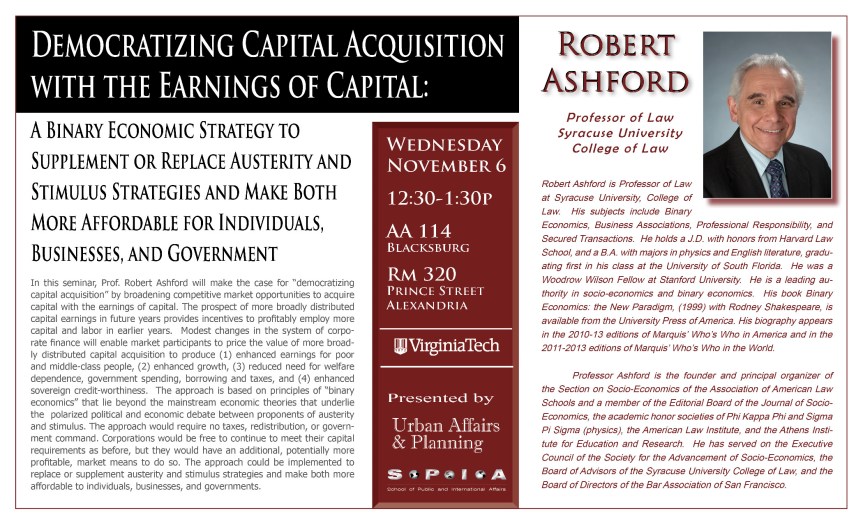
SPIA Seminar: Robert Ashford talks about Using Binary Economics to Democratize Capital Acquisition with the Earnings of Capital

  • When: Wednesday, November 6, 12:30-1:30pm
  • Where: Room 114 in the Architecture Annex and Room 302 in Prince Street, Alexandria

Economics Brown Bag: Discussion with faculty and students in the Department of Economics

  • When: Wednesday, November 6, 4:00-5:00pm
  • Where: Pamplin 1008

Radio ShowTalk at the Table with Andy Morikawa

  • When: Thursday, November 7, 10:00-11:30am
  • Note: The show will air on Sunday, November 10 at 2:30 p.m. EST on WUVT-FM Blacksburg (90.7). The show streams live at www.wuvt.vt.edu. The podcast will be available on the web page of the Institute for Policy & Governance at www.ipg.vt.edu.

VT NLI Seminar: Robert Ashford talks about How to Teach Binary Economics

  • When: Thursday, November 7, 1:00-3:00pm
  • Where: 3080 Torgersen
  • Register here

UAP 5784: Robert Ashford talks with students in UAP 5784 (Technology, Globalization, and Sustainable Development) about how binary economics could be used to advance sustainable development

  • When: Friday, November 8, 10:00am-12:00pm
  • Where: 3080 Torgersen (please contact me if you would like to attend this class discussion)

Moss Arts Center – Open House

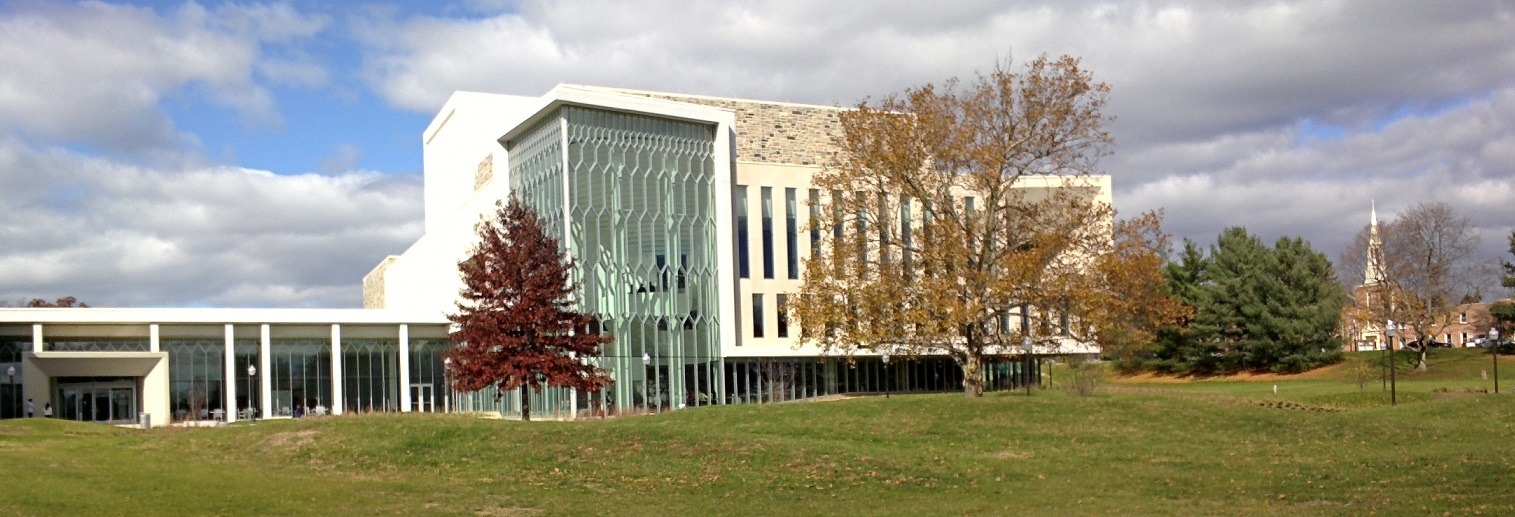
3This afternoon, I wore my Google Glass device to the open house for VT’s new, and I must say rather amazing, Moss Arts Center. The 150,000-square-foot facility is designed to bring creativity, art, and technology together under one roof. The facility has a 1,260-seat performance hall, visual arts galleries, amphitheater, four-story experimental Cube, and multiple studios. The potential of this facility is immense and I’m already thinking about one or two new collaborations in the area of policy informatics that such a facility will enable.

This slideshow requires JavaScript.

While walking around the open house, I had the opportunity to speak with Ben Knapp, the Director of the Institute for Creativity, Arts, and Technology (ICAT). Ben was one of three colleagues who I recently invited to join the VT Google Glass team. The team now consists of Peter Sforza, Brian Mathews, Tom Sanchez, Troy Abel, Ico Bukvic, Ben Knapp, and myself. [If the Glass XE team is reading this post, I have another three colleagues waiting in the wings to join our growing team of explorers 😉 One of these individuals is shown in the second video below.] While talking with Ben, we discussed how his research into the study of human emotion could be linked to my use of Glass in the classroom. There is a ‘hint’ of this new Glass application in the video below. With the addition of an Android/Glass programmer to our team in the near future, I’m keen to see how we can turn this idea/concept into a testable platform.

I first came across Google Glass while undertaking a New Media seminar at Virginia Tech. One of the great things about the seminar was getting to know faculty from across the university. One of my fellow seminarians was Joycelyn Wilson, who I also met during the open house. I asked Joycelyn to say a few words about her digital archiving project in which she is working to document over 4,000 vinyl records among other music-related items. During the video below, I asked Joycelyn how she would use Glass if I were given an additional three Glass invitations.

Opening for a Google Glass / Android Developer

Virginia Tech’s Center for Geospatial Information Technology is looking for a Google Glass / Android Developer to support the development of programs for the new platform. This is a great opportunity for someone to join the Google Glass Team at VT and help us develop some exciting new applications for the platform. Additional information about the position is provided below.

CGIT

Who we are?

A group of four Virginia Tech faculty building teaching and research applications for Google Glass.  We’re looking for a couple of rockstar developers.

What’s the position like?

A full stack Android developer to work on two applications: a teaching platform and a mapping research project on Google Glass. Responsible for building  applications for Google Glass. You’ll work with the Android SDK until the Glass Development Kit (GDK) is available.

What are the minimum requirements:   

  • Ability to communicate and collaborate effectively with a smart and diverse team
  • 1+ year(s) of development experience with Android SDK
  • 3+ years of software development experience
  • Experience working with RESTful APIs
  • Experience with live streaming data in an application
  • Experience with Google services
  • Ability to work part time on the Virginia Tech campus
  • Strong understanding of object oriented software principles, design patterns, and agile methodologies
  • Familiarity with automated test frameworks and test-driven development
  • Interested to explore new approaches to mirror world applications using Google Glass.

What would give you bonus points?

  • Experience with video/audio capture and streaming
  • Prior work that involved augmented reality, GIS, or interactive web maps
  • Experience working with 3D in a web browser (html5, x3dom, openGL, three.js, etc.)
  • An ability to analyze UX/UI workflows for quality/efficiency

To apply or learn more, please contact Peter Sforza at the Virginia Tech Center for Geospatial Information Technology — sforza@vt.edu or (540) 231-8935.

VT Student Seeks Crowdfunding for Doctoral Research

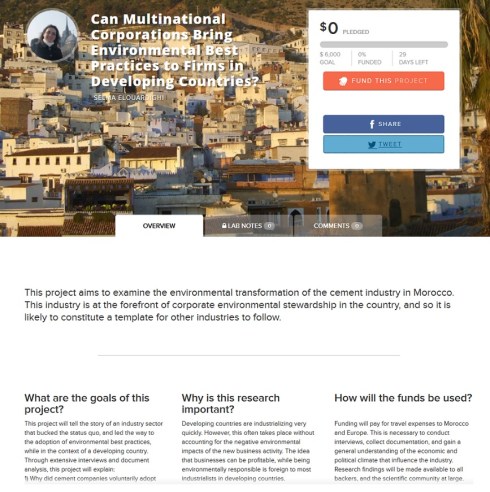
Pic1Selma Elouardighi, a PhD candidate in Planning, Governance, and Globalization at Virginia Tech’s School of Public and International Affairs, recently launched her campaign to raise $5,000 (via Microryza) to support the fieldwork she plans to undertake in Morocco over the next several months.

Selma’s research revolves around corporate environmental stewardship in developing countries within the context of globalization. More specifically she is focusing on how multinational corporations in the cement industry can bring environmental best practices to firms in Morocco.

Please consider supporting Selma’s research. As far as I know, Selma is the first doctoral candidate at Virginia Tech to pursue funding via Microryza, which provides some insight into the creativity she brings to her research.

Pic2

New Review of Textbook

Socio-economicsA new review of the textbook I wrote with Prof. Nicholas Ashford (MIT) has been written by Robert Stone (Occupational Safety and Health Administration (OSHA), U.S. Department of Labor) in the Journal of Socio-Economics.

Stone, R. (2013) Technology, Globalization, and Sustainable Development: Transforming the Industrial State, N.A. Ashford, R.P. Hall. Yale University Press, New Haven and London (2011), xxvi, 752 pp. $90, £75.00 9780300169720 2011, Journal of Socio-Economics, Volume 46, October 2013, Pages 78–79.

Robert Ashford to Visit VT

Ashford-Robert Photo 2013I’m pleased to announce that Prof. Robert Ashford will be visiting Virginia Tech in November, during which he will take part in a series of events related to the concept of Binary Economics. The first of these events will be a SPIA seminar on November 6, during which Robert will make the case for “democratizing capital acquisition” by broadening competitive market opportunities to acquire capital with the earnings of capital – see the flyer below for more information about this talk.

Over the past several years, I have had the opportunity to work with Robert, leading to the two papers below published in the European Financial Review.

Ashford_poster-Nov6I first became aware of binary economics when searching for alternative, transformational models of development. The importance of identifying new development pathways has only intensified following the recent global financial crisis that has deepened economic inequality both within and between nations. Robert’s ideas relating to binary economic growth hold great potential to transform and reignite the economy. My interest in this subject, and reason for bringing Robert to VT with the assistance of an AdvanceVT grant, stems from the need to ensure that any surge in economic growth does not also create a surge in negative environmental and social externalities. My hope is that we can find ways to stimulate binary growth while transforming industrial systems towards inherently sustainable practices.

Google Glass Invite

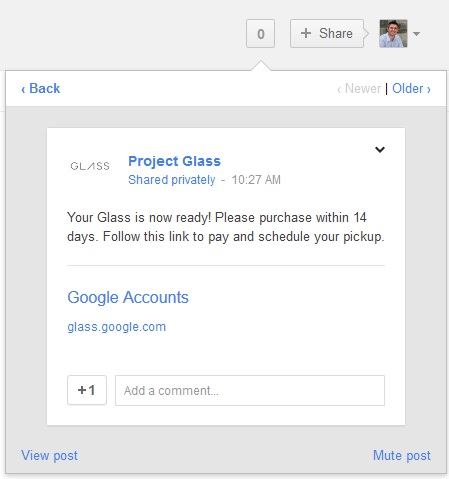
For those of you waiting to receive notification about when you can purchase your Google Glasses, it should look something like this if you applied for the Glass Explorer program through Google+. Once I have the device up and running in the next month or so, I will start sharing my experience with using the technology to transform the way I teach my seminar on sustainable development. Watch this space!

Invitation

The Fieldwork Begins!

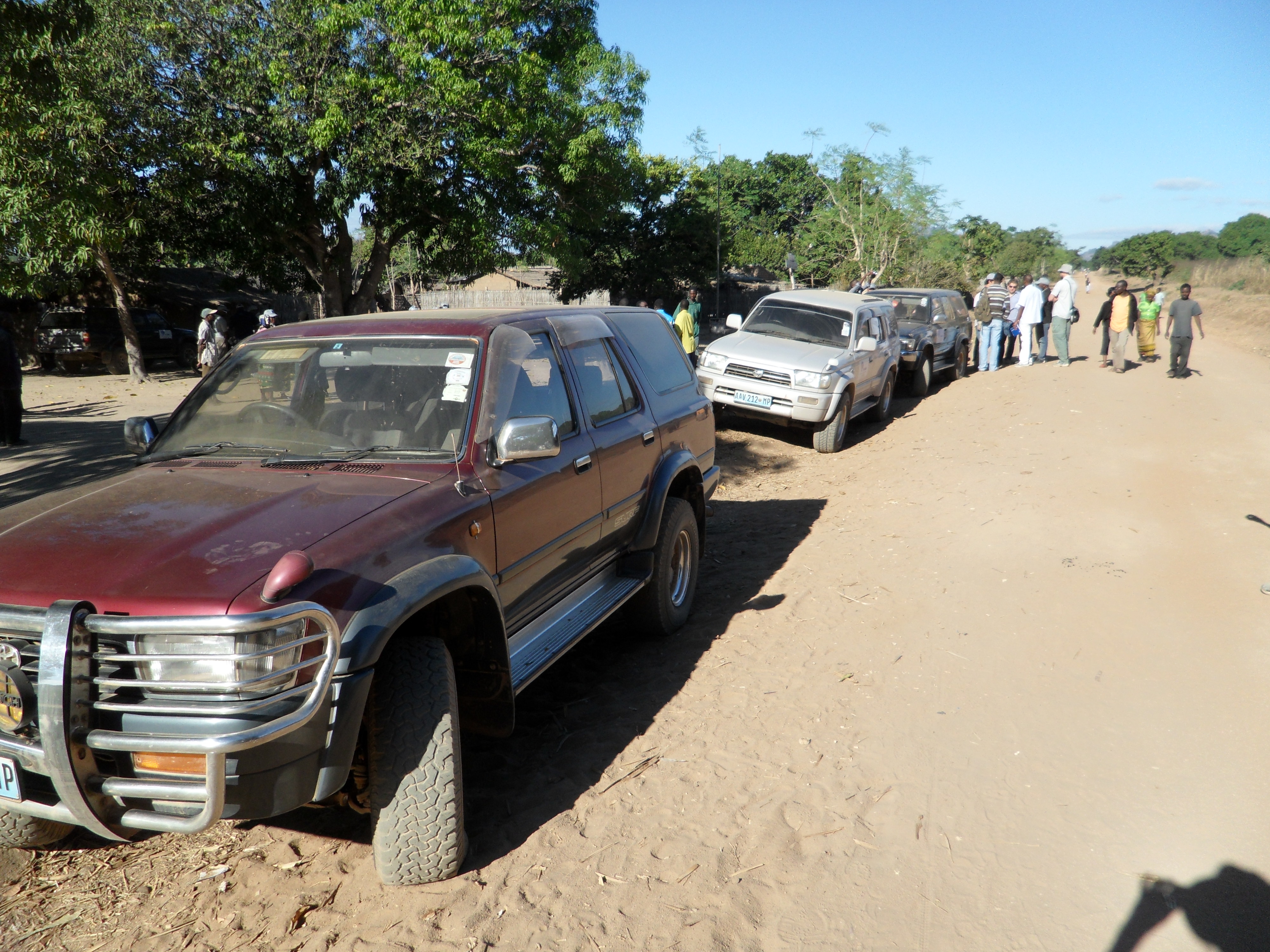
After two weeks of intensive training and a successful pilot study, the fieldwork for the follow-up study of the MCA’s rural water program in Nampula, Mozambique, began on Monday (June 10). As the fieldwork progresses over the next seven weeks, the surveying teams will undertake household surveys, water committee interviews, water point observations, technical assessments, and water source/storage testing, among other activities.

SAM_3627As usual, the pilot study proved to be an invaluable way to learn where the surveyors and team leaders required additional training and where our support team (consisting of researchers and staff from Virginia Tech, Stanford, and WE Consult) needed to provide additional support or rethink existing standard operating procedures (SOPs). The logistics associated with this project are complex and not only involve the careful programing of when and where the field teams will be over time, but also managing tasks such as how the 1,800 water samples will be transported for processing and where this processing will occur – i.e., in the field or back in our base camp. We also plan to collect water source samples in four communities at four different times during the day on three different occasions to check for variability in the quality of water over time. This type of water source testing will add a new dimension to our study and help identify whether the quality of water in these communities changes over a period of around six weeks. Another new dimension in the follow-up study is that the surveyors will use GPS devices to find the households we interviewed back in 2011. I will report back later on how successful they were at finding these households.

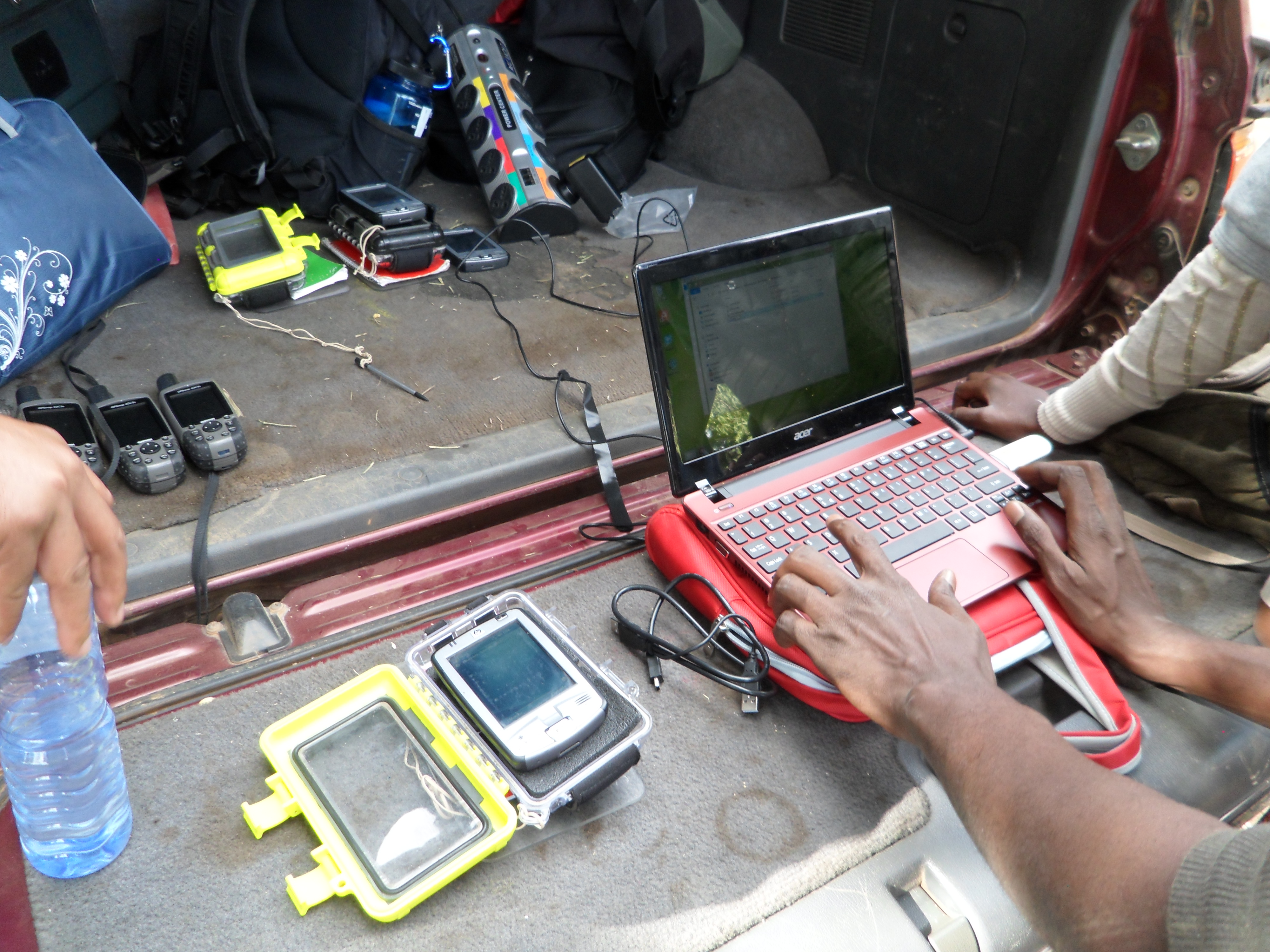
Data upload in the field - powered via the car battery
Data upload in the field – powered via the car battery

From a data quality perspective, we continue to advance and refine our data review and cleaning processes with our on-the-ground statistician (Marcos Carzolio). This year we are leveraging secure data transfer technology to enable the research team to view the data from any location in the world as soon as it is available. This platform also enables the lead researchers to communicate with the fieldwork team leaders as they upload the data in remote rural areas.

While the household survey is administered using PDAs, making the data easily accessible, the remaining surveying instruments are paper-based and require a different data entry and review process. This task will be managed by our in-country partner (WE Consult) given the need to have native Portuguese speakers managing the process.

In the next week, a fourth surveying team will leave Nampula and travel to Cabo Delgado to begin a study of eight small piped solar systems that have been constructed by the MCA. This more qualitative study will attempt to identify those factors supporting or limiting the successful delivery of water services via these systems. The Cabo Delgado team will be led by Emily Van Houweling (Virginia Tech) who spent a year in Mozambique as a Fullbright scholar last year while completing her doctoral research.

The above description should provide some insight into the many moving parts of this large-scale study, which is providing our team with plenty of challenges, but is also proving to be a highly rewarding experience for all involved. While our primary objective is to undertake an impact evaluation for the MCC, we hope our data will be of real value to the provincial and national governments of Mozambique and to the international community when making decisions about how to invest in sustainable rural water and sanitation services in the country.

The images below were taken during our final week of training and the pilot study.

This slideshow requires JavaScript.