Teaching Sustainability

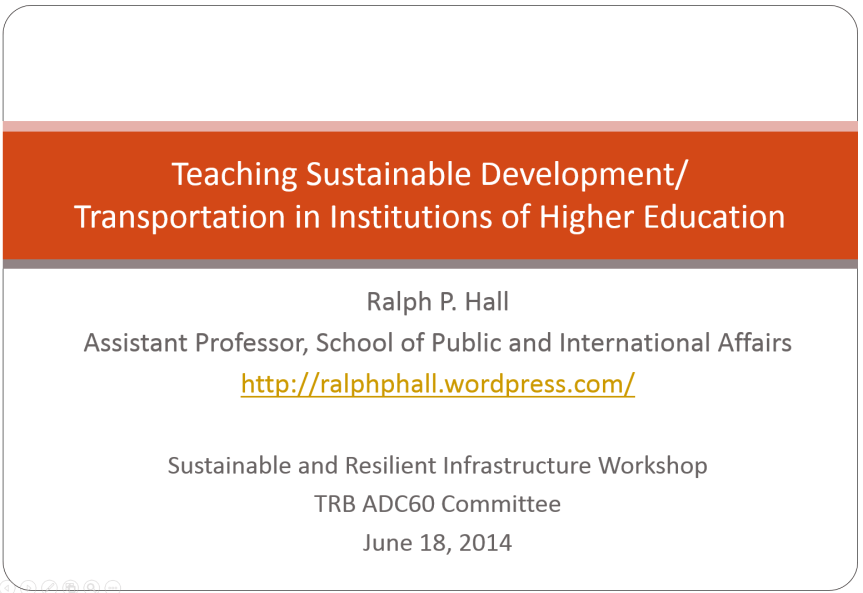
Last Wednesday, I joined Joe Zietsman (Texas A&M), Damon Fordham (Cadmus), and Ann Xu (Georgia Tech) in New York for a discussion of Education and Practitioner Training to Promote Sustainability. We were invited to speak at the TRB ADC60 summer conference on Sustainable and Resilient Infrastructure.

To prepare for my presentation on “Teaching Sustainable Development/Transportation in Institutions of Higher Education,” I reviewed the past decade of research captured in the International Journal of Sustainability in Higher Education. I also read papers from journals such as Sustainability Science and the Journal of Cleaner Production. For those new to this subject area, I recommend the following articles that provide useful frameworks or discuss important pedagogical approaches:

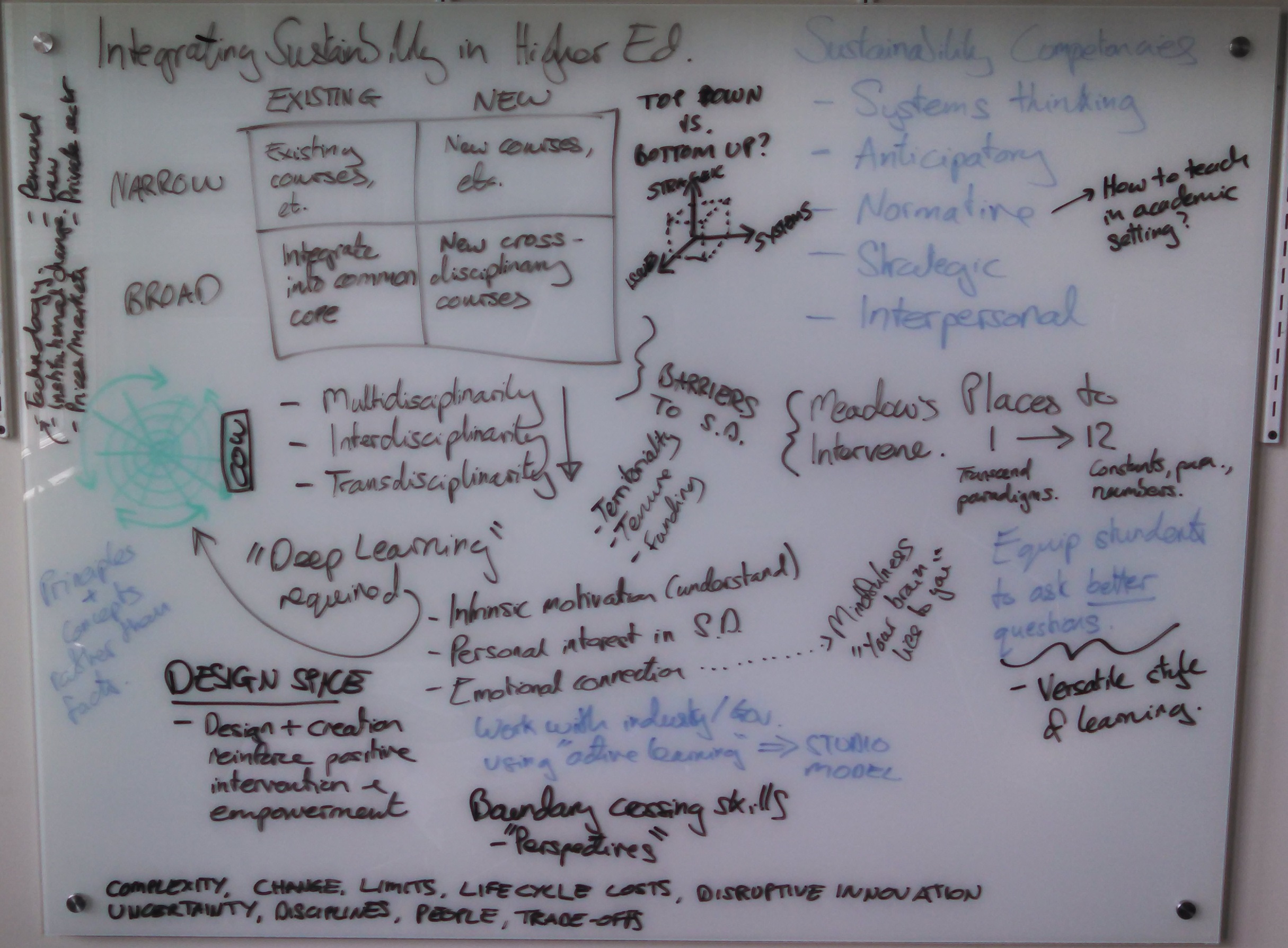
BrainstormingAfter absorbing this material, I tried to visually capture the various approaches, theories, competence areas, etc. that emerged (see photo). This visual patchwork of ideas laid the foundation for my presentation that focused on the following four questions:

  • —What knowledge and skills do students need to learn?
  • —How should we promote ‘Sustainability in Higher Education’ (SHE) – e.g., top down vs. bottom up?
  • —How do we change the hearts and minds of faculty?
  • —What should be the role of non-academic entities – e.g., government agencies, private businesses, and NGOs?

While I was only able to briefly respond to these questions in my presentation (below), the literature I cite on my slides (and listed above) should provide a useful starting point for anyone interested in learning more about theories on how to teach sustainability.
ADC60


Teaching Using Google Glass and Apps

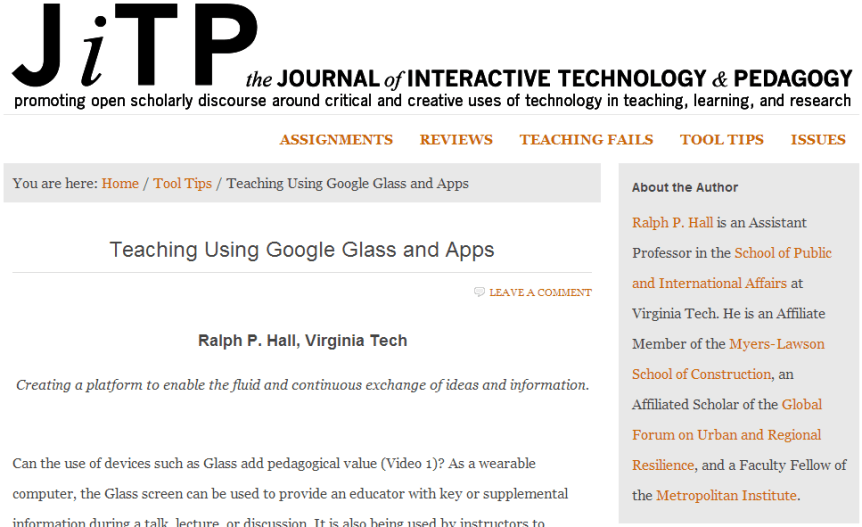
The Journal of Interactive Technology and Pedagogy has just published a Tool Tips article I wrote on how I’m using Google Glass and Apps to support my teaching at Virginia Tech. The multimedia format of the journal offers a unique opportunity to embed pictures and videos in the article that provide a rich context to the platform I’m using and what students thought of the experience.

2014-06-03_1021

Welcome IITK Scholars

This morning we held our first IITK-VT partnership summer meeting, during which we welcomed three visiting scholars from IITK to Virginia Tech. Anshita AgrawalAbishek Saraf, and Saurabh Dixit will be spending eight weeks at Virginia Tech working with Prof. Sunil Sinha, Prof. Brian Kleiner, and me. The scholars will undertake research focusing on resilient water infrastructure, construction safety, and sustainable infrastructure development, and will support the development of a new course on urban infrastructure that will offered this fall semester.

The pictures below were taken during our meeting using Google Glass.

This slideshow requires JavaScript.

Talk at the Table – Binary Economics

On Sunday, May 4, a conversation between Robert Ashford, Joyce Rothschild, Woody Crenshaw, and I aired on Talk at the Table with Andy Morikawa. During our conversation, we explain the basic idea of binary economics and how it relates to critical issues such as growing income inequality and sustainable development.

Soundwave

This slideshow requires JavaScript.

Congratulations Mark Seiss!

On Friday, March 28, Mark Seiss – the first “on-the-ground” statistician at Virginia Tech – successfully defended his doctoral dissertation in statistics.

Mark1Mark’s research covers several aspects of survey methodology, from questionnaire design to final estimation. His first paper develops an approach to matrix sampling designs, where a subset of questions are administered to a respondent in such a way that the administered questions are predictive of the omitted questions. The proposed methodology compares favorably to previous matrix sampling methods when applied to data collected from a household survey conducted in Nampula, Mozambique. His second paper documents how statisticians can help improve the quality of data collected from surveys by carefully analyzing the data soon after it is collected. In addition to correcting data entry errors, the approach provides surveyors with continuous support throughout the fieldwork, enhancing their training and reducing the number of errors being made as the fieldwork progresses. His final paper proposes a model-based approach to the estimation of the mean squared error associated with synthetic (indirect) estimates. Mark applied the proposed mean squared error estimation methodology to simulated data and estimates from the 2010 Census Coverage Measurement (CCM). He found that the proposed mean squared error estimation methodology compared favorably to the previous methods in the literature, while allowing for area-specific estimates.

I served on Mark’s doctoral committee with Eric Vance (committee chair), Leanna House, and Inyoung Kim.

The pictures below were taken in 2011, when Mark acted as the “on-the-ground” statistician during a household survey in rural Nampula, Mozambique.

This slideshow requires JavaScript.

MCC Webinar: Impact Evaluation of the RWSA in Mozambique

On Thursday, March 27, Dr. Eric Vance and I will be giving an MCC webinar to explain some of the main findings from our impact evaluation of the MCC-funded Rural Water Supply Activity (RWSA) in Nampula, Mozambique. The slides for this webinar can be accessed below.

MCC Webinar

20140327_104939_513b
Photo taken through Google Glass just before the start of the MCC webinar


Developing Glass Videos

This past week, I enjoyed working with Carlos Waters (VT InnovationSpace), Shelli Fowler (Director, Networked Learning Initiatives – NLI), and Jacques Walker (NLI) on developing the outline for several videos that will document how I’m using Glass to advance learning in my courses. I will post these videos as soon as they are ready for distribution. 


RWSA Impact Evaluation Presentation

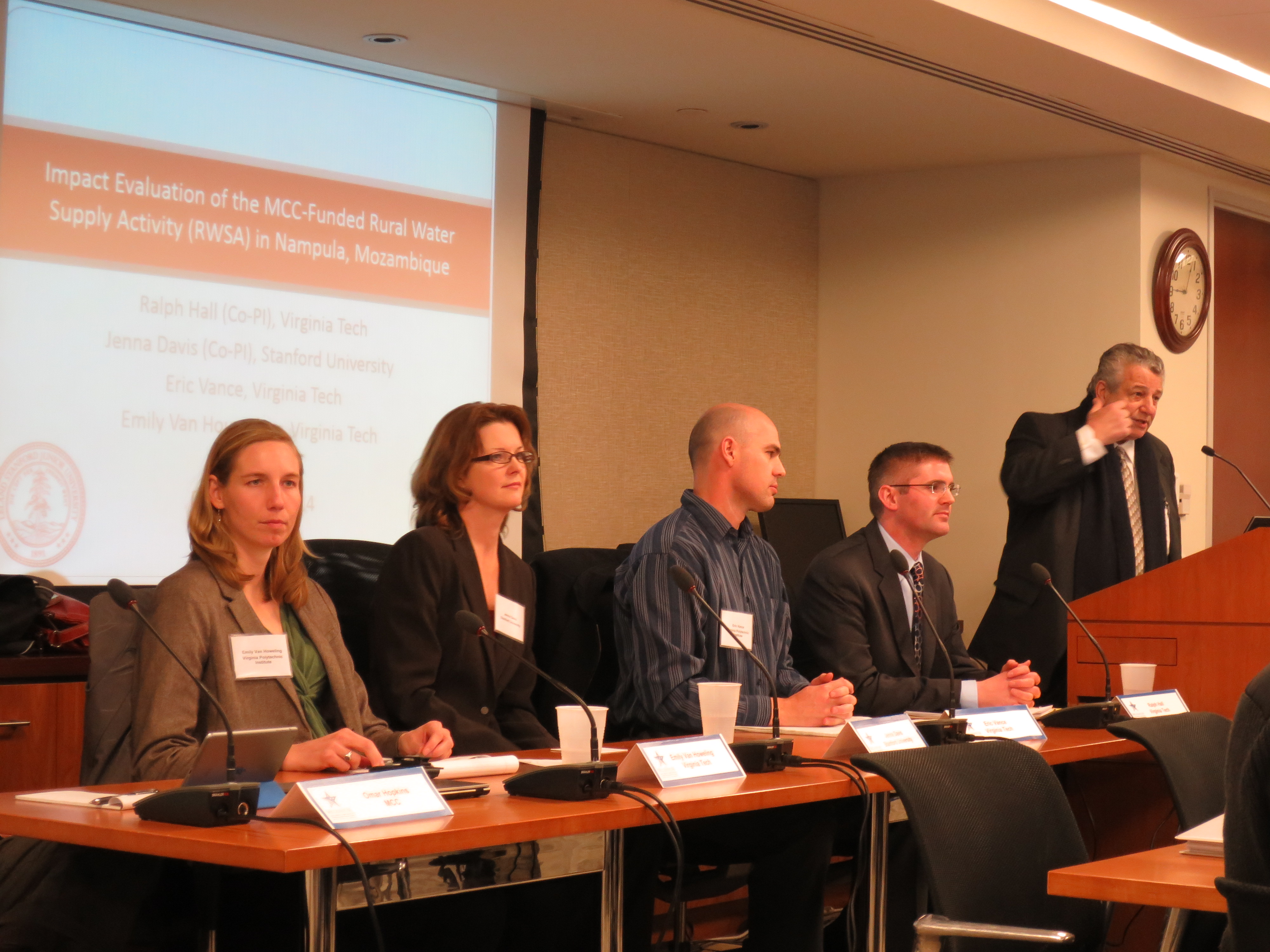
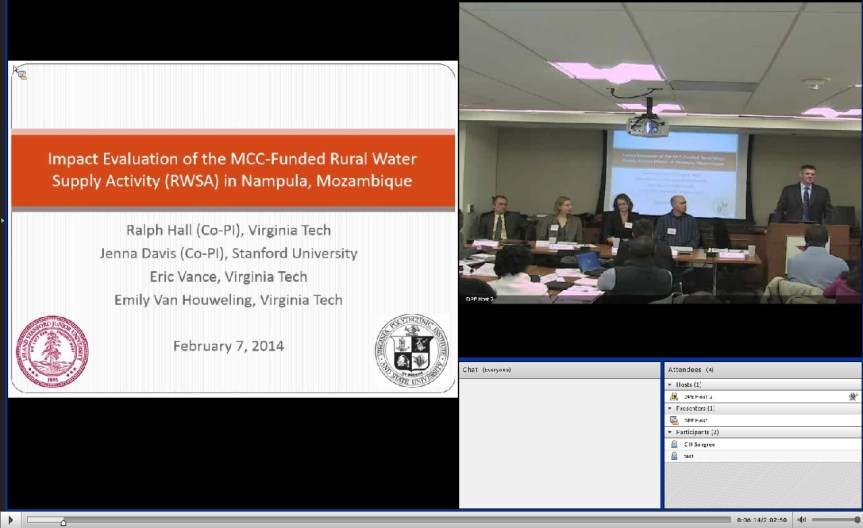
IMG_1257On February 7, I was joined by colleagues from Virginia Tech and Stanford University to present the results from our impact evaluation of the Millennium Challenge Corporation-funded Rural Water Supply Activity (RWSA) in Mozambique at the MCC’s 2014 Monitoring and Evaluation (M&E) and Economic Analysis (EA) College. The M&E/AE College was attended by monitoring and evaluation and economic analysis experts from many of the countries with which the MCC has an active Compact.

The presentation was recorded using Adobe Connect and can be accessed by clicking on the image below. The final impact evaluation report will be available in the coming weeks via the MCC’s Independent Evaluations Catalog.

MCC

New Google+ WASH Community

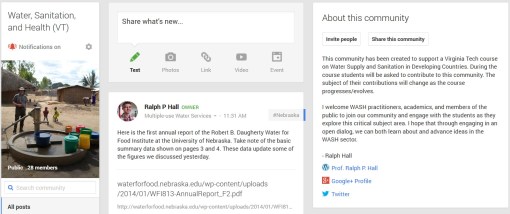
This semester I’m going to use a Google+ community to support my course on Water Supply and Sanitation in Developing Countries. Whereas the community I created last semester for my sustainability seminar was private, this WASH (water, sanitation, and health) community will be open for anyone to join.

WASH

My transition to using Google Apps is fueled by my interest in using Google Glass in education. While the VT Glass Team is still working on an App that I can use during my class (more to come on this), I have had some initial success in recording assignment-feedback videos for students. This semester I have teamed up with Mary English in VT’s Network Learning Initiatives, to formally evaluate my video feedback process. I am aware that there are many ways in which video feedback could be provided, but the Google Apps and Glass platform does make the process easy and therefore doable. I also believe that this use of Glass is one area where the device can add real value in an educational setting.

Since the assignment-feedback videos are privately shared with each student (via their Google+ account), they will not be available on the Google+ WASH community. However, I plan to post videos that discuss new WASH material that will be of interest to my students. These videos will provide a sense of how the assignment-feedback videos work in practice. I will share the results from our formal evaluation of this application of Glass as soon as they are available.

ADD40 and Collaborative Research

I’m looking forward to reconnecting with members and friends of the Sustainable Transportation Committee (ADD40) at the TRB 93rd Annual Meeting in January. During the conference we will hold the inaugural Sustainability Research Subcommittee, ADD40(2), meeting on Tuesday, 14 January, 1:30pm – 3:15pm (Hilton, Kalorama).

As you may know, in ADD40’s Triennial Strategic Plan we made the decision to promote and support research that integrates the three dimensions of sustainability. One important step in achieving this goal will be the extent to which we can develop collaborative research relationships with other TRB standing committees that have an interest in sustainability. Our objective is to try and broaden the scope of TRB research to ensure a more balanced treatment of environmental, social, and economic concerns.

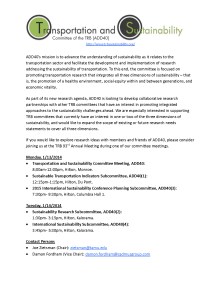
ADD40 FlyerThe TRB Annual Meeting presents a unique opportunity for members and friends of ADD40 to reach out to other relevant standing committees and begin the process of reviewing sustainability-related research needs statements and/or developing new statements. To assist with this task, we have developed the adjacent flyer that can be used to inform other committees about our mission and interest in developing collaborative research projects.

During the main ADD40 committee meeting from 8am-12pm on Monday, 13 January (Hilton, Monroe), everyone in attendance will have the opportunity to brief the committee on which TRB standing committees they plan to reach out to during the annual meeting. This will enable the committee to identify the coverage we have at the annual meeting and will provide those in attendance with an opportunity to identify others who may have a shared interest in working with a specific committee.

During the research subcommittee meeting ADD40(2), I look forward to learning about the collaborations that are already underway or are planned and beginning the process of developing several new research thrusts that ADD40 will lead. If you have any ideas for transportation research projects that integrate all three dimensions of sustainability, please either send me an email (rphall@vt.edu) prior to the annual meeting or join us on Tuesday, 14 January.