Inclusive Capitalism

Earlier this month, Prof. Robert Ashford and I had the pleasure of engaging with various academic, government, and non-government entities in the UK about our ideas on inclusive capitalism. The two images below will take you to a version of the presentations we gave at the University of Oxford, in London (at the Portcullis House and Syracuse University’s Faraday House), and at the University of Southampton.

In the first presentation, I outline two major challenges that can be represented by two “ice hockey stick” curves. The first curve relates to global climate change, but can be thought of as emblematic of a range of stubborn environmental concerns that show no signs of halting or declining with continued economic growth. I predict that we will soon see a similar curve for the volume of plastic waste in the world’s oceans. Curves could also be drawn for the bioaccumulation of persistent chemicals. For example, when looking at the health of long-lived and high trophic level marine mammals, there is now evidence that some killer whales have consumed sufficient quantities of polybrominated diphenyl ethers (PBDEs) to be fireproof. Many scientists are now concerned about the health and environmental impacts of these chemicals, especially on reproductive and immune systems.

The second ice hockey stick curve provides a snapshot of the concentration of wealth in the US that is accompanied by a series of graphs that chart a number of concerns relating to the hollowing out of the middle class (or job polarization) in America and the EU, and to trends in income inequality over the past several decades.

The real challenge comes when the two curves are considered alongside one another. In 2012, the Rio+20 conference advanced the notion of the Green Economy as a mechanism through which progress will be made towards sustainable development. Since the dominant strategy for advancing a green economy – that targets the decoupling economic growth from growth in environmental impacts – is based on advanced and hyper-efficient technologies, a critical question is what will happen to well-paying jobs and more broadly to trends in income inequality and job polarization. (For more on this issue, see my book review of Cents and Sustainability.) Having mapped out these macro concerns, Prof. Ashford (in his presentation) provides a new way to view them based on the principles of binary economics (what we call inclusive capitalism).

The following text (from our talk description) provides a brief overview of the content of Prof Ashford’s presentation (which can be viewed by clicking on the image below below).

To reverse growing income inequality and to achieve greater and more broadly-shared prosperity and sustainable growth, Professor Ashford advocates a much more “inclusive capitalism” (beyond conventional right- and left-wing strategies of austerity and stimulus) based on “binary economics.” The inclusive capitalism approach is to broaden competitive market opportunities to acquire capital with the earnings of capital. The same market mechanisms that presently assist mostly wealthier people to acquire capital with the earnings of capital can even more profitably be opened, without redistribution, to assist poorer people to acquire capital with the earnings of capital. The prospect of such ownership broadening will unleash substantial (presently suppressed) productive capacity in the UK because the prospect of more broadly distributed capital earnings in future years provides great untapped incentives to profitably employ more labor and capital in earlier years.


Dr. Martin Luther King, Jr. Jubilee Summit

April 4, 2018 marks 50 years since Dr. Martin Luther King, Jr.’s departure. In response to this anniversary, members of the Beloved Community Initiative created the Dr. Martin Luther King, Jr. Jubilee Summit to draw on the collective experiences of more than a dozen national and local organizations and individuals to answer Dr. King, Jr.’s question: Where do we go from here?

The Jubilee Summit consists of a series of strategic online gatherings. Information about each event is provided here. Summit speakers include academic, religious, and community leaders, and everyone is invited to participate.  

The Jubilee Summit will begin on Friday, March 23, 10am (EST), with a discussion between Dr. Virgil A. Wood (Co-founder, Jubilee National Collaborative) and Dr. Howard H. Stevenson (Harvard University Business School), on a collaboration they have shared for more than ten years. They will launch the summit by addressing the topic: Does Martin Luther King, Jr. have a living legacy, and if so, where is economic justice?

A Successful Mzuni Delegation Visit

During the past week, the visiting delegation from Mzuzu University (Mzuni) had a whirlwind tour of Virginia Tech’s capabilities in the area of architecture, data analytics and visualization, library services, and health and medical device research. The purpose of their visit was twofold. First, they carefully reviewed three of the conceptual library designs that students and faculty in the School of Architecture + Design had developed over the past several months. Second, they interacted with faculty and students to explore the scope of a future data analytics and visualization center that we hope will be incorporated into a future Mzuni library.

The delegation’s visit was covered by our local news media – WDBJ7 and the Roanoke Times.

I also recorded a short video that captured each day of the delegation’s visit. These videos can be viewed by clicking on the links below:

Virginia Tech also prepared the following story on the Mzuni delegation’s visit.

2018-02-20_2046

Ready for the Mzuni Delegation

On Monday, an 11-person delegation from Mzuzu University (Mzuni) will be visiting Virginia Tech for a week. The purpose of their visit is to engage with students and faculty in relation to the design of a new library for Mzuni. In 2015, Mzuni lost their library, containing over 45,000 titles, to a fire caused by an electrical fault. Since then, the Mzuni Library Initiative – an effort led by Virginia Tech and supported by Radford University, local community groups, and the Malawian Education and Children’s Welfare Foundation – has shipped over 8,000 books to Mzuni for their temporary library (see the video below).

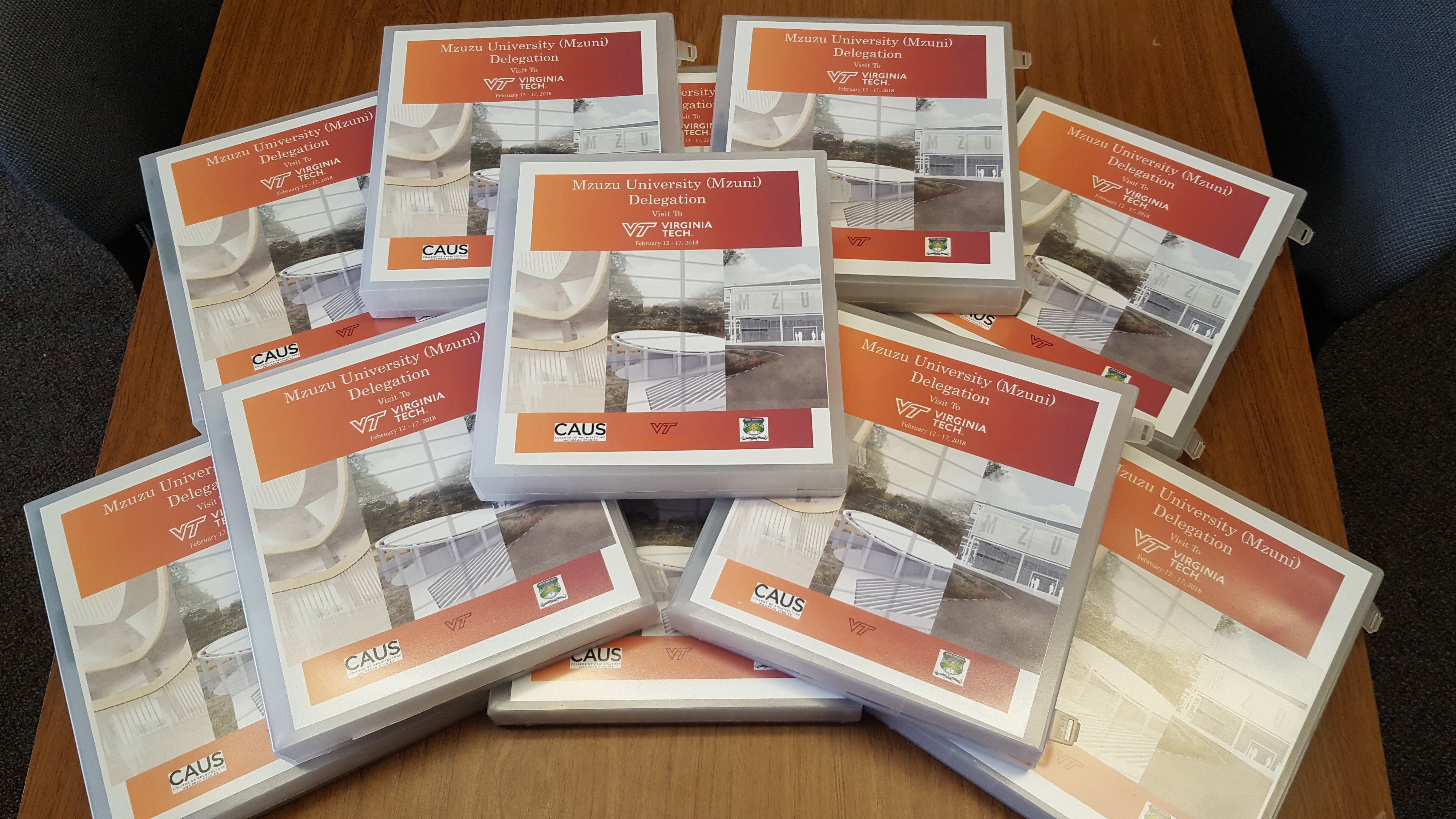
During the past year, four faculty and around 20 students in the School of Architecture + Design have developed three conceptual designs for a new Mzuni library (see the images on the front of the binders below). During their visit, the Mzuni delegation will explore each of these designs and connect with faculty across Virginia Tech who are supporting an effort to design a data analytics and visualization research+learning facility that could be located in the new library.

The students will be publicly presenting their library designs on Wednesday, February 14, from 1-3pm in the foyer to Cowgill Hall. Please consider attending this event of you would like to learn more about this project.

Dr. Walker to Speak on Dr. Martin Luther King, Jr. and the Politics of Freedom

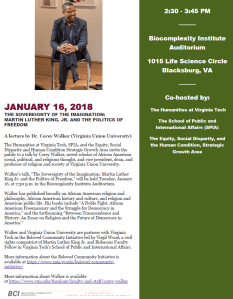
On Tuesday, January 16 at 2:30pm, Dr. Corey Walker (Vice President, Dean, and Professor of Religion and Society at Virginia Union University) will be giving a public lecture entitled The Sovereignty of the Imagination: Martin Luther King, Jr. and the Politics of Freedom, at the Biocomplexity Institute Auditorium at Virginia Tech.

Dr. Corey’s lecture is the first official event of Virginia Tech’s 2018 MLK Week. Dr. Corey is a core member of the VT-VUU team behind the 2018 Beloved Community Initiative Essay Contest (see the video below). This contest provides junior and senior students at high schools across Virginia with the opportunity to explore exemplars of Dr. Martin Luther King Jr’s notion of the Beloved Community – a community based on social and economic justice and a common love for fellow human beings. The essay submissions are due by 6pm on April 4, 2018.

The Beloved Community ‘Dream Reset’ Richmond Gathering

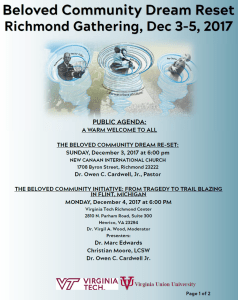
Next week I will be taking part in a series of events and meetings in Richmond, Virginia, that will officially launch the Beloved Community Initiative. The press release below provides more details about this gathering. If you live in Richmond, please consider attending one of the four FREE public events that will be held from Dec 3-5. Please click here to register for these events.

Press Release – 11/28/2017

The School of Public and International Affairs is pleased to announce a workshop developed through the efforts of the Beloved Community Initiative (BCI). The Beloved Community ‘Dream Reset’ Richmond Gathering is a three-day event hosted in partnership with Virginia Union University and will be held at various locations in Richmond, Virginia, starting on December 3, 2017, and closing on December 5, 2017.

The working group associated with the BCI has developed the concept of “Spirals,” or holistic organizing efforts that combine broad, creative thinking and writing with input and inspiration of engagement and experience as a convenient heuristic to describe its aims for this effort. The Richmond workshop will examine community projects (engagement and experience) rooted in current understandings of social change that engage community members, students, and faculty, and seek actively to learn from them (creative thinking and writing) by means of sustained discussion (reflection).

The Virginia Tech team behind the BCI believe that as a leading academic institution, the university can serve as a wellspring of ideas for community change and strategies to secure social justice. These strategies can be developed, applied, and refined both with and in partner communities.

The Beloved Community ‘Dream Reset’ is a workshop convened by Dr. Virgil Wood and has been designed to encourage the sharing of ideas and new ways of thinking concerning social change. The planned events will explore the ongoing work in Flint, Michigan, and the educational uplift of children both physically and psychologically affected by the Flint water crisis. Additional sessions of the workshop intend to explore the following:

  • Investigate ways and means of cultivating hope as an essential resource and reservoir for encouraging community resilience by means of systematic assessment of specific community action strategies.
  • Examine and create conditions necessary to ensure environmental justice for all community residents, but particularly those suffering economically or as a consequence of social discrimination in partnership with the Flint city government and civil society organizations in that community.
  • Envision the broad political, social, and economic changes necessary to secure the moral arc identified by the concept of the Beloved Community at local, state, and national scales.

The workshop will feature presentation and commentary from the following list of speakers:

  • Marc Edwards, Charles P. Lunsford Professor of Civil and Environmental Engineering, Virginia Tech
  • Ralph Hall, Associate Professor, Urban Affairs and Planning, Virginia Tech
  • Chivonne Battle, Virginia Tech, BCI Task Force
  • Virgil Wood, Ridenour Faculty Fellow, Virginia Tech; Pastor Emeritus, Pond Street Baptist Church; VUU Alum, Former Dean, Northeastern University; Former ten-year working associate of Dr. Martin Luther King, Jr.
  • Christian Moore, WHY TRY Founder.
  • Owen C. Cardwell Jr., Pastor, New Canaan International Church, President and Founder, Heroes and Dreams Academy
  • Max Stephenson Jr., Professor of Public and International Affairs and Director, Institute for Policy and Governance, Virginia Tech
  • Sylvester Johnson, Assistant Vice Provost for the Humanities, Virginia Tech
  • Anne Khademian, Director, School of Public and International Affairs Virginia Tech

Additional information and registration is available at www.belovedcommunityinitiative.eventbrite.com.

Images from Study Abroad Course – Switzerland and Senegal

Last week I completed a module for the Deans’ Semester on Global Challenges that began in Riva San Vitale, Switzerland, then moved to Geneva, and ended in Senegal. During this module, students explored the global food challenge, paying specific attention to sustainable agricultural practices, the food-water-energy nexus, agricultural education, (mal)nutrition, and value/supply chains. After exploring these subjects, we engaged with professionals working on various aspects of the global food challenge and met with faculty and students studying agricultural systems and entrepreneurship at two universities in Senegal.

The images below provide a snapshot of the various activities we were able to undertake during this course. Click here for a Google-created video of our time at Lake Retb (the Pink Lake) in Senegal.

This slideshow requires JavaScript.

Thank You Social Investors!

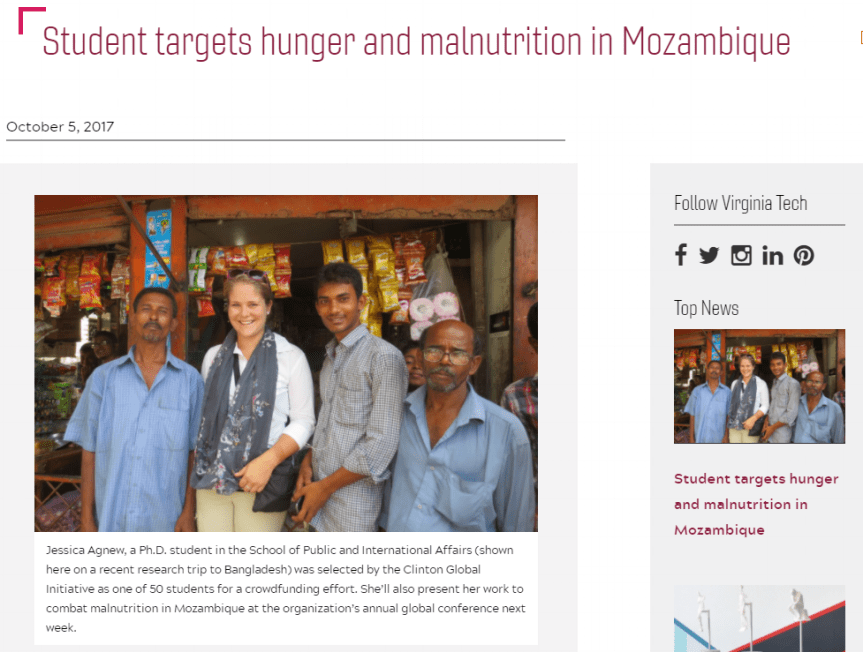
On behalf of Jessica Agnew, I wanted to thank everyone who kindly donated money to Jessica’s BUY2THRIVE program. The positive response Jessica received from family, friends, students, faculty, and members of the general public (including one or two from the UK and Ireland) has been the most rewarding aspect of her initiative so far. In total, 147 people made a donation and the final amount raised was $16,555. This amount put Jessica in second place in the overall CGU-U Commitments Challenge, which far surpassed what we thought was possible.

Jessica will be leaving for the CGI-U meeting tomorrow, where she will present her ideas and learn about ways to enhance the impacts of her project. If you plan to attend the event, please keep an eye open for Jessica and ask her plenty of questions about the program she is developing.

John O. Browder

Last week, a colleague, mentor, and friend Professor John O. Browder lost his battle against cancer. John has left behind a significant legacy at Virginia Tech and I wanted to take a moment to reflect on his enduring impact.

During the eight years I worked with John, I was able to witness his dedication to student learning and leadership in advancing the international aspects of our academic programs. As a mentor, John was always willing to provide honest and constructive feedback that helped many faculty at Virginia Tech navigate the tenure and promotion process. I now find myself repeating the advice I received from John to others, advice that came from his decades of experience serving on promotion and tenure committees at the school, college, and university level.

In the classroom setting, John created a relaxed and open environment, but always challenged students to continually advance their knowledge. He created a learning partnership model with our doctoral students as they co-explored theories of pedagogy and learning. With our masters students, John anchored our international development offerings. At the undergraduate level, John taught environmental ethics and addressed real problems with clients in the environmental problem solving studio.

When I arrived at Virginia Tech in 2009, John asked me to take over the international development planning studio that he created and had taught for over a decade. We later made this studio one of the two core classes that support the graduate certificate in Global Planning and International Development Studies. This certificate was created under John’s leadership in collaboration with other programs at Virginia Tech. John never went far from the studio, leading discussions on the lessons he learned from his research in the Amazon or serving on the studio’s proposal review panel. I have included a few pictures below of John in action.

This slideshow requires JavaScript.

John will be dearly missed by everyone he touched. He still had much to give, especially related to helping Virginia Tech become a global land grant institution.

Thank you John for everything you gave us.