International Development Planning Studio

UAP 5764, 2013 Spring Semester
Instructor: Dr. Ralph Hall
Meets: Thursdays 12:30pm to 3:15pm
Location: Architecture Annex 111

Studio Overview

Concepts and practices in the field of international development have changed dramatically over the past few decades and even the past few years. This studio course is designed to prepare students with the most current approaches to the practice of international development as implemented by leading actors today. Students will learn the traditional project planning tools used by multi-lateral and financial institutions as well as alternative processes. They will be equipped with a variety of skills necessary for working on development projects in the real world.

Throughout the studio, elements of project development, planning, management, implementation, and monitoring and evaluation will be covered from the perspective of the prevalent development sectors. Emphasis will be placed on synthesizing and practicing skills through the preparation of a proposal for an international development project/program. During the studio, students will work on, present, and critique different elements of their project proposals. To complement the theoretical discussions, several studios will be led by experienced practitioners and academics in the field of international development.

Studio Objectives

Upon completion of the studio, students will be able to:

  1. develop a complete proposal for an international development project/program – which will include a problem analysis, a needs assessment/stakeholder analysis, a gender analysis/discussion, a clear set of goals/objectives (supported by a logframe analysis), an assessment of resources and organizational ability, a proposed work plan and timeframe, a budget, a monitoring and evaluation plan, and a plan for the successful implementation of the project; and
  2. undertake a financial analysis of a proposed development project.

Syllabus

New Papers in The European Financial Review

Nicholas Ashford, Robert Ashford, and I recently published two articles in the European Financial Review that extend some of the ideas we have discussed previously in our textbook and related papers.

Addressing the Crisis in Employment and Consumer Demand: Reconciliation with Environmental and Financial SustainabilityThe earning capacity of ordinary people can be enhanced by some combination of two contributions; wages earned through employment, and money earned through the ownership of productive capital. The latter includes ordinary investment from wage savings that people might make through the purchasing of stocks, bonds, and property; changes in ownership structures of businesses, employee stock ownership plans (ESOPs), and enabling people to acquire capital with the earnings of capital based on binary economics. This article focuses on employment and the restructuring of work to enhance the contributions and productiveness of labor – as opposed to increasing labor productivity by enhancing the productiveness of physical capital.

Broadening Capital Acquisition with the Earnings of Capital as a Means of Sustainable Growth and Environmental SustainabilityThis article expands on the first by taking an explicit look at increasing earning capacity through the ownership of productive capital. The article focuses on the binary economic approach and explains how this approach can enhance not only the capital earning capacity of poor and middle-class people, but also the demand for employment and the prospects for achieving environmental sustainability. The binary economic approach envisions an implementation of an ownership-broadening system of corporate finance that would require no taxes, redistribution, or government command. Corporations would be free to continue to meet their capital requirements as before, but they would have an additional, potentially more profitable, market means to do so.

During the Spring 2013 semester, Robert Ashford will join other scholars at Virginia Tech to take part in a seminar that will debate how a binary economics approach could lead to sustained and sustainable economic development.

PhD for On-the-ground Statisticians

If you are interested in pursuing a PhD in statistics and would like to apply your skills to evaluation work in developing countries, I highly recommend you take a close look at the Laboratory for Interdisciplinary Statistical Analysis (LISA) in the Department of Statistics at Virgina Tech. Please see the flyer below for more information about being an “on-the-ground” statistician for LISA.

New Paper in Water Alternatives

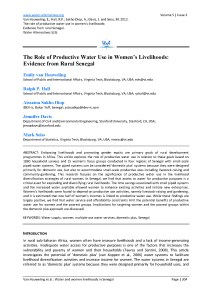
The first paper from our research on the productive use of rural domestic water in Senegal will be published in Water Alternatives (Volume 5, Issue 3). The abstract to the paper is included below.

ABSTRACT: Enhancing livelihoods and promoting gender equity are primary goals of rural development programmes in Africa. This article explores the role of productive water use in relation to these goals based on 1860 household surveys and 15 women’s focus groups conducted in four regions of Senegal with small-scale piped water systems. The piped systems can be considered ‘domestic plus’ systems because they were designed primarily for domestic use, but also accommodate small-scale productive uses including livestock-raising and community-gardening. This research focuses on the significance of productive water use in the livelihood diversification strategies of rural women. In Senegal, we find that access to water for productive purposes is a critical asset for expanding and diversifying rural livelihoods. The time savings associated with small piped systems and the increased water available allowed women to enhance existing activities and initiate new enterprises. Women’s livelihoods were found to depend on productive use activities, namely livestock-raising and gardening, and it is estimated that one half of women’s incomes is linked to productive water use. While these findings are largely positive, we find that water service and affordability constraints limit the potential benefits of productive water use for women and the poorest groups. Implications for targeting women and the poorest groups within the domestic plus approach are discussed.

Citation: Van Houweling, E.; Hall, R.P.; Sakho Diop, A.; Davis, J. and Seiss, M. (2012) The role of productive water use in women’s livelihoods: Evidence from rural Senegal. Water Alternatives 5(3): 658-677.

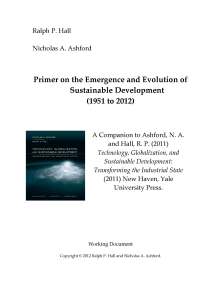
Updated Primer on Sustainable Development

Primer_SustDev_2012-09-11I recently updated the Primer on the Emergence and Evolution of Sustainable Development (1951 to 2012), to include a discussion of the United Nations Conference on Sustainable Development (known as Rio+20), held in Rio de Janeiro, Brazil, June 20-22, 2012. The updated text takes a close look at the idea of the green economy, which was endorsed by delegates at the conference as a flexible mechanism for advancing sustainability.

A Week in Bellagio

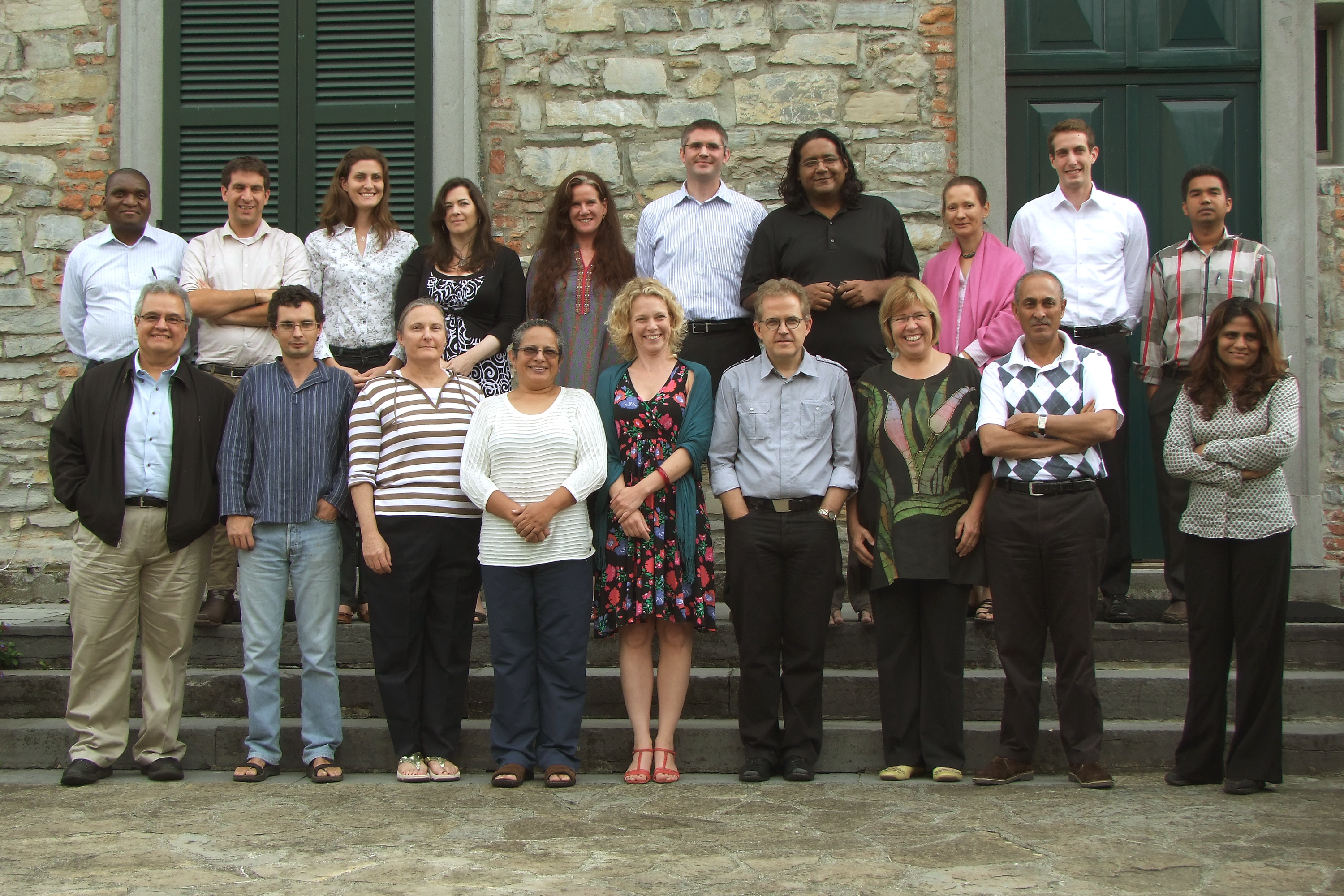
I write this post sitting in a beautiful villa at the Rockefeller Foundation’s Bellagio Center in Italy. During this past week, I have taken part in a workshop on Multiple-Use Water Services (MUS) attended by some 19 practitioners and academics from around the world. The objectives of the meeting were to: develop a common understanding and framework for MUS; elaborate a common direction and goal for the next five years around MUS; elaborate strategies for the MUS Group and its core members to reach this success; elaborate how best MUS can be moved forward; and develop a broad road-map for the way forward and clear commitments for action among the members.

The workshop was facilitated by Dr. Jürgen Hagmann and Dr. Joe Ramaru – professional facilitators from the Institute for People, Innovation, and Change in Organisations (PICOTeam) in South Africa. I mention the PICOTeam because of the superb facilitation they provided. I learnt much from watching how they worked with the group and managed the workflow as the meeting progressed.

The workshop participants developed a comprehensive agenda that will be developed further in the coming months. What was encouraging was the emphasis given to the need for a robust evidence base from which further MUS activities and programs can be built.

In addition to the workshop, we had the opportunity to meet many of the Rockefeller Fellows in residence at the Bellagio Center. I had the privilege with speaking with Geoffrey West, Ellen Silbergeld, and David Freedman and learning about the research and writing projects they are pursing at the center.

Below are several photos from the workshop and grounds of the Bellagio Center, which is now my new favorite place to work in the world. The location has a unique way of relaxing and freeing the mind.

This slideshow requires JavaScript.