
In the video below, Eric Vance and I are joined by several of our graduate students to describe how we developed the concept of an “on-the-ground statistician” to advance our data collection and cleaning practices in relation to large-scale household surveys.
Author: Ralph Hall
Congratulations Emily Van Houweling!
On March 29, Emily Van Houweling successfully defended her dissertation entitled “Gender, Water, and Development: The multiple impacts and perspectives of a rural water project in Nampula, Mozambique.”
Emily was a doctoral candidate in the Planning, Governance, and Globalization (PGG) program at Virginia Tech, and over the past several years has become a highly valued team member on two large-scale research projects in Senegal and Mozambique. The slide show below provides a few pictures of Emily in the field.
Development organizations claim that rural water projects deliver a wide variety of benefits – from poverty reduction to women’s empowerment. Emily’s research explores these claims in the context of a rural water project (RWP) in Nampula, Mozambique. From August of 2011 to July of 2012, Emily spent 11 months conducting ethnographic research in five communities where handpumps were installed as part of the RWP. The goal of her research was to describe how the water project unfolds “on the ground” from the perspective of men and women in Nampula, and illuminate the social and gender related impacts of the project that are not captured in standard evaluations. Emily’s research contributes to theoretical debates about the relationship between gender, water, and development, and also offers practical suggestions for designing water projects that are more equitable, culturally sensitive, and sustainable.
I served as the chair of Emily’s dissertation committee along with committee members Maria Elisa Christie, Keith Moore, and Brett Shadle.
Personal Dynamic Media
The assigned reading for today’s New Media Seminar is entitled “Personal Dynamic Media,” written by Alan Kay and Adele Goldberg in 1977 (two years after I was born). In this article, Kay and Goldberg look to the future and describe with remarkable accuracy the various components and capabilities of the modern day personal computer, including several ideas that have yet to be fully realized. After reading the article, I visited the Innovation Space at VT to find a quiet place to write this entry (only to find it was buzzing with activity in a good way) and to see if I could be inspired to think about what “future” new media might look like. It’s always surprising how a new environment can provide inspiration.
In parallel with this week’s seminar, I am hosting several colleagues from IITK, who are visiting VT for the second meeting of the IITK-VT partnership. A primary objective of our week-long meeting is to identify transformative research opportunities around the notion of sustainable infrastructure systems.
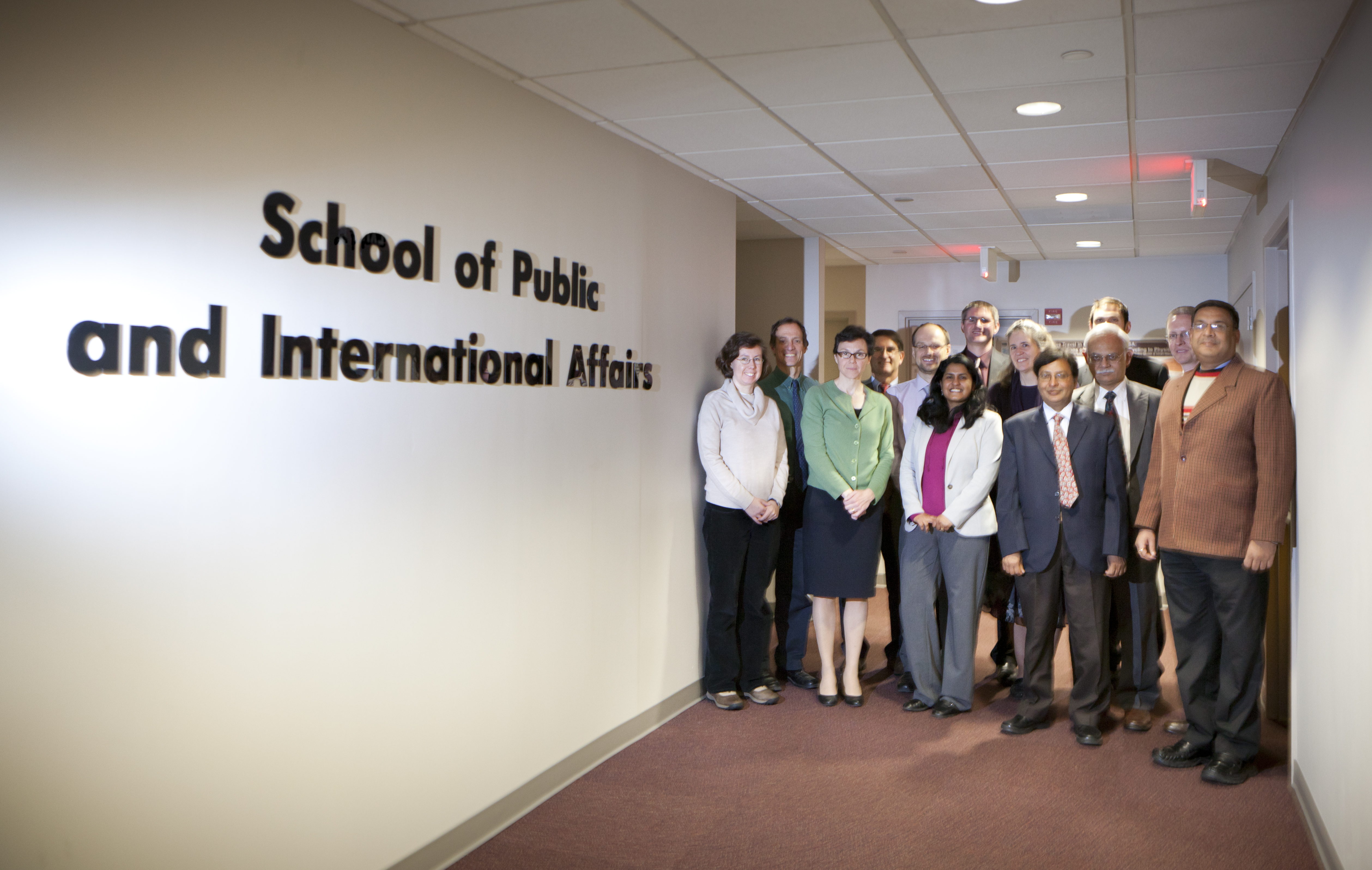
As I think in the Innovation Space, the worlds of the New Media Seminar and the IITK-VT partnership begin to collide. One question that emerges is what would a future technology platform look like that enables the design of sustainable infrastructure services in the US and India? What would be transformative about this platform from a technological and social perspective? I’m also left wondering how communities (including children) could be enabled by the technology platform rather than excluded from the learning process. I have several ideas about how to address these questions, but they need a little more finessing before being discussed here.
Congratulations Joseph Arcella!
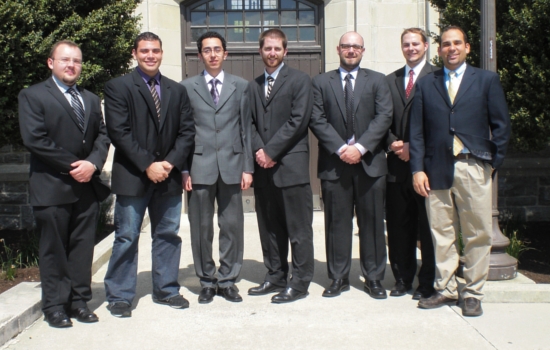
 On Monday, March 4, Master’s Civil Engineering student, Joseph Arcella, successfully defended his thesis entitled “A Comparative Analysis of Current Performance-Based Maintenance Procurement Methods to Improve Virginia Highways.” Joseph’s research was conducted out of the Center for Highway Asset Management Programs (CHAMPS) at Virginia Tech. Funding was provided by the Virginia Department of Transportation’s Maintenance Division in an effort to help improve their current performance-based “Turnkey Asset Maintenance Services” (TAMS) contracts used on the interstates.
For his research, Joseph studied the current state-of-practice in performance-based highway maintenance both domestically and internationally. The research was completed in two phases. Phase one involved a mini-scan study of the highway maintenance industry to identify the current practices in performance-based maintenance contracting (PBMC). This phase gathered information on domestic and foreign agencies currently using performance-based maintenance on highways. Phase two used the mini-scan study information to build, compare, and analyze agency timelines (i.e., VDOT to others). Timelines included major milestones at each agency; milestones which enabled innovation in the field of performance-based contracting. The purpose of comparing VDOT to other agencies was to provide VDOT with industry best practices as well as recommendations for future contract evolutions. Timelines were constructed for Florida DOT, Main Roads of Western Australia, England’s Highways Agency, and New Zealand Transport Agency. Connection links were made between VDOT and the other four agencies based on similarities in procurement laws and maintenance milestones. The timeline linkages and collection of information on benefits associated with PBMC (compared to traditional method-based maintenance) were used to make five recommendations for VDOT’s future maintenance program. VDOT recommendations were: Use performance-based contracting on secondary roads, use area-wide contracts to cover addition facilities, shift VDOT TAMS focus from lowest-cost to a best-value approach similar to England’s Managing-Agent Contractor, devise a strategic network of highways to prioritize maintenance, and use key performance indicators to align the Maintenance Division’s and VDOT’s objectives. Recommendations also considered the current restrictions imposed by Virginia procurement laws.
I served as a member of Joseph’s thesis committee, along with Jesus M. de la Garza (committee chair) and Michael Garvin.
“Mind-full” Learning
In our New Media Seminar today, I was rather quiet, not because I had nothing to say, but rather because my mind was constantly spinning around the conceptual framework articulated in Douglas Engelbart’s 1962 article entitled “Augmenting Human Intellect: A Conceptual Framework.”
The essence of Engelbart’s article could be described as constructing a conceptual framework for conceptual frameworks. One of Engelbart’s overarching objectives, articulated so well by Gardner Campbell, was to improve (i.e., augment) the process of thinking and to improve the process of improving the process. You may need to read that last sentence twice!
I found Engelbart’s article intriguing. While reading the article and during our seminar conversation, I found myself trying to deconstruct how I read his article, what I highlighted and why, etc., being mindful of the techniques Engelbart introduces. When describing his framework, Engelbart comments “we have learned quite a few simple tricks for leaving appended road signs, supplementary information, questions, and auxiliary links on our working structures – in such a manner that they never get in our way as we work – so that the visitor to our structure can gain his comprehension and isolate what he wants in marvelously short order.” To me, this is the essence of Engelbart’s process for augmenting knowledge – to find the most elegant way to structure and connect ideas so the “scaffolding” by which the mind had created the knowledge is revealed, furthering learning and advancing knowledge.
One example I have, that connects to my previous post, can be found in the quote below from Engelbart’s article where he talks about his research program:
- “In particular, the electronic-based experimental program could simulate the types of processes available from electromechanical artifacts, if it seemed possible (from the vantage of experience with the wide range of augmentation processes) that relatively powerful augmentation systems could be based upon their capabilities – but the relative payoffs for providing even-more-sophisticated artifact capabilities could be assessed too so that considerations of how much to invest in capital equipment versus how much increase in human effectiveness to expect could be based upon some experimental data.”
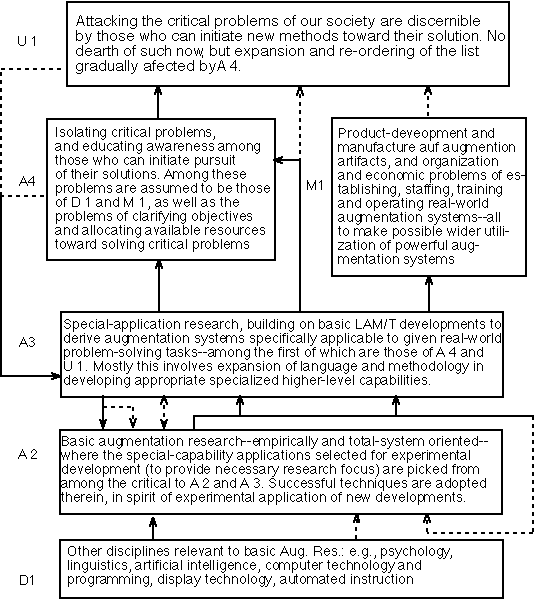
If I had the capabilities of Engelbart’s human intellect augmentation system at my fingertips, I would link the latter part of the above quote to my previous post (as I have done), and append substructures on cybernetics, binary economics, innovation and jobs, co-operatives, etc., establishing the scaffolding for a new research agenda targeted at understanding how capital and labor “productiveness” (and the combination of the two) are linked with wealth and what this holds for a sustainable future. What would be interesting is whether revealing the structure of my thought process would enable others to comprehend the ideas faster (and more deeply) than they would have done had they read the same ideas in a proposal or journal article. This question highlights a challenge faced by Engelbart when trying to articulate his ideas. There is a certain irony to writing a “linear” article describing a conceptual framework that is designed to enable you to tear the very same article apart and reconstruct it in a fundamentally different way. I have no doubt that Engelbart’s conceptual framework would enable one to experience complexity usefully, which perhaps best embodies what he was trying to achieve.
Finally, an interesting question raised during our discussion was whether a human intellect augmentation system (as envisioned by Engelbart) would lead to atrophy, automation, or augmentation of the mind. Only time will answer this question.
Humans, Machines, and Employment
A question raised in Norbert Wiener’s 1954 article entitled Men, Machines, and the World About – but not discussed during the last New Media Seminar – is how the symbiotic relationship between humans and machines may impact our working lives (or employment and equality more generally). With possible links to Marx’s notion of relative surplus value, Wiener discusses a new industrial revolution “that consists primarily of replacing human judgment and discrimination at low levels by the discrimination of the machine.” Another way to think about this idea is the transfer of knowledge from the worker to the machine, possibly rendering the worker jobless. A familiar example is the automated phone system. These systems have captured the basic knowledge of the operator and have externalized the cost (in time) of managing calls onto customers, whether they like it or not.
While there is much that could be said about the displacement of jobs by technology (or innovation), my interest here lies with the use of technology to enhance worker productiveness – not to be confused with labor productivity. Labor productivity is calculated by dividing an output by a factor of input (labor or capital), i.e., it is the amount of output per unit of input. In contrast, labor productiveness is a measure of the quality of being productive or the capacity for producing. Thus, labor productivity could be increased by a more productive worker (e.g., the worker’s skill has been improved), the use of more efficient technology/processes, or some combination of the two.

Wiener’s notion of cybernetics, like J. C. R. Licklider’s concept of human-computer symbiosis, points to a new frontier where worker productiveness could be greatly enhanced by the intelligent use of technology. Imagine a worker (white/blue/green collar) whose queries/questions are answered via a Google Glass type of technology that uses data processed and analyzed through a next generation version of Wolfram Alpha. While such a Star Trek-like device sounds intriguing, there are two questions that trouble me. Who will benefit (financially) from this human-machine symbiosis (if it can be called that) and is labor productiveness truly enhanced?
If the worker invests in the technology and is able to enhance his/her productiveness (i.e., knowledge and skills), he/she may be able to demand higher wages for the higher-skilled work being performed. However, there are myriad assumptions behind this statement. The most significant is perhaps the assumption that the technology is actually enhancing the productiveness of the worker, rather than enabling a worker to perform at a higher level due to the data/processes/etc. embodied in the technology – i.e., the knowledge and skills of the worker are largely unchanged. In fact, at an extreme, the worker’s skills/ability could decline has he/she becomes more reliant on the technology to do more of the thinking. Further, if the augmentation technology were owned by the employer, the worker would likely be paid less over time as the technology/capital begins to do more of the actual work. Just as automated phone systems displaced operators, higher-skilled workers could be displaced by lower-skilled workers using skill-augmentation technology to the benefit of the capitalist. Finally, if an augmentation technology were capable of operating in the ‘formulative’ (i.e., idea creation) domain of innovation, whoever owns that technology will be at the leading edge of the market and wealth.
To me, these questions are fascinating, extremely important, and warrant far greater consideration than I am able to provide here.
Your Brain Lies to You
In this second post relating to a VT seminar I’m participating in on New Media, I wanted to return to Vannevar Bush’s 1945 article, “As We May Think,” to take a closer look at why we might need a memex – i.e., a memory augmentation – device.
In 2008, I read a New York Times Op-Ed by Sam Wang and Sandra Aamodt entitled “Your Brain Lies to You,” which broaden my understanding of the challenges I might face when trying to present new ideas to students; ideas which might at first run against long held beliefs. The problem with our brain rests in how it manages information. Unlike the memex device envisioned by Vannevar Bush (or a modern day computer), your brain does not record information in a way that it can be retrieved in its original form. In the words of Wang and Aamodt, “Facts are stored first in the hippocampus, a structure deep in the brain … . But the information does not rest there. Every time we recall it, our brain writes it down again, and during this re-storage, it is also reprocessed. In time, the fact is gradually transferred to the cerebral cortex and is separated from the context in which it was originally learned. For example, you know that the capital of California is Sacramento, but you probably don’t remember how you learned it.”
This phenomenon is known as source amnesia and can result in a person forgetting whether a statement is true. Thus, while you might initially discredit an idea form a non-credible source, the problem of source amnesia means that the original idea might gain credibility as you misremember where it came from. Another challenge is that we tend to fit new information into established mental frameworks. This means that we are likely to selectively accept and remember ideas that reinforce existing beliefs and reject and forget those that don’t. The question then, is what can be done to address these inherent problems in the way in which our mind works?
One possible solution is to associate a new, contradictory, perhaps, controversial idea to an emotion. In their Op-Ed, Wang and Aamodt discuss how ideas can spread by their emotional selection, rather than by their factual merits. In the classroom, when covering an idea that may be at odds with a student’s mental framework, one approach I have tried is to ask the student to imagine how their world would be different if the information were true. The trick is to try and create an emotional jolt that the student will remember in the future when confronted by the same contradictory information.
Another potential way to resolve this dilemma might be to adopt a technology platform that can help counteract source amnesia and one’s own mental frameworks. The new Google Glasses, demonstrated in the short video below, present a modern day example of a possible memex device.
While these glasses could be used as a memory augmentation device, the question is whether or how the recording/structured information would change, hopefully improve, your mental frameworks. A deeper question is whether such a technology could be used to enhance your intelligence/wisdom, or would it simply enable you to cheat the system in some way.
Finally, while watching the video above, I started to wonder what would happen if my students and I were to use this technology during a group discussion. The possibilities seem immense, even if a little scary. Perhaps, I’ll be inspired in the next two days and submit a proposal to be a Google Glass explorer.
The New Media Seminar
Every so often, one reaches a point where you can step forward into the unknown or stay within the safety of the familiar. Over the past year, I have developed my blog to record information about the activities undertaken by my colleagues, students, and myself. Thus, the blog is a compendium of interesting information, but it does not contain my voice or thoughts. As an experiment (for me), over the next couple of months this will change.
This semester, I am taking part in a VT FDI (Faculty Development Institute) seminar on New Media. The seminar asks participants (faculty and staff) to blog about the readings, our group discussions, or the connections between the two. The idea is to adopt a “first-thought-best-thought” approach, in the words of our intellectual guide, Gardner Campbell.
Having missed the first session due to a commitment in the UK, I joined the seminar for a discussion of Vannevar Bush’s classic 1945 article “As We May Think.” Rather than reflect upon the content of our conversation here (which I will leave for a future post), I wanted to reminisce a little.
Vannevar Bush was a faculty member at MIT from 1919 to 1938, and became the Dean of Engineering in 1932. During our group discussion about the life of Vannevar Bush, I started to wonder what he would think about MIT’s Engineering Systems Division (ESD). During the six years I spent at MIT (from 2000 to 2006), I was able to witness the emergence of ESD through the lens of a master’s student and then as a doctoral candidate. Thanks to MIT’s open courseware, I can share an example of ESD’s doctoral seminar, in which students explore “the core theory and contextual applications of the emerging field of Engineering Systems.” Our group discussion about Vannevar Bush’s 1945 vision of the future sent me back to the 2003 version of the ESD doctoral seminar. The creation of a new field of study requires the generation, accumulation, structuring, and communication of knowledge, which links me back to Vannevar Bush’s article in which he describes the memex – a memory augmentation device (see the video below). In the context of ESD, one could envision a memex approach that enables the engineer/scientist to combine and store information about complex socio-technical systems in new and creative ways, freeing the mind to further explore more and more complex interrelationships that may help solve the critical contemporary problems facing society. In 2011, ESD celebrated its first 100 doctoral alumni, a milestone that I would hope Vannevar Bush would celebrate.
New Graduate Certificate
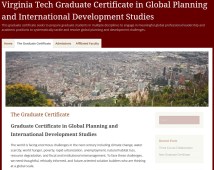 I am pleased to announce the launch of a new graduate certificate at Virginia Tech in Global Planning and International Development Studies.
The certificate builds on Virginia Tech’s internationally recognized, 30-year specialization in international development planning and an innovative partnership between faculty in programs such as Urban Affairs and Planning, Public Health, Geography, and Building Construction. The certificate seeks to prepare graduate students in multiple disciplines to engage in meaningful global professional leadership and academic positions to systematically tackle and resolve these global planning and development issues.
The certificate may be taken in conjunction with most of Virginia Tech’s masters and doctoral degree programs.
 Ralph P Hall