
Dr. Marc Fialkoff Receives Outstanding Dissertation Award

This evening I had the pleasure of attending Virginia Tech’s Graduate Awards Banquet where Marc Fialkoff received the award for Outstanding Dissertation in Social Sciences, Business, Education, and Humanities. This university-level award is a significant achievement and well deserved.
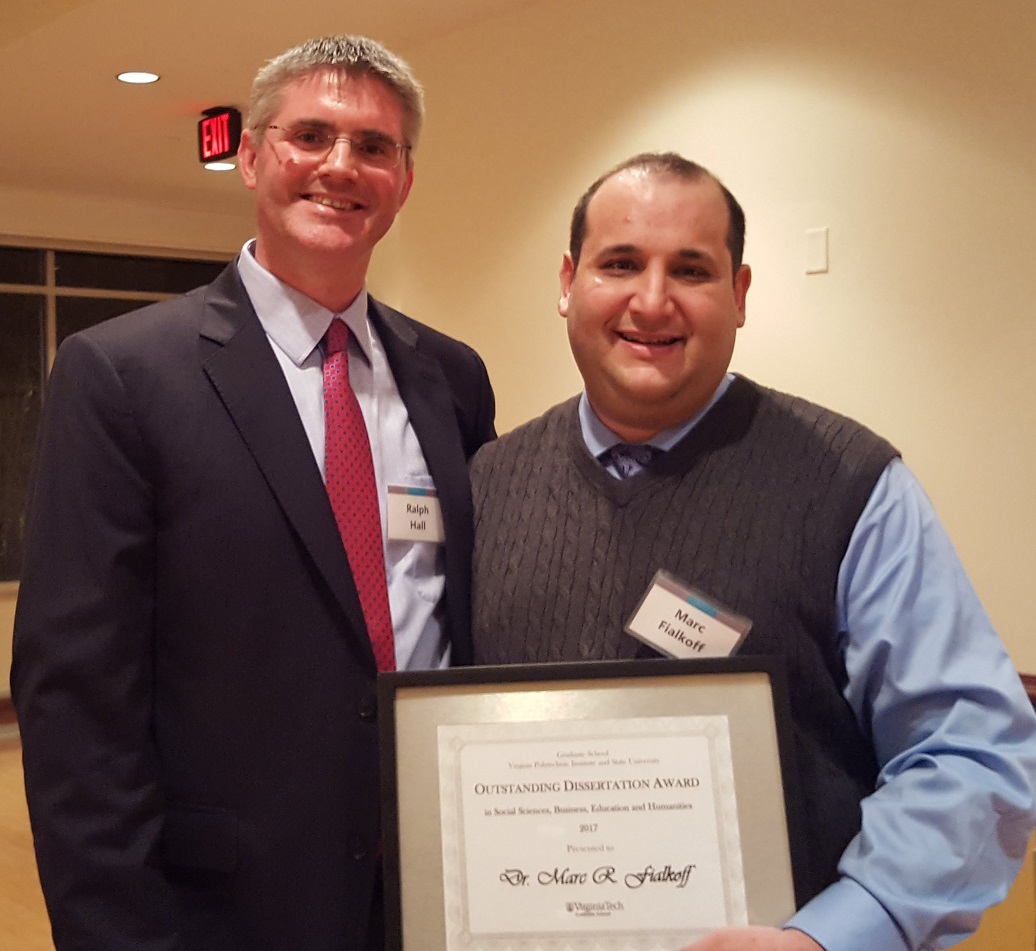
Marc’s research focused on quantifying the effect of the Jones Act restriction on freight transportation networks in the aftermath of Hurricane Sandy. His research blended civil engineering, law, network science, and planning to analyze the impact of a law on critical infrastructure. Marc’s committee represented the interdisciplinary nature of transportation policy, with committee members from Urban Affairs and Planning; Civil and Environmental Engineering; Law; and Network Science. I served as co-chair of Marc’s committee with Ralph Buehler, along with committee members Kathleen HancockHenning Mortveit, and Jonathan Gutoff.

This slideshow requires JavaScript.

During the evening, Marc and I reflected on the life and legacy of one of my PhD advisors – Prof. Joseph Sussman – who sadly passed away on March 20, 2018. I had the privilege of knowing Prof. Sussman since 2000, and he served on both my Masters and PhD committees. Since I graduated from MIT in 2006, Prof. Sussman continued as a mentor and friend, providing insightful advice on my tenure process and was always keen to learn what was happening on the family front.

Prof. Sussman also became a mentor to Marc, who included Prof. Sussman’s approach to CLIOS (Complex, Large-Scale, Interconnected, Open, Sociotechnical) systems in his research. Prof. Sussman fondly referred to Marc as his “academic grandson,” which provides a sense of how he approached his role as an educator and mentor. Prof. Sussman made MIT a home for his students, many of whom (including myself) were international and new to the American way of life. I know that my approach to advising has been heavily influenced by Prof. Sussman, who I’m sure is also very proud of what Marc has been able to achieve.

Prof. Sussman (1939-2018)

Inclusive Capitalism

Earlier this month, Prof. Robert Ashford and I had the pleasure of engaging with various academic, government, and non-government entities in the UK about our ideas on inclusive capitalism. The two images below will take you to a version of the presentations we gave at the University of Oxford, in London (at the Portcullis House and Syracuse University’s Faraday House), and at the University of Southampton.

In the first presentation, I outline two major challenges that can be represented by two “ice hockey stick” curves. The first curve relates to global climate change, but can be thought of as emblematic of a range of stubborn environmental concerns that show no signs of halting or declining with continued economic growth. I predict that we will soon see a similar curve for the volume of plastic waste in the world’s oceans. Curves could also be drawn for the bioaccumulation of persistent chemicals. For example, when looking at the health of long-lived and high trophic level marine mammals, there is now evidence that some killer whales have consumed sufficient quantities of polybrominated diphenyl ethers (PBDEs) to be fireproof. Many scientists are now concerned about the health and environmental impacts of these chemicals, especially on reproductive and immune systems.

The second ice hockey stick curve provides a snapshot of the concentration of wealth in the US that is accompanied by a series of graphs that chart a number of concerns relating to the hollowing out of the middle class (or job polarization) in America and the EU, and to trends in income inequality over the past several decades.

The real challenge comes when the two curves are considered alongside one another. In 2012, the Rio+20 conference advanced the notion of the Green Economy as a mechanism through which progress will be made towards sustainable development. Since the dominant strategy for advancing a green economy – that targets the decoupling economic growth from growth in environmental impacts – is based on advanced and hyper-efficient technologies, a critical question is what will happen to well-paying jobs and more broadly to trends in income inequality and job polarization. (For more on this issue, see my book review of Cents and Sustainability.) Having mapped out these macro concerns, Prof. Ashford (in his presentation) provides a new way to view them based on the principles of binary economics (what we call inclusive capitalism).

The following text (from our talk description) provides a brief overview of the content of Prof Ashford’s presentation (which can be viewed by clicking on the image below below).

To reverse growing income inequality and to achieve greater and more broadly-shared prosperity and sustainable growth, Professor Ashford advocates a much more “inclusive capitalism” (beyond conventional right- and left-wing strategies of austerity and stimulus) based on “binary economics.” The inclusive capitalism approach is to broaden competitive market opportunities to acquire capital with the earnings of capital. The same market mechanisms that presently assist mostly wealthier people to acquire capital with the earnings of capital can even more profitably be opened, without redistribution, to assist poorer people to acquire capital with the earnings of capital. The prospect of such ownership broadening will unleash substantial (presently suppressed) productive capacity in the UK because the prospect of more broadly distributed capital earnings in future years provides great untapped incentives to profitably employ more labor and capital in earlier years.

Dr. Martin Luther King, Jr. Jubilee Summit

April 4, 2018 marks 50 years since Dr. Martin Luther King, Jr.’s departure. In response to this anniversary, members of the Beloved Community Initiative created the Dr. Martin Luther King, Jr. Jubilee Summit to draw on the collective experiences of more than a dozen national and local organizations and individuals to answer Dr. King, Jr.’s question: Where do we go from here?

The Jubilee Summit consists of a series of strategic online gatherings. Information about each event is provided here. Summit speakers include academic, religious, and community leaders, and everyone is invited to participate.  

The Jubilee Summit will begin on Friday, March 23, 10am (EST), with a discussion between Dr. Virgil A. Wood (Co-founder, Jubilee National Collaborative) and Dr. Howard H. Stevenson (Harvard University Business School), on a collaboration they have shared for more than ten years. They will launch the summit by addressing the topic: Does Martin Luther King, Jr. have a living legacy, and if so, where is economic justice?
